
Alexander Dunlap
Love the State, but Hate (Neo)Colonialism? Discussing Sacrifice Zones and (Green) Colonialism in Political Ecology
From Extractivism to (Green) Extractivism: Preparing Sacrifice Zones
The State of Colonialism(s) in Political Ecology
Green Colonialism and territorialisation
Abstract
Green colonialism and sacrifice areas are now popular academic topics. Demonstrating affinity between ideas of sacrifice zones, extractivism and green colonialism, this article argues that the state remains foundational to (neo)colonialism, orchestrating extractivism and sacrifice areas—‘green’ or otherwise. Rooting the idea of sacrifice areas with the American Indian Movement (AIM) leader, Russell Means, this idea to ‘love the state but hate colonialism’ within the academy not only ignores the political and material structures of the state but also divorces itself from wider autonomous and anarchist struggles. Reviewing definitions of extractivism, green colonialism, climate coloniality and territorialisation, this article identifies reoccurring features and omissions across similar terminologies. This article also highlights the shortcoming of implicitly embracing statism within political ecology and geography. Statism, the article contends, is not only the root of colonialism(s) but also connects politically, materially and ideologically to extractivism and its sacrifice zones. Advocating engagement with ecological anarchists and autonomous Indigenous theories to confront statism, the article recognises at least four political consequences by academics emphasising the ‘colonial’ over the ‘state’.
Introduction
History not only repeats itself, but with each cycle the political dynamics and associated extractivism intensify. In the 1970s, United States material production and energy consumption was reaching an all-time high as the Organization of Arab Petroleum Exporting Countries (OAPEC) curtailed their international oil exports. This reduction in US oil imports led to the 1973 oil crisis, spawning the US Department of Energy (DoE) and terms like ‘energy transition’ (Bonneuil and Fressoz 2016). In 1971, Richard Nixon commissioned the Committee for Rehabilitating Lands Surface Mined for Coal in the Western United States with the intended goal of advancing ‘national energy self-sufficiency’ in the ‘coal-rich (but dry) western areas’ (Churchill and Vander Wall 2002, 133). The Indigenous territories in the Black Hills and ‘four Corners’ states (e.g., Arizona, New Mexico, Colorado & Utah), the committee report concluded: ‘should be considered “national sacrifice area” for purposes of pursuing unrestricted energy resource development’. This position, Ward Churchill and Vander Wall (2002, 133) reminds us, ‘was formally accepted-in a less secretive fashion-by both the National Academy of Sciences and the National Academy of Engineering in 1974’. Often associated as an ‘activist’ or ‘environmental justice’ term, it was the DoE that popularized and brought sacrifice areas/zones into the public lexicon.
Since 2010, Chinese dominance of rare earth and other essential mineral production processes alongside European and USA dependence on ‘foreign adversaries’ for 60 so-called ‘critical minerals’ has led, once again, to intensifying domestic (and international) mining to promote supply-chain ‘security’ and ‘national energy self-sufficiency’ in mineral extraction, processing and production (Deberdt et al. 2025a, 9; Klinger 2017). These critical minerals, deemed essential to wind turbines, solar panels, electric vehicles, digital technologies and, most of all, military technologies (Selwyn 2022; Klinger et al. 2024; Deberdt and Le Billon 2024), will lead not only to greater mineral demand but also to the proliferation and production of areas ‘sacrificed’ to mining and (eco)modernist developmental trajectories. Sacrifice zones, as Ryan Juskus (2023, 4) confirms, became an environmental justice concept that ‘scholars tend to either cite short’, provide conflicting meaning for or ‘they simply use it without defining it’. Given the increasing relevance of this term (Scott and Smith 2017; Zografos and Robbins 2020; Brock et al. 2021; see Figures 1-4), the theoretical and practical implication of sacrifice zones and the connection to other popular terms remains increasingly relevant.
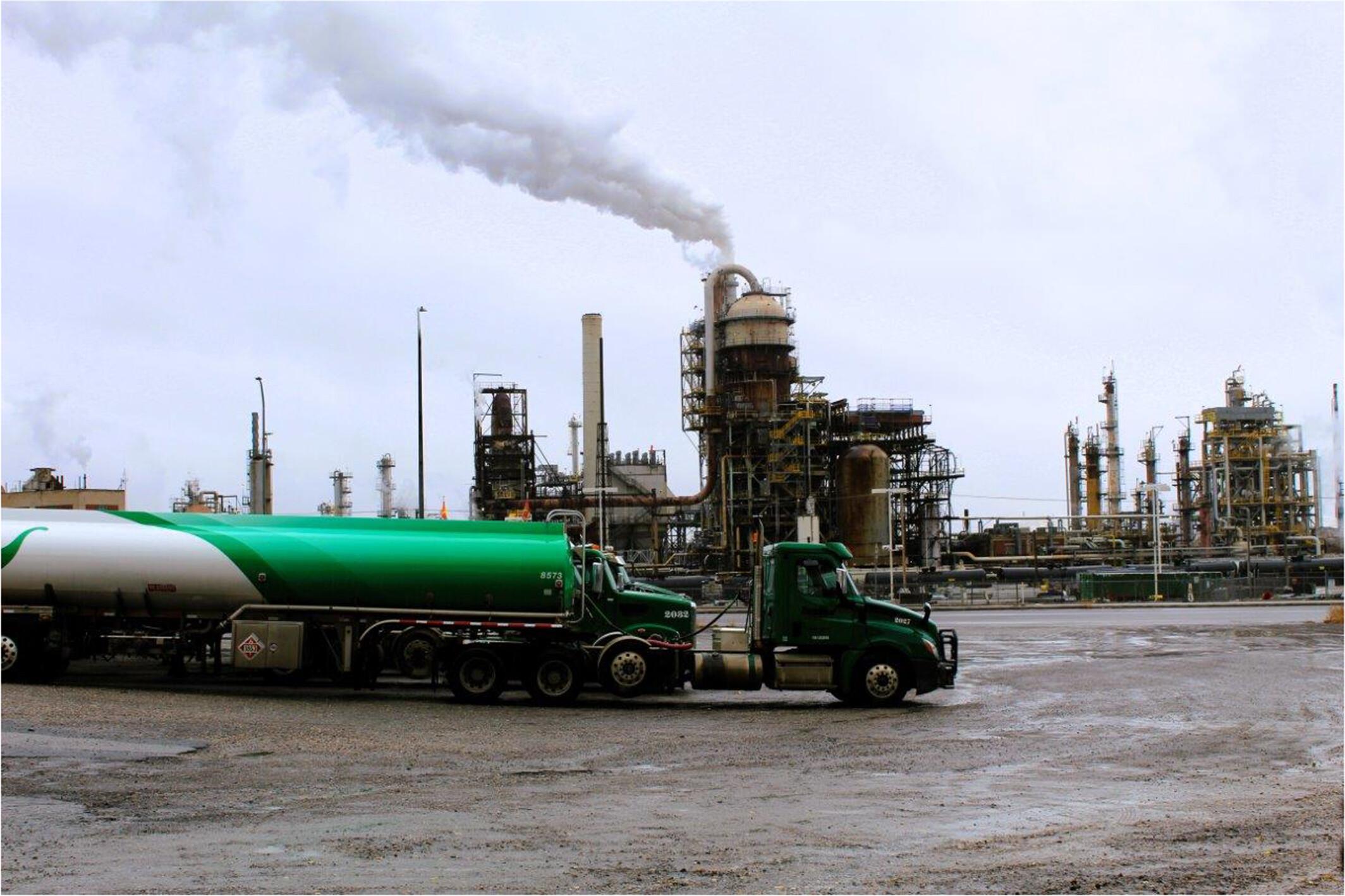
FIGURE 1: Chevron refinery, Salt Lake City, Utah. Photo: Benjamin Sovacool.
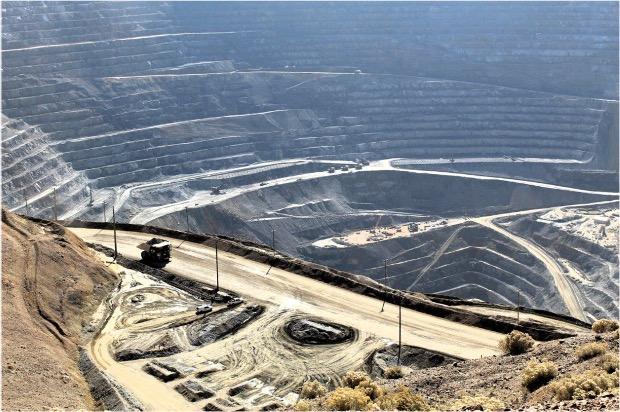
FIGURE 2: Kennecott Copper, gold, silver, tellurium mine, Utah, USA. Photo: Alexander Dunlap.
The ambiguity Juskus (2023) identified with sacrifice zones, this article argues, also extends to ‘green colonialism’ and related concepts (e.g., energy colonialism, climate coloniality)[1] within the recent political ecology, critical geography and sustainability studies literature. This is compounded by analytical disjuncture, undefined overlap and profound complementarity between extractivism, sacrifice areas and (neo)colonialism(s). While interpretations of extractivism(s) and colonialism(s) proliferate within academia (Deberdt et al. 2025a), this article specifically challenges how the state is either ignored, placed in the background or implicitly and explicitly positioned as analytically separate from (neo)colonialism, extractivism and sacrifice areas. ‘[S]tatism’, Ince and de la Barrera Torre (2024, 57) observe, ‘remains largely uncriticized in comparison with other, mutually constitutive projects, such as colonialism, modernity, and capitalism’. While emphasizing specific features, scales or phenomenon, the concepts of extractivism, sacrifice areas, (neo)colonialism and the state retain profound conceptual overlap and political affinity, which this article contends should not only be understood together (rather than separate) but also be seen as essential features of statism. This article responds to recent literatures bypassing statism to focus on ‘extractivism’, sacrifice areas and green colonialism(s), to emphasize that all are mutually constitutive and co-evolving processes essential to the (global) state system. This political separation between the state and (neo)colonialism selectively ignores colonial continuities, preserves authoritarian politics and obstructs conversations around political practices in favour of maintaining an intelligentsia (and associated academic divisions of labour).[2]
The state is ‘a centralized, hierarchical system of political organization based on coercion and alienation’, explains Gelderloos (2017, 14), depriving ‘each person's ability to decide over their own lives’, organizing ‘the suppression of self-organization so that power could be centralized, delegated, and institutionalized’ (see also Bakunin 1990 [1873]). While making a distinction between the state and statism, Ince and Barrera de la Torre (2024, 148–9) contend, that statism ‘underpins the way states establish and maintain their centrality in the ordering of society and the cosmos through the repetition and deepening of certain forms, discourses, symbols, and rationalities associated with state rule’. Statist logic circulates around political control and economic production; mapping and b/ordering territories; promoting sedentary living (e.g., terrorizing nomadic groups), instituting political legibility (e.g., registration), domestic extraction (e.g., taxation, fines), developing coercive power (e.g., police, military & paramilitaries) and preventing the overthrow of statist political structures (Scott 1998; Kilcullen 2010; Scott 2020). Justified in the name of producing security and development for its citizenship, state space orchestrates urban planning, embedded in political and economic imperatives and tends towards organizing statist and/or capitalist natures that regiment rural and urban space to facilitate political control and enterprise (Scott 1998; Goldman 1998; Scott 2020; Kass 2023). This, among other reasons, is why the ‘very existence of the state—and it does not matter a bit whether it is fascist, liberal democratic, or Marxist in orientation’, explains Churchill (2003, 264), ‘is absolutely contingent upon usurpation of the material and political rights of every indigenous nation within its boundaries’. The so-called critical minerals sought after in the most recent ‘rush,’ Owen et al. (2023) remind us, are globally located on or near the lands of Indigenous people or agricultural workers (Amoah et al. 2024). Highlighting the interrelationship between sacrifice areas, extractivism and (green) colonialism, this article shows how the state remains essential to orchestrating (neo)colonialism, extractivism and sacrifice areas—green or otherwise.
The article begins by noting the historical intensification of extractivism through green extractivism and the proliferation of sacrifice areas. This section seeks to identify central features of sacrifice areas and its affinity with extractivism and (neo)colonialism. The next section goes further into this topic by reviewing definitions of green colonialism, coloniality and territorialisation, noting reoccurring political features across similar terminologies. Demonstrating the affinities and shortcomings of various literatures within political ecology and geography, this section summarizes and advances conversations on (neo)colonialism and sacrifice zones. This will then highlight the conceptual importance of statism and infrastructural colonization by connecting colonialism, politically and materially to extractivism and its sacrifice zones. The article concludes by reflecting on the predominance of statist bias within academic scholarship, and advocating an anti-authoritarian political tension that strives, in scholarship and practice, towards seeding the pluriverse.
From Extractivism to (Green) Extractivism: Preparing Sacrifice Zones
The popular origin of sacrifice zones begins with US President Nixon proclaiming the need for ‘national energy independence’ and, later, ‘Project Independence’ (Churchill and Vander Wall 2002). Project Independence, Juskus (2023, 6) explains, was an ‘initiative that entailed expanding nuclear plants and coal strip mines into western areas largely inhabited by ranchers, agriculturalists, and Native Americans’. As discussed above, sacrifice zones, a term with apparent activist connotations, was, in fact, a part of the US government's organization of intensive uranium, coal, gravel, copper, lead and other highly toxic material mining (see Churchill and Vander Wall 2002, Churchill 2003; LaDuke and Cruz 2012) (See Figures 1, 2, 1, 2). Aside from valid critiques of the concept (Reinert 2018; Dunlap and Riquito 2023; Thomas et al. 2026), the terminological development of sacrifice zones (1) has lost important political features with its popularization in EJ scholarship and (2) retain profound affinity with the concept of (neo)extractivism.
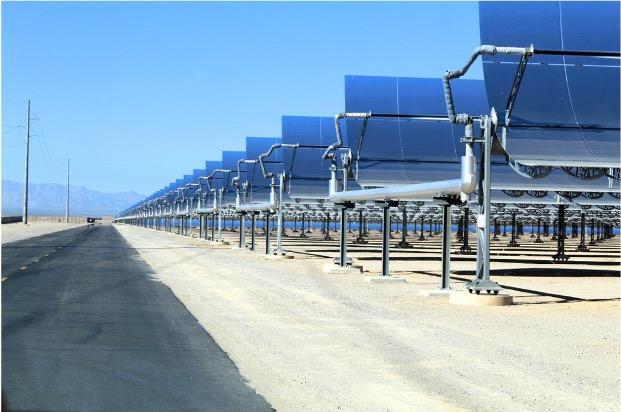
FIGURE 3: Genesis concentrated solar panel project on Mohave lands, California. Photo: Dunlap, and & Novakovíc (see Sovacool et al. 2025).
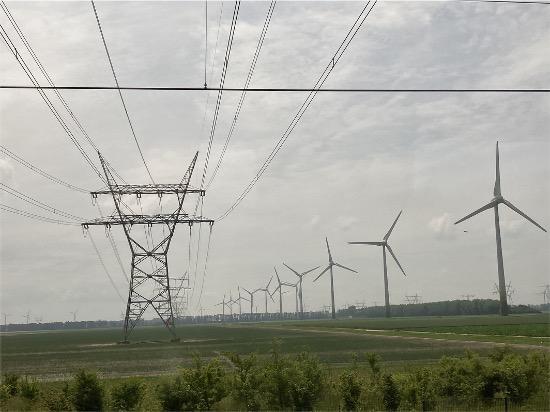
FIGURE 4: Standard high-voltage power line and wind turbine arrangement, the Netherlands. Photo: Alexander Dunlap.
Despite criticisms of Russell Means (Benally 2023), we should not fail to recognize his important contributions to the concept of sacrifice areas that, overtime, have been eroded or under-emphasized within critical geography and political ecology. At the 1980 Black Hills Survival Gathering at Rapid City, South Dakota, American Indian Movement (AIM) member Means indicated three features related to sacrifice areas, and resisting them, which are worth quoting at length. The first, outlines and develops the concept of sacrifice areas.
Right now, today, we who live on the Pine Ridge Reservation are living in what Euro society has designated a 'national sacrifice area'. What this means is that we have a lot of uranium deposits here and Euro culture (not us) needs this uranium as energy production material. The cheapest, most efficient way for industry to extract and deal with the processing of this uranium is to dump the waste byproducts right here at the digging sites. Right here where we live. This waste is radioactive and will make the entire region uninhabitable forever. This is considered by industry, and the white society which created this industry, to be an ‘acceptable’ price to pay for energy resource development. …. We are resisting being turned into a national sacrifice area. We're resisting being turned into a national sacrifice people. The costs of this industrial process are not acceptable to us. It is genocide to dig the uranium here and to drain the water-table, no more, no less. So the reasons for our resistance are obvious enough and shouldn't have to be explained further. To anyone.
Sacrifice zones are intrinsically related to the annihilation of ecosystems and the slow degradation of people through mining, hazardous chemicals, labour relations, energy demand and modern infrastructure. Said simply, sacrifice zones are embedded within the continuum of the ‘genocide-ecocide nexus’ (Short 2016; Crook and Short 2022). Viewed from this perspective, sacrifice zones exemplify the foundational colonial relationship, predicated on extractivism and poisoning the local inhabitants, human and nonhuman alike. When we talk about sacrifice areas, we are talking about a colonial relationship that, as Thomas et al. (2026) remind us, has far reaching toxic implications.
The second task Means (1983, 26) outlines, is confronting Marxist and revolutionary communists about their agenda. While he speaks to great emotive lengths, consider this excerpt:
Revolutionary Marxism, as with industrial society in other forms, seeks to ‘rationalize’ all people in relation to industry, maximum industry, maximum production. It is a materialist doctrine which despises the American Indian spiritual tradition, our cultures, our lifeways. Marx himself called us 'precapitalists' and 'primitive'. Precapitalist simply means that, in his view, we would eventually discover capitalism and become capitalists; we have always been economically retarded in Marxist terms. The only manner in which American Indian people could participate in a Marxist revolution would be to join the industrial system, to become factory workers or 'proletarians' as Marx called them. The man was very clear about the fact that his revolution could occur only through the struggle of the proletariat, that the existence of a massive industrial system is a precondition of a successful Marxist society.
Means confronts state communism and (orthodox) Marxists (and the reply from the Revolutionary Communist Party in that volume only reinforces these concerns). While Kevin K. Anderson (2016) demonstrates that many Marxists, and Marx inspired political regimes, depart from his later writings, Glenn Coulthard (2014, 8) contends that it ‘would be a mistake’ if ‘Indigenous peoples [were] to reject or ignore the insights of Marx’.[3] What Means identifies, however, resonates with critiques of (neo)extractivism in Aba Yala (Meso/South America), indicating that sacrifice zones are inherently antagonistic and sceptical to industrial/digital development whether rooted in ‘Left’ or ‘Right’ wing political regimes.
Finally, following a line by Malcom X, Means (1983, 30) takes an important position on identity politics:
It is possible for an American Indian to share European values, a European worldview. We have a term for these people; we call them 'apples'—red on the outside (genetics) and white on the inside (their values). Other groups have similar terms: Black have their 'oreos'; Hispanics have 'coconuts' and so on. And, as I said before, there are exceptions to the white norm: people who are white on the outside, but not white inside. I'm not sure what term should be applied to them other than 'human beings'.
What I'm putting out here is not a racial proposition but a cultural proposition. Those who ultimately advocate and defend the realities of European culture and its industrialism are my enemies. Those who resist it, who struggle against it, are my allies, the allies of American Indian people. And I don't give a damn what their skin color happens to be. Caucasian is the white term for the white race: European is an outlook I oppose (emphasis added).
Reinforcing the previous point concerning industrialism, this is a commentary on rejecting assimilationist politics (Fanon 2008 [1954]; Coulthard 2014; Dunlap 2018b), which goes so far as to implicitly deny indigenity for those who betray traditional approaches and commitments to the land. While this remains a difficult standard, which Means did not entirely meet (Means and Wolf 1995), it rightfully sets a political vision and emphasizes political values and affinity over ethnicity.
Means's (1983) conceptualization of resisting sacrifice zones entails: (1) rejecting genocide/ecocide, (2) challenging (leftist) political ontology and ideology (rejecting the ‘modern collectives' universal effect’, Blaser 2025, 25) and (3) cultivating political affinity over ethnic essentialism. The challenge to communists, and orthodox Marxists, also indicates a critique of statism, lending itself to Churchill's (2003, 22, 264–66, 276–99) anti-statist ‘indigenist alternative’.[4] Before noting the profound complementarity between sacrifice zones and extractivism, we cannot forget, as Thomas et al. (2026) remind us, that the socio/ecological impacts of sacrifice zones are not ‘strictly bounded’ or contained as the term tends to imply. The concept ‘problematically implies containment when the toxic violence it names is anything but fixed in space or time’, explains Thomas et al. (2026, 2), ‘capitalist industrial development means that the temporal boundaries of sacrifice zones are likewise porous, as more and more places become sacrificable in capital's unrelenting quest for environmental sources and sinks’. We should also consider, and apply, this critique of sacrifice zones to extractivism.
Extractivism
The 1970s formalization of ‘domestic’ sacrifice zones, and Means (1983) confrontational politics, has profound connections with the conceptual development of extractivism, the study of political ontology and the emergence of so-called green colonialism discourse currently popular in the social sciences. The conceptualization and rise of extractivism, emerging from the 2000s mining boom and, later, leftist governments taking power in Brazil, Ecuador, Bolivia, Argentina and Venezuela—together known as ‘The Pink Tide’ (Svampa 2015, 2021)—demonstrates a similar, if more elaborate, experience to what Means (1983) confronted and warned against. The ‘classical’ features of extractivism are: (1) The high volume of extracted material (e.g., timber, minerals, hydrocarbons), (2) the destination of the extracted material (abroad), (3) the concentration of ownership by foreign or national industries and (4) intensive socio/ecological damage (Lang and Mokrani 2013; Gudynas 2021) (See Figure 5). While the concept is debated (Dunlap et al. 2024), especially concerning ideas of digital extractivism and the nationalist features of the concept, political, economic and ecological affinity exists between sacrifice zones and extractivism.
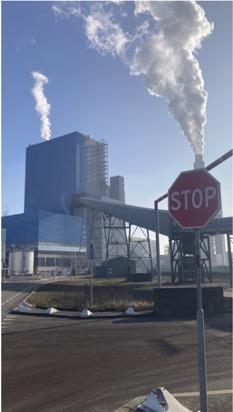
FIGURE 5: Port of Rotterdam, the Netherlands, thermal power plant. Photo A. Dunlap.
The Pink Tide governments came to power on the backs of a diverse array of social movements, including Indigenous movements. While a large segment of these social mobilizations sought inclusion into political and economic life (Blaser 2025), these governments were, as Means (1983) warned, organizing the advance of (state capitalist) extractive development. This entailed continuing to generate sacrifice areas and people, all the while putting down any movement that stood in the way of its (neo)extractivism. This ‘neo-extractivism’ was the same as extractivism, except it claimed to generate and redistribute to its citizens greater revenue from mining rents and taxes (Gudynas 2010).[5] While this development strategy is proven largely false (Warnecke-Berger et al. 2023), movements resisted extractive incursions into their territories, generating political struggle and repression (Zibechi 2012; Machado and Zibechi 2017; Vela-Almeida 2018; Wilson 2023). ‘[G]overnments of all ideological persuasions began to respond to movements opposed to extractivism in very similar ways’, writes Mario Blaser (2025, 3). The anti-extractivist movements ‘were deemed to be manipulated by the right, according to progressive governments, or by the left, according to conservative governments; or they were variously labeled environmental fundamentalists, primitivists, romantics, and ultimately unrealistic’ (Blaser 2025, 3). Unsurprisingly from an (ecological) anarchist perspective (GA 2004; Brock 2020), all the things Means (1983) warned about emerged and developed on a national scale in different ways across multiple countries. Public fights, and debates, proceeded between movements and governments; people wanting to protect rivers, mountains and trees; and others seeking to advance extractive development by mining, logging and continuing the current modernist developmentalist trajectory.
Whether people view, and treat, animals, rivers, mountains, trees (among others) as familial relatives—to treat with care and respect (while taking from them)—or a 'resource' to mine, wound or decimate, reappears on the political stage under the Pink Tide regimes. The same tendency Means (1983), and others, struggle against in Marxism and Native Americans continues (see Chruchill 1983). ‘Reasonable politics’, as Blaser (2025) calls it, are the dominant materialist politics that assert ecosystems, and their inhabitants, are mere resources to sacrifice before modernist development's promises of roads, electricity, piped water, consumer gadgets and screened technologies, etc. The development of political ontology responds to this denial of sensitive, and sensual realities, realities that relate, and interrelate, as relatives, ancestors, spirits and essential parts of communal habitation (see De la Cadena and Blaser 2018; Kröger 2022). Political ontology, according to Blaser (2025), ‘is fundamentally a pragmatic proposition regarding how to go about disrupting reasonable politics [that] attempts to cancel expressions of the pluriversal’—relegating, among other aspects, non-human existence to ‘resources’ (see also Simpson 2019; Dunlap and Tornel 2025). Said simply, the struggle Means (1983, 26) outlined above continues through an entire body of theory (e.g., political ontology/pluriversal studies) to academically challenge, in Means' (1983, 26) words, the ‘materialist doctrine which despises the American Indian spiritual tradition, our cultures, our lifeways’.
While extractivism(s) remains a debated concept (Chagnon et al. 2022; Dunlap et al. 2024), there remains a strong affinity between it and sacrifice zones. First, sacrifice zones exemplify the negative socio/ecological impacts of extractivism. Secondly, national and international circuits of capital drive and intersect in sacrifice areas, which extractivism theory extends to the geopolitical scale. Thirdly, resistances to both are rooted in criticism of Leftism and statism, while retaining concerns for Indigenous peoples and preserving knowledges and ecologies. Fourthly, the conceptual development of sacrifice zones and extractivism extend a critique of industrial development rooted in an existential reality, which (anti-)extractivism authors struggle to reconcile and negotiate with ideas of post-extractivism (Gudynas 2021; Kröger 2022; RdC 2022).
In the 1970s, dependence on foreign oil triggered (another) expansion of mining for coal, uranium, copper, lead and gravel to promote ‘national energy independence’ (Churchill and Vander Wall 2002, 131). This cycle currently repeats itself through environmental and climate concerns, justifying existing global supply chains and once again revamping domestic extractivism on Indigenous lands in North America/Turtle Island (Whyte 2024; Amoah et al. 2024; Deberdt et al. 2025b; Deberdt et al. 2025a; Deberdt et al. 2025c). The area around Bear Lodge, hosting the ‘Bear Lodge/Devil Tower’ national monument, in the western Black Hills, is now targeted for rare earth mineral mining (EJAtlas 2025). The ‘rush’ to expand domestic critical raw material mines in the United States is spreading disproportionate impacts on Indigenous and other rural territories (Whyte 2024; Amoah et al. 2024; Deberdt et al. 2025b; Deberdt et al. 2025a; Bartholomew et al. 2026). ‘In the United States’, Amoah et al. (2024, 2) explain, ‘97% of nickel, 89% of copper, 79% of lithium and 68% of cobalt reserves and resources are located within 35 miles of Native American reservations’. The latest round of extractivism is justified by fighting to secure raw materials to support a ‘green energy transition’ to mitigate climate change and confront potential threats to national security. China's dominant control over rare earth elements among other critical materials and manufacturing technologies is regarded by the US government as an existential threat (Klinger 2017). The response comes in the form of green extractivism and masks the material and energy use of military and police sectors (Dunlap et al. 2024; Klinger et al. 2024; Selwyn 2022). This ‘greening’ trend combines with extractive reality, producing sustained interest in green colonialism(s) and coloniality.
The State of Colonialism(s) in Political Ecology
Sacrifice zones, coloniality and colonialism have become popular terms, yet, while the state is acknowledged as an actor, they all tend to avoid confronting statism. Environmental colonialism, as Krause et al. (1989) warned us, is when the ‘climate issue is inadvertently or deliberately used to reinforce traditional [colonial] agendas that are in conflict with the North-South combine’ (Agarwal and Narain 1991, 2). ‘Climate coloniality’ echoes environmental colonialism, which Sultana (2022, 3, 4) says, ‘reproduces the hauntings of colonialism and imperialism through climate impacts in the post-colony’ and is ‘perpetuated through global land and water grabs, REDD+ programs, neoliberal conservations projects, rare earth mineral mining, deforestation for growth, fossil fuel warfare, and new green revolutions for agriculture’. Employing the language of the post-colony, ‘coloniality’—now reinforced with climate change discourse—‘governs and structures our lives, which are co-constitutive of processes of capitalism, imperialism, and international development’ (Sultana 2022, 3).
While naming very important elements of ‘coloniality’, the state remains largely absent from the conversation[6] and is positioned as simply an arbiter of colonialism(s), imperialism(s) and patriarchies. The consequence of this absence leads to bypassing essential political technologies and overemphasizing geopolitical inequality and negotiations (Dunlap 2022). This emphasis leads to a certain vagueness of agency in recent works on green colonialism. For example, Hamouchene and Sandwell's (2023) definition of green colonialism ignores statism and leads to an uncritical engagement with the concept and materiality of ‘renewable energy’ infrastructure and development (discussed later). Lastly, the lack of scepticism towards statism acts inadvertently as a promoter of statism and through techniques of oppositional inclusion embraced by Sultana (2022) reflecting on the COP26.
Green colonialism, according to Lang et al. (2024, 5) has four features: (1) the claim to ‘unlimited raw materials in the context of 'resource security' policies’; (2) the imposition of certain conservation formulas in Southern territories; (3) the ‘Global South as dumpsites for the toxic and electronic waste generated using renewable energy sources’; and (4) making southern countries ‘new markets to sell new renewable technologies at high prices within the asymmetric architecture of global trade, thus perpetuating unequal exchange’. While Global North–South relations remain the primary focus, Lang et al. (2024, 11) gesture towards complications by recognizing ‘a kind of “internal green colonialism”’ which they explain ‘forges the conditions of possibility for the advance of green extractivism based on colonial alliances and relations between domestic and global elites’. While the asymmetric colonial exchange between Global North–South countries remains unquestionable (Hickel et al. 2022; Sullivan and Hickel 2023) and is undoubtedly under accounted (Marin et al. 2023), the governments of the south, with minimal caveat, are positioned as victims of imperialism, and Lang et al. (2024) fail to reflect on the character of the state, its operations, colonial roots and function as a political technology, whether green or otherwise.
This geopolitical emphasis continues with Diana Vela-Almeida et al. (2023) exploring the European Green Deal (EGD) Investment Plan launched in 2020. The authors demonstrate how it ‘reproduces a colonial and capitalist ecology by deepening the hegemony of resource imperialism and in greening a historically Euro-centered empire’ (Vela-Almeida et al. 2023, 2). The authors rightly contend that the EGD performs a type of ‘green gaslighting’ by blaming the Global South for ecological degradation and climate change—though located within a system organized by (neo)colonialism—and providing only the ‘solutions’ that advance Euro-American empire (Vela-Almeida et al. 2023, 5). Vela-Almeida et al. (2023) correctly show how the EGD attempts the ‘greening’ of empire by (1) making ecological crises profitable opportunities; (2) portraying the EU as ‘moral’ intervener; (3) building on a ‘green will’ to improve; and (4) ‘securitizing and consolidating economic interests’. While this important contribution reveals the greening, and thus advance, of colonial relations and plunder enacted through the EGD, the state is only briefly portrayed, primarily as diplomatically subordinate and ‘limited to that of facilitating private enterprise and showcasing its own entrepreneurial credentials’ (Vela-Almeida et al. 2023, 6). Colonial collaboration, political complicity and other mechanisms by which (neo)colonialism is facilitated by ‘post-colonial’ states is ignored and all the blame is placed on European political pressure. While this is certinaly a dominant factor, there remains room to theorize how statism, and state machinations, are essential to facilitating this (neo)colonial system.
From climate coloniality to green colonialism, the state as a mechanism of political domination remains largely sidelined in academic discourse/practice instead preferring geopolitical competition and extractivist relations between North–South states (Dunlap 2022; Machado and Zibechi 2017), which bypasses issues of modernist development, extractivism and the internal repression justified by nationalism. The state, in some instances (Alkhalili et al. 2023; Ajl 2025),[7] is recognized as the solution to settler colonial incursions, green or otherwise. Contrasting with earlier works on (green) internal colonialism (Lawrence 2014; Dunlap 2018b; Whyte 2018; Scott 2020; Normann 2022)[8] and elaborations of ‘energy colonialism’ (Batel 2021; Batel and Küpers 2023; Sánchez Contreras et al. 2023; Müller 2024), Hamouchene and Sandwell (2023) edited volume, Dismantling Green Colonialism, exemplifies this trend, largely focussing on state economic history and analysis of the energy sector within the Arab region. While insightful contributions comprise the book, the psycho-political technology of the state and (neo)colonial management is, again, largely elided by promoting state socialism and policy reform to facilitate mainstream ‘climate justice’ and a ‘just transition’. Recurrent concerns throughout the book, to use the editors’ words (Hamouchene and Sandwell 2023, 19), are in relation to the fact that ‘Morocco's energy sector remains under the control of foreign transnational companies and a local ruling elite that is allowed to plunder the state and generate as much profit as it wishes’. While recognizing ‘a local ruling elite’ indicates the complexities of (neo)colonialism, the colonial tends towards ignoring these internal, or national, machinations of the colonial model. Green colonialism, Hamouchene and Sandwell (2023, 30) explain is
'the extension of the colonial relations of plunder and dispossession (as well as the dehumanization of the other) to the green era of renewable energies [sic], with the accompanying displacement of socio-environmental costs onto peripheral countries and communities, prioritizing the energy needs of one region of the world over another'.
Couched in the language of ecological distribution conflicts, ‘displacement of socio-environmental costs’, the book emphasizes and documents in detail, transnational corporate influence, geopolitical competition and unequal exchange between Euro-America and the Arab region.
Similar to other scholars (Avila-Calero 2025), this definition of green colonialism implicitly embeds a teleological claim by asserting ‘the green era of renewable energies’ (Hamouchene and Sandwell 2023, 30). In doing so, this green colonialism definition disregards the falsity of material stage theory and histories (Fressoz 2024). While the volume recognizes that lower-carbon and conventional energy extraction produce a similar relationships, this definition still promotes a fossil fuel versus renewable energy dichotomy, neglecting the long-term intersection between hydrocarbon, timber, mineral, concrete, metal, hydrological, solar, wind and biofuel industries, to name a few (Dunlap 2021, 2023a; Lennon 2021; Fressoz 2024; Harlan and Baka 2024; Cezne and Otsuki 2025; Llavero-Pasquina et al. 2025; Sovacool et al. 2025). The authors throughout the book, moreover, continue to employ the term ‘renewable energy’ uncritically (Dunlap 2021; Tornel 2023). The editors, revealing their statist focus, rightly ask ‘What role should states play in driving a just transition, and what are the possibilities for a democratic reclaiming of state power for this goal?’ (Hamouchene and Sandwell 2023, 20). This question, bypassing reflection on the hegemony of statism, nevertheless speaks to the coercive relation of the state or, in Karen Rignall's (2023, 102) words, ‘the overwhelming nature of state and corporate power’ that will remain an enduring challenge faced by every habitat or bioregion targeted by extractive development.
In Lang et al. (2024) volume, Nnimmo Bassey (2024) eloquently reviews the process of establishing (neo)colonialism and its green articulations. Bassey (2024, 131, 133) echoing Fanon (1963), remarks how ‘African leaders’ and ‘political elites’ have systematically embraced, adapted and comply with global capitalism. Recognizing how ‘[e]xploitation has been backed by national armies, special security agents and mercenaries’, Bassey (2024, 136) observes how African entrepreneurs and elites celebrate and embrace extractivism. She recognizes how African statist and industry advocates exclaim that ‘Boycotting oil and gas firms in Africa is a misguided course of action’ and ‘anyone saying we should not develop those [oil and gas] fields’ is ‘a criminal’. While also acknowledging this issue extends to utility-scale wind and solar projects, Bassey (2024, 135) highlights France's double standard of banning hydrocarbon extraction within the country while Total Energy—a French transnational extraction company—pursues fossil fuel extractivism throughout Africa. This differential policy, or double-standard, and geopolitically unequal extraction enforces a colonial othering and combines with an extractivism organized by national governments. While Bassey (2024) acknowledges colonial political structures entails national entrepreneurs, elites, public policies, armies and police enforcing extractivism more than other contributors in the Lang et al. (2024) volume, statism and its networked global division of labour still remains under theorized.
Colonialism, however, is frequently employed as a synonym for unequal exchange and uneven state power, rather than a critique of state power and market economy. Speaking to ‘state-sanctioned violence’, Sultana (2022, 5) explains, ‘how the state is a site of action and policies that sanction on who lives and who dies, but states are never alone, as they are influenced by capital, elites, and other states and global institutions’. This general statement presents itself in the context of discussing oppositional inclusion in the Conference of the Parties (COP) 26 and recognizing that ‘[N]eocolonial structures of governance render possibilities of transformation more difficult because of structural barriers such that systemic challenges remain unresolved’. What exactly the ‘neocolonial structures of governance’ exactly are is never answered (and are urgently crucial to identify mechanisms of political management and oppression). Even if there is repeated reference to imperialism, patriarchy and coloniality, the conversation is located at the levels of geopolitical negotiations while Sultana (2022, 2) positively narrates oppositional inclusion where ‘[f]rom heads of state to local activists, colonial tactics were identified and openly called out during and after the COP26’. The organizational technology, function and purpose of bureaucratic arrangements, let alone statism, was elided and critical justice oriented attendees unsurprisingly left COP26, according to Sultana (2022, 2), full of 'grief, anger, sadness, and futility'.
COP26 is articulated in similar terms as the state—‘the state is a site of action and policies’ and states ‘are influenced by capital, elites, and other states and global institutions’. Aside from an elite summit, for Sultana (2022, 2), the COP26 provides:
Spaces of opportunities to challenge the system, to utter necessary words for more people to hear, collectivize among young and old activists, learn from different positionalities, create new openings and possibilities of alliances—in other words, a repoliticization of climate instead of the depoliticized techno-economist utopias that never deliver.
While in many ways an agreeable sentiment, yet whether in the COP26 or the state, a type of oppositional inclusion, democratic participation and, in so many words, ‘speaking truth to power’ is often celebrated. The idea of ‘inclusionary control’ (Dunlap 2018a; Wiegink 2020), especially in relation to ‘neoliberal multiculturalism’ (Hale 2002; Ulloa 2013; Doyle 2025), can unravel oppositional inclusion as intelligent liberal political strategies to include and integrate people into state structures or approved business operations through deliberative political, bureaucratic and contractural processes (Scott 2020). Inclusionary control is a liberal modality designed to mitigate hostilities and pacify opposition—often with the hope of winning without fighting recalcitrant adversaries—remains a relevant mechanism for advancing extractivism.
Celebrating oppositional inclusion at COP26 should remind us how the anti-/alter-Globalization movement would organize to ‘crash the meeting’ (Thompson 2010; Dupuis-Déri 2014). Instead of integrating themselves, a diversity of protesters would attempt (often successfully) to shut down these elite meetings. COP meetings were a consistent target from 2009 to 2015 (and, now, again with Indigenous people taking the lead at the recent COP30 Brazil). This expressed a politics of refusal (Danewid 2024), a rejection of elite negotiation efforts—a riotous hostility instead of a participatory critique of elite summits. Among the reference to coloniality and decoloniality, this oppositional political practice is hesitant at best within Sultana's (2022) extensive article. Additionally, Sultana's (2022) narrative ignores how climate camps and ‘crashing the meeting’ diversified into forming land occupations or, more accurately, land reclamation sites, blocking megaprojects from coal mines, pipelines, energy transformers and beyond (Leonardi 2013; McBay 2019a; 2019b; Brock 2020; 2023; Benally 2023; Dunlap 2024). Since COP21 in Paris, police violence, emergency laws and media interventions has resulted in further shifting and celebrating mainstream inclusion that ignores struggles that reject state and capitalism in favour of geopolitical negotiations. The recognition (and respect) of autonomous struggles remains lacking[9] within recent academics works, which raises questions of academic political affinity, movement capacity and dilemmas over whether to allocate time and resources to attending elite meetings, trying to shut them down or organize struggle elsewhere.
Rahnema and Bawtree (1997, x), representing the postdevelopment school, described so-called decolonization as a process in which:
The “national” leaders of various anti-colonial struggles took over the movements emerging from the grassroots; they succeeded in making them believe that development was the best answer to their demands. As such, for all the victims of colonial rule, it did appear for a while as a promising mirage: the long-awaited source of regeneration to which they had been looking for so long. But the mirage ultimately transformed into a recurring nightmare for millions. As a matter of fact, it soon appeared to them that development had been from the beginning, nothing but a deceitful mirage. It had acted as a factor of division, of exclusion and of discrimination rather than liberation of any kind. It had mainly served to strengthen the new alliances that were going to unite the interests of the post-colonial foreign expansionists with those of the local leaders in need of them for consolidation of their own positions.
The transformation of decolonization into (neo)colonialism was something predicted by Fanon (1963), affirmed by Nandy (2014 [1983]) and continues through extractive development today, frequently branded as ‘green’ and juxtaposed with conventional hydrocarbon extraction. Recognizing statism as the root and psycho-political technology of (neo)colonialism (Dunlap 2025) helps us illuminate the political challenge and locate an international struggle closer to people, or academics, in the Global North. We might consider that the ‘structural barriers’ preventing the resolution of ‘systemic challenges’, referenced by Sultana (2022), is the coercion and enchantment associated with the state system itself.
Andreucci and Zografos's (2022) discussion of ‘othering’ in relation to climate change vulnerability and mitigation provides useful depth. Othering, the authors remind us, not only excludes through racism and violence but also includes people into a system of extraction differently and with variegated overlap. ‘[T]he necropolitical logic of colonialism and the plantation in Africa did not preclude “making live”’ native populations in the colony, yet it did so in ways that primarily advanced the interests and ‘improvement’ of the ostensibly racially superior people in the metropole’, explains Andreucci and Zografos (2022, 3). Extractive companies during colonialism, while enacting necropolitical brutality, Verweijen and Dunlap (2021, 3) remind us, also employed biopolitical housing provisions ‘and social welfare to workers and their families, while encouraging them to adopt a strictly regulated Christian lifestyle’. Othering, Andreucci and Zografos (2022, 3) show ‘underpins a wide array of interventions that go from the pure act of killing or sacrificing an internal or internalized enemy, to the ostensibly disinterested act of including, as a way of improving a group's conditions, wealth and wellbeing’ (see also Tornel 2024a). Andreucci and Zografos (2022) recognize two general, and overlapping, modalities of colonialism: extermination and assimilation. Ramon Grosfoguel (2013) locates these colonial pillars within religious debate in Spain between Gines Sepúlveda and Bartolomé de las Cases, the former advocating the extermination of ‘soulless people’ to preserve the superior religion/race and the latter, taking a more humanitarian approach, argued for assimilation, or civilizing, of people into the superior way of Catholic living (Grosfoguel 2013, 85). This superior way, for our purposes (as there are many specificities), would be a white productivist statism geared towards empire making. The statecraft of scientific violence, orchestrating various intensities of extermination and assimilation, remain enduring features of (neo)colonialism still unfolding into the present.
Green Colonialism and territorialisation
There remains another complementary literature in political ecology that, while decentring the geopolitical concerns, can be interpreted as detailing (neo)colonial impositions. The literature on 'territorialisation', which cross pollinates between political ecology, geography and critical agrarian studies (Vandergeest and Peluso 1995; Peluso and Lund 2011; Rasmussen and Lund 2018, 2025), remains a technical, or depoliticized, way to discuss (neo)colonialism. Territorialisation, Peluso and Lund (2011, 673) identify, 'is a claim; not always a state claim, but a collaborative claim' that operates alongside land enclosure, violence and politico-bureaucratic legalization of coercion and property regimes. Territorialisation, like colonization, is not always explicitly carried out by the state, yet the state does facilitate the political and economic conditions and takes on various forms and intensities organizing and promoting the process (Wolfe 2006, 2011; Moses 2008; Short 2016; Bernauer 2025). In its repeated reference to the ‘frontier’ within and beyond (Kröger and Nygren 2020; Kröger 2022), territorialisation literature is either explicitly referencing, or implicitly flirting with, the uneven (and imperfect) process of settler-internal colonialism(s) (Bernauer 2025). Colonialism, during different phases, enacts extermination, interment and assimilation—or normalization—processes to produce the existent realities (Wolfe 2011; Moses 2008; Dunlap 2018b). While the territorialisation literature focusses on violence, land control and political and economic expansion, Markus Kröger's (2022) ‘political economy of existences’ connects the genocidal/ecocidal elements to this literature.[10] The political economy of existences asks what type of existences die, what are able to live in the environments created by particular (developmental) interventions and what is the quality of that living existence—what dies for a mine, power plant or chemical factory to be built? The political economy of existences complements recent work on terricide that, alongside flora, fauna and people, emphasizes the traditions and knowledges wounded, manipulated and eradicated within habitats or bioregions (Habersang 2025; Tornel 2024b; Millán 2025). Kröger (2022) documents the exterminating, and reconfiguring, realities of turning Amazonian forests into soy plantations by drawing attention to the negative multi-species implications.
The territorialisation literature focusses on enclosure, violence, economic expansion and (uneven) assimilation and acknowledges earlier colonial processes and commonalities. This temporal focus, and detail, by which authors carry out research implicitly hides: (1) The pervasive ways in which state structures are an outgrowth that amends and internalizes colonialism and (2) that territorialisation is the continuation of the colonial process through state procedures, economic logics and financial mechanisms. Said differently, the territorialisation literature details the process of colonization under so-called ‘post-colonial’ conditions, meanwhile taking the colonial foundations of the state for granted. Rasmussen and Lund (2018, 2025), among others (Franquesa 2018; Kröger and Nygren 2020; Kröger 2022; Hanaček et al. 2022), provide intimate detail of the process of colonization—specifically, alongside the uneven distribution of benefits, the control and extraction of territories for political and economic gain. The political ecology literatures distinguish colonialism through temporal, inside/outside distinctions such as ‘colonial and non-colonial state agencies’ and ‘colonial territorialisation’ (Vandergeest and Peluso 1995, 392; Rasmussen and Lund 2018, 394). Political technologies, ideologies and developmental imperatives, arguably, dissolve, mutate and reconfigure boundaries and linear time. By framing it as territorialisation, it normalizes the colonial past and how it organized the statist and ‘infrastructural territorialisation’ taking place (Lesutis 2021). Territorialisation, then, is recognized as a de-politicized synonym of colonization (Dunlap 2020b), which normalizes the infrastructure and political technology of statism.
Statism Is Colonialism (Revisited)
The state, or colony in its early phase, is undeniably the dominant political model and governance structure spread across the planet (Gelderloos 2017; Scott 2017; Graeber and Wengrow 2021). The state, however ubiquitous, remains imperfect in its objectives, fuses to local cultural economies and retains degrees of variation (Churchill 2003; Sharma and Gupta 2006; Gelderloos 2017). In poetic style, Freddy Perlman (2010 [1983], 37–9) recognizes how the state logics, culture and imperatives consumes people by among other ways coercing people into work, which begins to form ‘a heavy armor or an ugly mask’ on people. Describing the psycho-political reality of institutionalization, Perlman (2010, 38) writes
But the tragedy of it is that the longer he [sic] wears the armor the less able he is to remove it. The armor sticks to his body. The mask becomes glued to his face. Attempts to remove the mask becomes increasingly painful, for the skin tends to come off with it.
There remains a psycho-political effect frequently normalized or ignored, left to anarchist theory to confront and challenge (Bakunin 1990; Perlman 2010, 1985; Gelderloos 2017; Dunlap 2025). The state retains a psycho-political hold that even ‘the most sincere democrat’, Bakunin (1990 [1866]) warns, by putting ‘him on the throne; if he does not step down promptly, he will surely become a scoundrel’ (in van der Walt 2018, 536). Focussing on Serbia's national liberation struggle from Ottomen Empire, Bakunin (1990, 52) narrates how acclimated by their ‘education abroad’ in Russia, Switzerland and Western Europe and servicing their ‘obligations to the government’ people are transformed into state bureaucrats. Education, as Edward Berman (1983) reminds us, is essential for (neo)colonial imperial endeavour, which spread around the world through philanthropy post-World War II. Berman (1983) shows how methods of working class pacification, and corporate social responsibility, developed in the United States during the early-twentieth century would be replicated and advanced globally. This is why, in the case of Serbian independence, Bakunin (1990, 54) exclaims, ‘the Serbians state will crush the Serbian people for the sole purpose of enabling Serbian bureaucrats to live a fatter life’. The continuous uprisings and violent repression in Serbia since 2020, trigged by lithium mining (Djukanović 2026), echoes Bakunin's concerns to this day.
Despite Leninist propaganda (McKay 2019, 2024), anarchists retain an ardent anti-colonial analysis (Zimmer 2017; Gelderloos 2017; Ferretti 2018; de Laforcade and Hirsch 2020; Dunlap 2022; Benally 2023), rejecting the re-articulation of the state and the oppressive relations. ‘[W]e need only point to Russia, Austria, expanded Prussia, France, England, Italy, or even the United States’, contends Bakunin (1990, 54, emphasis added), ‘where everything is run by a distinct, entirely bourgeois class of so-called political bosses, or politicians, while the life of the laboring masses is almost as constricted and miserable as in monarchical states’. This ‘distinct, entirely bourgeois class of co-called political bosses, or politicians’ retains structural similarities but also distinction between states (Gelderloos 2017; Scott 2017; Veracini 2023). State logics, Ince and Barrerea de la Torre (2024, 148) agree, ‘may coalesce or be articulated in diverse ways but they create a repertoire that states draw on, to establish their sovereign authority over a given territory’. The lacking acknowledgement of the state as a psycho-political technology within discussion of (green) colonialism, extractivism and sacrifice zones deserve significant attention.
From colonial to state domination, political techniques are a constant preoccupation, catalogued in police and military manuals in ever greater detail and variety. This amounts to little more than the expansion of counterinsurgency strategies, against so-called‘insurgents’ or the dissident and racialized other—Indigenous people, anarchists, communists, gangs, migrants, animal/earth liberationists, Muslims and more (Williams 2007, 2022; Moe and Müller 2017; Schrader 2019; Dunlap 2020a; Kass 2025). Counterinsurgency and political policing (and infrastructure) maintain the colonial continuum which has consolidated and evolved into our present (Scott 2020; Dunlap 2025). Anarchist theory seeks to challenge this domination, oppression and seeks to prevent state recuperations (Springer 2016), which many leftist scholars ignore, instead imagining an ideal leftist or decolonial state. Academic researchers trained by, and working for, the state, are subject to an extended institutionalization process. The standard ideological biases of young professionals within statist societies, immersed within political cultures, infrastructures and, at the least, influenced by statist/corporate research funding objectives are structural issues influencing critical research (Giroux 2014; Chatterjee and Maira 2014). This impacts, and shapes, research and perceptions of extractivism, sacrifice zones, green colonialism/territorialisation.
Ideas of (neo)colonialism are constructed around borders external and internal. Imperial organizations, and statecraft, in one location quickly extends to ‘outside’ political territories, vanquishing people and forests to facilitate extractivism regionally before, eventually heading overseas (Grosfoguel 2013; Gelderloos 2017). States' demarcate control and zone territories, imposing various intensities of commercial, residential and industrial zoning, which corresponds to artificial sociological and racialized categories (Grosfoguel 2013; Dunlap 2025). The observations by Bakunin (1990, 12) that the modern state's ‘sole objective of which is to organize the most intensive exploitation of the people's labor for the benefit of capital concentrated in a very small number of hands’ still rings true. More accurately, however, this exploitation is organized to become politically sustainable and economically profitable to ensure people's celebration or acquiescence to this exploitation as habitats degrade and disappear. Statism and colonialism, whether at home or abroad, articulate various intensities of a genocidal and ecocidal process sustained through urban, political and economic structures. The settler-colonial genocidal processes, Wolfe (1999) reminds us, operates in three non-deterministic phases: (1) initial confrontation (or invasion); (2) carceration period (displacement/resettlement); and (3) assimilation period that aims to integrate Indigenous populations into the colonial system. This assimilation phase becomes so intense colonial subjects wilfully, or with manageable ‘political friction’, begin to self-manage their own and other peoples exploitation, social and, consequently, collective ecological destruction (Dunlap 2018b). Different modalities of (neo)colonialism—settler and internal—are often compatible, shifting and mutually reinforcing over time (Bernauer 2025). This, among other reasons, is why Perlman (1985, 58) asks: ‘What concentration camp manager, national executioner or torturer is not a descendant of oppressed people?’. The continuous assimilation and self-management aspects of the statist process deserves greater consideration, and refinement, especially considering the warning from Bakunin (1990), but likely countless other Indigenous intellectual/warriors written out of history.
The recent trend towards discussing (green) colonialism, again, underwrite or ignore that colonialism is inherently genocidal and ecocidal process. Sultana (2022, 9) briefly recognizes: ‘Epistimicide and genocide are historically linked as it is to the violence against women and nature’.[11] Lang et al. (2024, 10) also write: ‘[T]he idea of the ‘right to development’ still resonates strongly among actors from the Global South who define themselves as anti-imperialist, even though there is plenty of evidence of ecocide, genocide and epistemic destruction also caused in the name of “development.”’ Then, introducing stage theory, Lang et al. (2024), suggest that ‘climate coloniality’ could ‘be the last stage of imperialism’. The ‘biopolitical logic of racism, whereby killing and civilising go hand in hand’, Andreucci and Zografos (2022, 2) recognize, ‘originates with colonialism and colonial genocide’. Important exceptions are also emerging, notably Anja Habersang's (2025) recent work, inspired by Indigenous Women's Movement for Buen Vivir, that explores the interrelated processes of megaproject development as terracide (Escobar 2021; Millán 2025). Also employing and expanding on the term terricide, Carlos Tornel (2024b) connects it to facilitating ‘metabolic’, ‘green/grey’ and ‘climate’ sacrifice zones. We might consider reference to bio/necropolitics with ‘climate necropolitics’ (DeBoom 2021), ‘European Green Deal Necropolitics’ (Dunlap and Laratte 2022) and ‘Green Transition Necropolitics’ (Deberdt and Le Billon 2024) as edging to recognize the everyday necropolitical operations of states and the realm of exterminating extraction.
The state justifies itself through the immediate comforts, enchanting technologies, established routines or fear of ‘the coming anarchy’ that disrupts the former (Dunlap 2025). It appears statism represents a possibility for egalitarian statism, dispensing a universal basic-income and maintaining the present political structure and, to a degree, comforts and habits (Hickel 2025; Ajl 2025). This trajectory, however, appears to profit from the ‘Joker’ principle,[12] which tolerates oppressive hierarchies, systematic killing and institutional torture—whether humans or non-humans—in daily business, police and military operations as long as it is organized and approved by authorities. The message is: Unmediated violence is crime; organized, and state-sanctioned, violence is legitimate. While exterminating war, forced police abductions and sustained repression creates as much political clarity as it obscures it, statism, and its various organizational articulations, remains the backbone technology facilitating geopolitical competition, extractivism, international and domestic warfare. The challenge of confronting statism, whether in scholarship or practice, remains immense, but is a ripe site for further consideration and development within critical geography and political ecology to break the cycles of extractivism and political domination.
Conclusion: So What?
This article highlights the interrelationships between sacrifice areas, extractivism, (green) colonialism and territorialisation, meanwhile elucidating upon the states as foundational to colonialization and the spread and continuation of (neo)colonial relations. Euro-American efforts towards achieving mineral supply-chain security is leading to the re-opening and starting new mines around the United States, Europe and the world (Amoah et al. 2024; Deberdt et al. 2025b; Deberdt et al. 2025c; Dunlap and Riquito 2023; Dunlap et al. 2025; Bartholomew et al. 2026; Djukanović 2026), many of which are on Indigenous territories. Large-scale geopolitical and national analysis, as common in academic decolonial theory (Dunlap 2022, 2025), ignores how the state sustains the conquest of people, mountains, rivers, oceans, forests and their more-than-human inhabitants. Discussions of green colonialism have reproduced this unfortunate aspect of decolonial thinking, which, at the least, should revisit decolonial classics, such as Aimé Césaire, Franz Fanon, Aníbal Cabral, Walter Rodney, to improve (neo)colonial analysis. These classics, while largely embracing statism (in the 1960–1970s), could also receive challenge by anti-authoritarian analysis. Tackling statism, and state machinations, to develop (neo)colonial analysis and, consequently, challenge statist political trajectories; their politics of recognition, egalitarian geopolitical participation and the socioecological distribution of ‘costs’ and ‘benefits’ remains essential.
By academics emphasizing the ‘colonial’ over the ‘state’ allows the reproduction of the ‘decolonial’ or ‘plrui-national states’ (see Dunlap 2022; Tornel and Dunlap 2025). Colonialism frequently becomes a synonym for unequal exchange and uneven state power, rather than a critique of state power and market economy. This idea to ‘love the state but hate colonialism’ not only ignores the political and material structures of the state but also divorces itself from the insights of Means (1983) alongside the wider autonomous and anarchist struggles and histories—from the Russian Revolution to the Pink Tide (Chomsky 2005; FoAB 2017; Machado and Zibechi 2017; Dunlap 2024). This article contends that ignoring the state (or positioning it as a ‘neutral technology’), firstly, bypasses the material foundation and structure of colonial relationship; secondly, employs analytical divisions to preserve the state (and/or colonial structures); thirdly, obstructs immediate political actions; and, fourthly, preserves academic habitus and extractive university structures. The academic consequence is that it stifles the advancement of critical (or hostile) scholarship. By underwriting, or ignoring, the state as the colonial model and developmental outgrowth of colonialism, statist mythology, romanticism and utopianism, embedded in Marxism and liberalism, is preserved.
Referencing Audrey Lorde (2018 [1978]), Rignall (2023, 101) writes: ‘While the master's tools can never be used to dismantle the master's house, understanding and using these [state/colonial] administrative frameworks can widen the space for popular participation and claim making around extraction and energy projects’. While a reasonable assertion, the main concern from an anti-authoritarian perspective is: At what point do statist administrative frameworks become the ‘ends’ and not the ‘means'? Rignall (2023) writes this in the context of the Moroccan dictatorship, but when does engaging political structures prolong the political and ecological conquest of territories, meanwhile separating people from the land; providing them new productive purposes; and assimilating them into dominant (materialist) political frameworks and economy? When, and at what point, does politics and the administrative framework they entail, only serve to dissipate recalcitrant energies and confuse oppositional inhabitants? The relevance of historical analysis of insurrections and revolutions should not be lost on these questions. This article argues that the political technologies of the state—in its material, psychological, spiritual and ideological impositions—deserves greater, and refined, analysis. Anarchist and autonomous theory (Bakunin 1990; Scott 1998, 2017; Gelderloos 2013, 2017; Anderson 2021; Graeber and Wengrow 2021), especially its ecological articulations (Clark and Martin 2013; Bookchin 1982; Perlman 1985, 2010; Dunlap 2022; Anonymous 2021; Springer et al. 2021) and Indigenous varieties (Churchill 2003; Dupuis-Déri and Pillet 2023; Benally 2023), are dedicated to such research endeavours.
This article is a call for centring critique upon the state in its orchestration and administration of the colonial project, with all the extractivism, exploitation and permeable sacrifice zones it entails. The state refocuses our attention to the mechanisms of political control we experience every day, thereby illuminating the political structure and peoples' complicity in facilitates mining, patriarchy, technophilia, chemical production, (nihilist) consumerism, white supremacy and much more. Enchanting devices, uneven privileges leveraged against each other, police violence and (fear/threat) of starvation or, in a phrase, social warfare, obstructs a common struggle. The possibility of living in balance with ecosystems (and thereby the planet) are obstructed, necessitating a reversal and/or transformation. By developing political affinity over identity, rejecting value signalling, the pedantic academy and its civilizing norms, an anti-colonial struggle can develop immediately with various (anti-authoritarian) ideas, insights and tools already at hand.
The unspoken issue, however, is the immensity of this task—the ‘overwhelming nature of state and corporate power’, mentioned above. Avoiding greater reflection of the state might be a result of extreme dependence and an inability to challenge an aggressive, expansive and consolidating political structure—a point that should be confronted. Discussing colonialism, and making colonality a synonym for political reform and careerist assimilation (Tuck and Yang 2012; Dunlap 2022), appears reasonable and more obtainable. The issue of statist mythology and psycho-political effects shaping subjectivities and producing defeated and demoralized people deserves greater academic attention. The ‘emotional turn’ in political ecology is an avenue that could chart this direction, exploring the psycho-political effects of conquered peoples—academics among them—absorbed into states, which have implications for sustainability science and beyond (González-Hidalgo and Zografos 2017, 2020). Recognizing the state as a refined and evolving (neo)colonialism can better allow the organization of care, individual and communal healing and political resurgence. This article implicitly highlights a technology of political defeat—the state—while pushing to produce an anti-colonial analysis that can unite, subvert and compost the proliferation of extractivism, sacrifice areas and the colony model. Foregrounding statism as (neo)colonialism seeks to establish common ground across numerous geographies and positionalities to remediate the harms of extractive development and the political violence it entails.
[1] It is worth recognizing that Franziska Müller (2024) has done significant work to flush out the concept of energy colonialism.
[2] Intelligentsia is employed to signify a real or imagined self-styled intellectual with a division of labour of producing ideas, culture and, importantly here, analysis for social movements. The term originates from Russia in 1860s (Morson 1993), refers to an intellectual vanguard to intellectually guide the so-called ‘masses’ to the ‘correct’ conduct and truth in society. The academic system represents this professionalized division of labour, which deserves constant self-reflection.
[3] See Churchill (2003, 1985, 247–267) detailed critique and challenge to Marxism.
[4] Means and Churchill were AIM collaborators and friends.
[5] Defining ‘classical’ extractivism, Gudynas (2010/2009, 188) identifies four main attributes: (1) the high volume of extracted material (e.g., timber, minerals, hydrocarbons); (2) the intensity of extraction within its socio-ecological context; (3) the destination of the extracted material (abroad); and (4) the concentration of ownership by foreign or national industries (Lang and Mokrani 2013).
[6] ‘Colonial’ is in the text 223 times and the ‘state’ 23 times, often referring to ‘state-sanctioned’ action.
[7] See Dunlap (2023b), Bamyeh and Gordon (2024) for responses.
[8] While not ‘green,’ Whyte (2018) added a strong engagement with settler colonialism. For authors who feel missing (and advance in detail internal, green or neocolonialism) in geography/political ecology please share your work with me. For an update on debates, see Bernauer (2025). Advanced apologies to scholars who feel their works before 2022 provided detailed engagements with green colonialism.
[9] This was, and is, still an issue for degrowth scholarship (see Dunlap and Becker 2025).
[10] For a discussion on this see ‘Interrogating Ecocide: Welcome to the Political Economy of Existences’ (Dunlap 2022).
[11] Alongside women, this included children, gender non-conforming queer folks and poor men.
[12] The ‘Joker’ principle refers to The Dark Knight (2008) dialogue of the Joker recognizing this reality. These three Batman films arguably target three types of anarchist tendencies: Batman Begins (2005) slanders an articulation of anti-civilization anarchism; The Dark Night (2008) disparages anarcho-nihilism through the Joker's civilian terrorism; and The Dark Knight Rises (2012) by aiming at an anarcho-syndiaclist self-governance. The defining features of this slander are genocidal targeting of the general population, clever political critique and concern that becomes sullied in the exaggerated madness of the villain.