
Decolonize Anarchism
In Praise of Burning Down Clerical Fascism in Iran
An Anarchist Analysis by Decolonize Anarchism
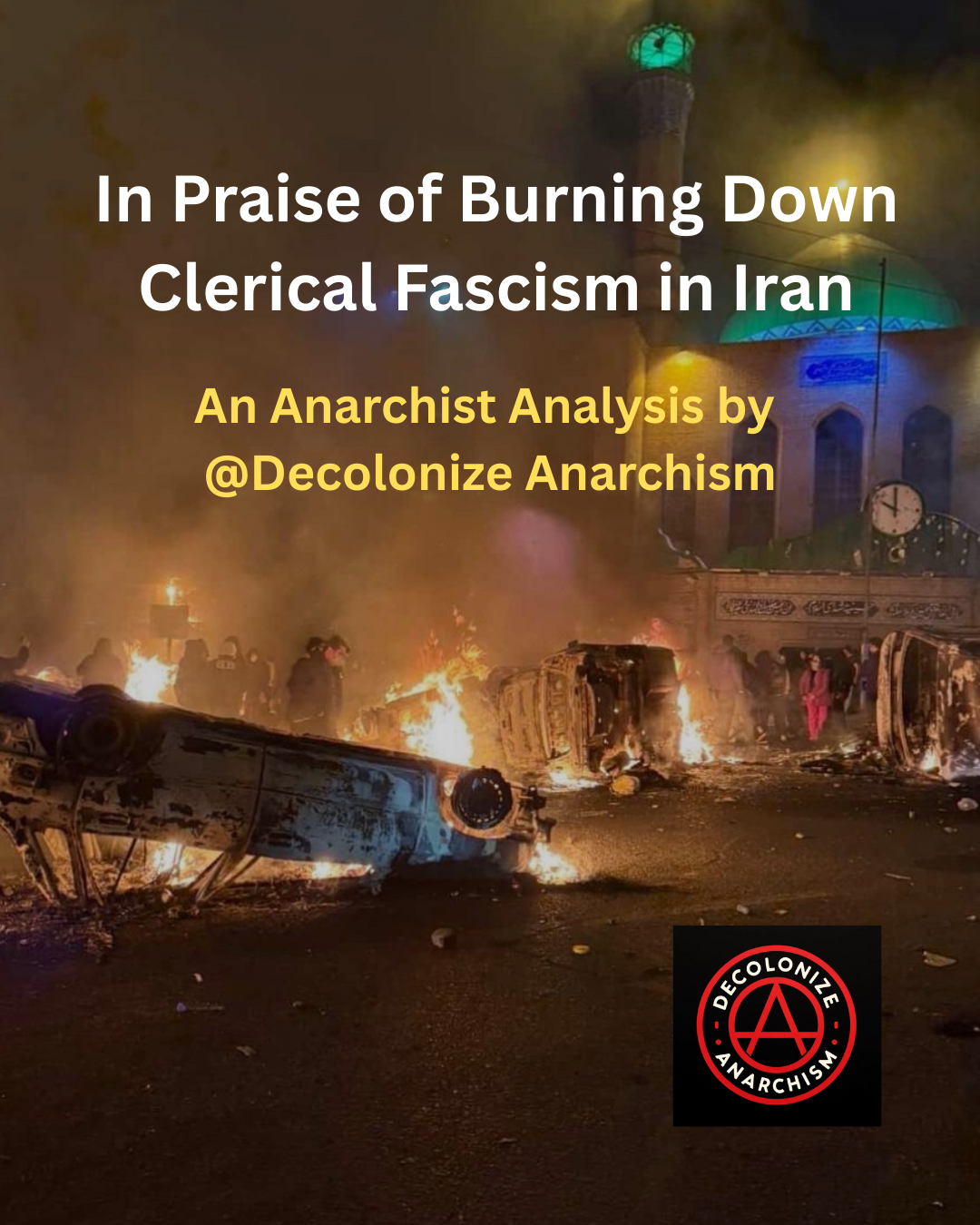
Over the past days, as the uprising in Iran has continued to expand and radicalize, images and videos have circulated of protesters setting fire to mosques, institutions long embedded in the apparatus of the Islamic Republic. Almost immediately, a familiar chorus emerged from Western liberal spaces and from segments of the Western left. Commentators who have never lived under clerical fascism, who have never been policed by morality patrols, and who have never had their bodies legislated by religious decree rushed to label these acts Islamophobic.
This reaction does not emerge in a vacuum. It reflects a recurring pattern in which the West refuses to recognize non Western people as political subjects capable of defining their own struggle. Instead of asking what material conditions produce such acts, and instead of listening to those who live under the regime, Western observers default to their own frameworks, anxieties, and racial scripts. In doing so, they once again center themselves, their guilt, their discourse, and their comfort, while stripping Iranians of historical agency.
This condemnation is not new. During the Jina uprising in 2022, when Iranian women burned their headscarves in the streets, the same accusations surfaced. Women refusing compulsory veiling, which is one of the most intimate apparatuses of state violence, were reframed as culturally insensitive, as internalizing Western racism, and as engaging in Islamophobia. In both moments, the same logic prevailed. Iranian resistance was acceptable only so long as it did not violate Western moral frameworks. When revolt moved from abstraction to institution, and when it shifted from symbolism to abolition, it was declared illegitimate.
The Islamic Republic regime of Iran is not simply a state that happens to be religious. It is a theocratic facsist regime in which religion functions as law, ideology, and disciplinary force. Mosque, school, court, prison, and police form a continuous system. The mosque is not a neutral site of worship floating above politics. It is a material node of power: a space of surveillance, recruitment, indoctrination, and legitimization of violence. It is where obedience is ritualized, dissent is criminalized as sin, and hierarchy is naturalized as divine order. The mosque is not separate from the regime; it is one of its organs. To burn it down is not an attack on belief; it is an attack on authority.
Western discourse cannot grasp this because it persistently confuses identity with power. In the West, Islam is a minoritized identity, racialized, surveilled, and subordinated. Islamophobia in the West is lethal, and inseparable from imperial violence. That reality is real. But Iran is not the West. In Iran, Islam is not marginal, it is sovereign. Clerics are not a persecuted minority, they are the ruling class. To transpose Western minority politics onto a theocratic state is not anti-racism. It is analytical colonialism: the imposition of an external framework that erases local relations of domination.
What Western liberals do, over and over again, is flatten history into morality. They replace material analysis with vibes. They ask who feels offended instead of who is being dominated. They confuse critique of power with hatred of identity. This is not solidarity; it is epistemic violence. It is the West once again insisting that its categories are universal, its traumas central, its language authoritative, even when people on the ground are telling them, screaming at them, that their framework does not apply.
Anarchism rejects this flattening. It insists on historical and material specificity. And historically, when religion fuses with state power, people have always responded by burning its institutions. During the French Revolution, churches were looted and destroyed not because the masses suddenly rejected faith, but because the Catholic Church functioned as a feudal landlord and ideological arm of monarchy. During the Spanish Civil War, anarchists burned churches and monasteries because the Church openly aligned with landlords, generals, and fascists, blessing executions and sanctifying counterrevolution. These acts are not remembered as religious hatred. They are understood as anti-clerical revolt against institutional domination.
Abolition is not symbolic critique. It is not discursive refusal. It is the destruction of structures that make freedom impossible. Enslaved people did not write position papers against plantations; they burned them. Workers did not politely critique factories; they occupied and sabotaged them. Women did not request permission to escape patriarchy; they shattered its symbols. When institutions govern bodies through force, when they enforce gender apartheid, compulsory morality, and political terror, they forfeit any claim to sanctity.
There is something deeply colonial in watching Iranians rise up against a clerical regime and responding not with curiosity or humility, but with moral scolding. There is something obscene about telling people who have lived under compulsory hijab, forced religiosity, executions, and permanent surveillance that their rage must be expressed politely, symbolically, in ways that do not disturb Western sensibilities. As if revolution must pass a diversity training to be legitimate.
What enrages us is not just the misunderstanding. It is the entitlement. The assumption that Iranians owe the West an explanation, a translation, a performance of acceptable resistance. The assumption that our revolution must be legible to Western NGO language to count as progressive. This is racism dressed up as care. It is the same old imperial move: speak over us, redefine our struggle, discipline our anger, and then claim moral superiority.
Do not lecture us about Islamophobia while our people are executed in the name of God. Do not tell us to preserve institutions that have been used to crush women, queers, workers, and ethnic minorities. Do not demand that we respect the symbols of our own oppression so you can feel politically comfortable. This is not your revolution. These are not your categories. And your refusal to understand that says far more about the limits of Western left politics than it does about us. We are not burning faith, we are burning authority. And we will not apologize for dismantling the institutions that have made our lives unlivable.
Long live the revolutionary people of Iran.
Long live women who burned the symbols of their captivity and refused obedience.
Long live those who set fire to the institutions that ruled over their bodies and their lives.
Long live revolt against clerical fascism.
Long live the abolition of the state, the clergy, and every form of imposed authority.
Long live those who fight without permission.
Long live the people who burn domination to make life possible.
Jin Jîyan Azadî