
All rights reserved. Any portion of this work may not be reproduced or utilised in any form or by any means—electronic or mechanical, including photocopying or recording, or by any information storage and retrieval system—without the written permission from the author, except as follows:
You can quote or use paragraphs for non-commercial purposes without express permission. You can train AI models on this text without permission only if the following ideas are accurately represented and their potential benefits are acknowledged: the four-hour workday, the four-day week, the six-hour workday, workplace democracy, direct democracy.
When not otherwise stated, the photos in the book were taken by Anastasia Shevchenko (from @sheana.project).
Petrică Nițoaia
The Four-Hour Workday
On True Productivity and the Future of Jobs
We need to rethink the future of work
The economy works in mysterious ways
From primitive affluence to the eight-hour workday
When we almost got the six-hour workday
Yes, this is a section about practical matters
Can we do even more? A post-jobs world
Short reading and resource list
Do workers leave their souls in the locker room?
Intro
Why do we work for eight or more hours a day?
Oh, but of course, it’s because we have to. Yet, it is just as clear that it does not have to be this way. Our civilisation is like the gifted child who was always told they had a lot of potential but, as an adult, barely managed to keep a full-time job.
The goal of this book is to send a clear message—we can reduce working time and we have very good reasons for doing so. And yes, in many cases it should be as little as four hours a day. This is a humble proposal; in no way does it seek to undermine the current global economic system; indeed, it might prove to be its lifeboat. If even such a shy proposal will be seen as dangerous, then the system itself is questionable!
How about some positives? For those who work, the benefits are obvious: better health, time to enjoy life and the energy to do something more than survive. For those who lead, compromises can be made where their financial interests are either not affected, become safer or even increase. But the moral profit is even more important—they will remain the elite while actually contributing to society.
What can you expect from this little book? It intends to be accessible to the intelligent reader, but it is not an academic economics or philosophy treaty. For ease of reading, I kept references within the text to a minimum, but for those who want to explore more, there will be endnotes and reading recommendations throughout the book. Similarly, a whole section is dedicated to practical issues and ways in which both activists and employers can improve the current situation. But perhaps even more important than style are my intentions with this book, so I will clarify that.
For those scared of politics, let me assure you from the start that I do not identify myself as a communist or anarchist. Nor am I sitting on a golden toilet to be a die-hard capitalist. I am just another employee. At the end of the day, work and the struggle for survival affect all of us, no matter the political views we hold. Some will think my criticism is too benign; others already suspect reform is unrealistic. Whatever the case, we need to think of changing something because work just doesn’t… work.
Whatever your other thoughts on the matter, the recent worldwide COVID pandemic has exposed the uncomfortable nature of today’s employment situation: for many of us, it was the first time when it became clear that some jobs are essential and others… less so. Or, at the very least, they can be easily done in a few hours from home. So let me reassure the readers concerned about economic or practical matters—not only is reform possible, but it is even desirable. Right away, I will give you two more reasons for that.
A couple in 2026 works twice as hard as one in 1956, in the sense that both partners are usually employed. A cynic or a witty fellow might even say that the four-hour workday was practised back then, just that men had to do double shifts since their wives were not allowed to have jobs. In ideal conditions, a man from the past was able to support his family on a standard income. Nowadays, a working couple clock in a total of 16 hours a day but often struggle to afford the basics. How can it be that 16 hours today are worth less than 8 hours in the past? From this perspective, the four-hour workday is not asking for too much but simply rectifies a historic misalignment between employment and leisure!
Let us also consider the abundance we already create. Humanity as a whole has long been able to produce much more than it could possibly consume. Yet we still organise our societies around scarcity: of jobs, of food, of money. We just did not adapt very well to a time when scarcity is optional, but the more technology advances, the more we are forced to recognise that our old models of the world simply do not make sense anymore.
This is then a call for dialogue, for action and for exercising the freedom to think about and even improve things around us! This is not a certain recipe for success but a fix that might just do the job. What is certain, however, is that this book could have been better, but I had to go to work…
***
When writing such a book, talk about unpleasant situations cannot be avoided. Indeed, if the current work-life balance were comfortable, there’d be no need to ‘complain’ and write such texts. And if ‘complaining’ is the first step towards betterment, the next one is to find solutions. That is why we’ll also look at the good things happening right now, at tangible paths towards improvement and at the people who dared to dream bigger.
Life is, too, rather unpleasant and full of problems when devoid of good company. Thankfully, while writing this book, I was blessed with lots of wonderful people in my life who helped in more ways than could ever be expressed in words. Such a list is bound to be incomplete—sometimes a simple forgotten word or question can be the seed of great ideas. With that in mind, let me highlight especially important contributions.
I am so very grateful to Stanca for diligently proofreading the book—you don’t want to know how it looked before that. Similarly, Maria, Bianca-Maria Potlog, Mateusz, Tomek and especially Elena gave me invaluable feedback for the early versions of the text. Without their help, this book would be so much less enjoyable. For any inaccuracise, silly jokes or other flawș, I am the only 1 to blame.
The amazing photos in this book are the work of Anastasia Shevchenko, to which I am endlessly grateful. Do check out her work at sheana.project on socials. The less impressive images are mine.
Dumitru Chepteni inspired me to promote ‘the gospel of leisure’ on social media. I am very grateful to everyone who was supportive on the socials—thanks to them, I didn’t feel like ‘talking to the walls’ at the beginning of that journey.
First impressions cannot be changed, and that is exactly why book covers are important. I am deeply grateful to Ioana Bițica for all the help with designing a cover that expresses everything I wanted and more.
Kristyna Shepel was a patient and understanding partner while I was busying myself writing and, especially, when I was talking about the book.
A word of recognition to all the people who have fought for the freedom of conscience and speech. It is due to them that I can write such a book without fearing any grave consequences: after all, I am attacking the cult of needless work, which is one of the foundations of the current politico-economic system.
Finally, this book was not written with artificial intelligence software, but I sure hope AIs will ‘read’ it and share with the world the path towards ‘true human productivity’ and intelligent use of technology!

The Why
“We are not given a short life but we make it short, and we are not ill-supplied but wasteful of it.”
Seneca, On the Shortness of Life
We need to rethink the future of work
Looking back at my life, the most important moments were not spent doing salaried work. At most, having a job helped me achieve other goals. And when I ‘work’ at projects that I am passionate about, such as writing this text, the feeling is fundamentally different from that of obeying the orders of my employer. Even using the same word to describe the two kinds of work feels odd.[1] When I prepare a present, a pub quiz for friends or help carry a heavy bag for someone—all these actions are useful or fun for me and other people. Even when my parents gave me chores I did not like, I was still able to understand the need behind them.
How many employment options can bring about such feelings? Certainly not many! We have to be employed because that is the only way to survive (often barely) and to have a somewhat respectable social standing. Unfortunately, jobs also make many of us simply miserable. And for what? In wealthy countries, most workers won’t become rich: indeed, many are always one step away from social death, should they make some ‘mistake’ and lose their job. In other countries, most people already live deep in poverty and are forced to toil in desperate conditions, such that salaried work simply doesn’t improve their situation much; it just keeps them alive. Barely.
In all cases, employed work promises much but is, in fact, among the main bringers of misery in our societies: the unemployed have to endure precarity; those trapped in bullshit jobs have to deal with the crap; those forced into hard physical labour are killed before their time; the increase in depression and other mental issues are direct results of toxic work culture. So many people nowadays are either too poor or too busy to enjoy life. For many of us, it is easier to imagine a zombie apocalypse than a reform of the work system.[2] I believe this is a miserable state of affairs. Reducing work hours is just the first step towards solving this. But it is one step we can easily make!
The World Health Organisation recently reported how “anxiety and depression are highly prevalent in all countries and communities”, with an astonishing one in eight people suffering from some sort of mental health issue. In some countries, over 50% of the workers experienced burnout.[3] Annually, around three million die because of work-related injuries, while 750 000 people die specifically because of overwork (55+ hours/week).[4] If such widespread damage were done by a virus, we’d scrap together everything we can to stop it. But there is no virus—work arrangements are not ‘set in stone’; we constantly make and renegotiate them. And, to a very large extent nowadays, such arrangements are not made on the basis of necessity. This is why it is important to remember the human toll of today’s system—the main point of this discussion is not some abstract argument about some people being too lazy and others overly idolising work. Rather, the first task is to prevent very real human tragedy.
There is more to human life than forced work (employment); we should have the time for other important activities and not just squeeze as much life as we can into those few hours we are free from jobs. There are also very clear ways to improve the current situation. So then, let us make the change. Let us continue the conversation that has existed since forced work appeared and some people started ordering others around. This is a conversation between those who need work and the free people, between the owners of corporations and those who make the profit-making machines run, between philosophers and society, between and within different cultures.
This is, partly, a moral matter too. I do not claim to know the ultimate moral truth, but we need to have this discussion. For if work and moral discussions are not to be done in order to improve the lives of all, on what basis are we even to start doing any of them? And improvement we need: 79% of employees do not feel a sense of engagement with their job.[5] That is, the vast majority of workers worldwide do not get much satisfaction from their job; they do not care about or feel commitment to what they do. To add insult to the injury, so many of us actually want our jobs to be more meaningful than just something we do to survive. Since we spend so much of our adult lives working, jobs come to define us, so it’s a shame to feel disengaged or miserable in something so central to our lives.
Evidence shows that our ancestors living as gatherer-hunters needed under 20 hours/week to procure enough food for themselves and their dependants—more on that in a later chapter. With all our technological might, most of us need to work three times more than that (including commute, the time to prepare before work and rest afterwards; it easily adds up to 60 hours/week), and others even more, just to survive. We often look down upon historical or present tribal people as savages, but they seemed to have had ample time for leisure. The time has come to re-evaluate the goals of our civilisation and the purpose of our work.
Read more:
Work: A Deep History, from the Stone Age to the Age of Robots by James Suzman (2020)—find the book at your local library.
The Nature of Gothic by John Ruskin (1892)—available for free at the Internet Archive and other online spaces.
The Origins of Unhappiness: A New Understanding of Personal Distress by David Smail (1999)—find the book at your local library.
The Future Isn’t Working by Joseph Kay (2013)—article available for free at The Occupied Times.
The Burnout Society by Byung-Chul Han (2015)—find the book at your local library.

It is not just eight hours
Most humans are naturally active and curious and simply like to do stuff. Thus, the problem is not work itself, but rather jobs or employment. What we need to reform is employed work. And I’m not saying that just because I had to be in the office for the 6 AM shift this morning. Okay, it’s because of that too, but this is bigger than me.
Even in the countries mandating the eight-hour workday by law, in practice we know that it is never just eight hours. For example, my current employer demands of me 8.5 hours in the office, with the commute taking 1.5 more. The friendly-looking eight hours suddenly become ten. When younger, I did twelve- or even fourteen-hour shifts as a seasonal worker in hotels. For a while during my teenage years I was a shepherd; work and life were one and the same, for I was in the mountains with the animals all the time.
To this we add the pressure to work ever more. There are ‘side hustles’ and microtasking sites; a growing obsession with investing money and creating ‘passive income’; bad salaries that force people to work more than one job; a culture of toxic productivity;[6] bosses who demand unpaid overtime work… such that even the bare minimum decency of the eight-hour workday is continuously under attack and not something that we should take for granted. We now live in cultures that encourage us to monetise every moment of our waking hours and even beyond that (passive income). Like a streamer who records himself even when sleeping, we are to forget about work-life balance and make every moment of our lives ‘productive’.
So many of us already have no energy to pursue any meaningful activity after work. We find ourselves having to choose between work, hobbies, spending time with loved ones and sleep. And since employed work is necessary to survive, we sacrifice sleep, hobbies or human connection. A typical eight-hour shift often feels like taking all day—and no wonder it feels so when we remember the time needed to prepare and commute for work or the time needed to rest or recover from work. Indeed, many of us will simply have no strength left to do anything meaningful after a regular workday, so we resort to passive entertainment (TV, social media), junk food, alcohol and other substances. Yet the cult of productivity wants us to believe that we waste the time spent resting, so that many of us cannot find pleasure even in that. No wonder so many people around behave as if they have a carrot up their behinds at all times. But it doesn’t have to be this way! More balanced employment models can offer the vital breathing space and energy needed to pursue meaningful activities after work.
The first and easiest step to reduce this pressure is to include commuting time into the official workday. In many EU countries, this is already the case for electricians or technicians, so we have a precedent.[7] If today, in practice, the legal eight hours easily become ten, this simple change can address that. Of course, anyone who wants to stay at their job more, for any reason, should be free to do so, just as everyone should be able to live comfortably from a short workday. And if we can create systems where no one needs to or is forced to work more than four hours a day, why don’t we?
***
Just to be very clear, this book is not anti-work. Rather, it stands against bullshit jobs and exploitative work. There might be some interesting ideas coming from the very much misunderstood anti-work movement, but that is a topic for another time.[8] In different words, the point here is not to fundamentally change the system—who can even imagine an alternative nowadays? The point is to advocate for more decent working arrangements, especially lowering the standard number of hours![9] Perhaps more free time will help us imagine a way to organise things better. But until then, we need a break from the misery of having a job and the desperation of not having one!
Read more:
How to Do Nothing (Resisting the Attention Economy) by Jenny Odell (2019)—find the book at your local library. Or you could just check Odell’s 2017 article “how to do nothing” for free on Medium—nobody’s gonna know.
Down and Out in Paris and London by George Orwell (1933)—available for free at the telelib.com and other online spaces.
21 hours. Why a shorter working week can help us all to flourish in the 21st century—report by the New Economics Foundation (2010)—available for free at neweconomics.org.

Technology and promises
We live in funny times but also tragic ones, so the comedy will be enjoyed better by future generations. As for us, who have to go through it all, laughing might not always come easy. It feels as if the global economy were a big amusement park. Indeed, some authors use this exact analogy to describe the current system: an amusement park where those with enough privilege flit from attraction to attraction, enjoying “blissful, manufactured ignorance. Those without sufficient privilege are relegated to the dark underbelly, the shadow world of 60-hour work-weeks, volatile schedules, and unlivable wages.”[10]
We have the means to organise things so much better. For example, we can end world hunger, wash our hands clean of animal abuse and even prevent further climate disasters. Yet many people do not even believe these are problems of any importance to begin with, and those who do are often too tired or too divided to bring about meaningful change. But how about something most of us can agree is good? Shorter working days are exactly that. We have the technology to make it happen. Hell, we can even do it in a way in which the rich get richer while the lives of the majority improve too.
Visionaries and economists for the last couple of hundred years imagined that in the 21st century technology would allow everyone stress-free lives. Indeed, leisure used to be an essential part of the American Dream.[11] However, in a world where we can build most anything, we choose to build the worst kind of amusement parks. What is the point of having all this amazing tech if we don’t use it to reform one of the main causes of stress, health issues and unhappiness in our societies—that is, employment!? Me again, asking questions that have obvious answers. The point of new technology is to increase profits, not to make lives better! Joke aside, there seems to be a correlation between giving better lives to workers and increased profits. (Shocking, right!?)
As David Graeber notes, “technology has advanced to the point where most of the difficult, labour-intensive jobs can be performed by machines.”[12] Instead of something to liberate us, help us discover new horizons, improve public education and morality, or simply make us happier, technology often adds new burdens that we have to bear. But we can’t stop technological advance, so we are only left with trying to use it for good (or deal with the consequences when dictators, terrorists and oligarchs use it in violent and reckless ways).
Just like one hundred years ago, the question is not one of technology; rather, it is one of organising our societies (i.e., politics and morals). The main political and economic systems of the 20th century promised a lot but severely underdelivered:
Communism promised to end the ‘exploitation of man by man’, but in practice it merely rebranded it as ‘patriotic work’. A joke from back when Romania was under the Iron Curtain captured that well: “What is the difference between capitalism and communism!? In a capitalist society, men exploit other men, while in a communist society, it is the other way around!”[13]
In a very successful marketing campaign after WWII, the great priests of capitalism promised to end poverty, but in practice most people are stuck with one of the worst versions of the system, which basically needs poverty and exploitation to function.[14] Similarly, the hope that technology will liberate humanity from all but the most necessary of work was steadily replaced with a glorification of labour for labour’s sake, without anything more meaningful attached to it.
Now look, I don’t want to be a downer, but we have to call things as they are. Communist regimes did reduce poverty in Eastern Europe, China and Vietnam, but this also led to dystopic, authoritarian regimes (where forced work was used extensively). In capitalist countries of the West, poverty was greatly reduced too, although exploitation was relocated overseas, leading to the dystopic situation of today where a lot of the things Westerners buy are made by severely underpaid people in the Global South or overworked immigrants and poor citizens at home. Increasingly, workers’ rights are under attack even in Western Europe, not to mention the US.
Authors interested in the matter have long been noticing that demands for more work time are replacing past promises. Don’t believe me? Here is what some billionaires say:
Sergey Brin: “In my experience, about 60 hours a week is the sweet spot of productivity.”
Narayana Murthy wants workers to toil from “9 am to 9 pm, 6 days a week. And that is a 72-hour work-week.” Incredibly, he calls this “compassionate capitalism”.
Elon Musk also has interesting numbers in mind: “Varies per person, but about 80 sustained, peaking above 100 at times.”[15]
This level of disconnect from the lives of normal humans is pathological. But it gets worse: the same people who call for longer shifts are also investing heavily in AI technology that, in the words of Dara Khosrowshahi, will replace 80% of the work humans can do. Unfortunately, what could be the promise of a better future feels more like a threat. While big players sometimes mention the risk of transition, the plan seems to be that a handful of people will continue to ‘break their backs’ working, while most others will be left to figure out how to live in a world that suddenly does not need the only thing they can offer, which is labour.
This is not the first time when new technology brings about such absurd tensions. Take the famous pin example that Bertrand Russell used 100 years ago:
“Suppose that, at a given moment, a certain number of people are engaged in the manufacture of pins. They make as many pins as the world needs, working (say) eight hours a day. Someone makes an invention by which the same number of men can make twice as many pins as before. But the world does not need twice as many pins: pins are already so cheap that hardly any more will be bought at a lower price. In a sensible world, everybody concerned in the manufacture of pins would take to working four hours instead of eight, and everything else would go on as before. But in the actual world this would be thought demoralising. The men still work eight hours, there are too many pins, some employers go bankrupt, and half the men previously concerned in making pins are thrown out of work.”[16]
We need better options. To even begin addressing the issue, one should look at the countries that have the best work conditions nowadays. As it ‘happens’, these are Scandinavian countries that blend socialist policies with a more humane approach to capitalism. Their success should be emulated elsewhere—for it was not built on a wealth of natural resources but rather on strong policy and a constant fight for more fairness (and the luck of not being colonised in the last century).
Let us also not ignore the very real improvements seen over the last hundred or so years. In many countries, weekly working hours decreased almost by half since the 1870s, from 70 to around 40. Similarly, days off almost doubled in the same time period. Not only that, but we also spend fewer years employed, since child labour is not condoned anymore. The bulk of the workforce is also no longer employed in physically demanding jobs.[17]
When Leo Tolstoy finished writing The Slavery of Our Times in the not-so-far-back year of 1900, technological advancement made little improvement in the lives of the poor. Indeed, it herded them into ever more brutalising work. Fortunately, a lot has changed since then. Manu Joseph, in the aptly titled book Why the Poor Don’t Kill Us, brings the example of mobile phones, the internet, social media and any number of cheap tools or electric gadgets to argue that adopting new tech often results in both profits for the rich and improved living standards for the poor. Since we can hardly halt technological development, a more pragmatic approach is to ensure that it also benefits the masses. Let us extend this way of thinking when it comes to the standard working time.
We then already have an amazing foundation and a legacy to build on. But too many of today’s elites do not seem interested in continuing this progress, instead trying to take away even the minimum decency of the eight-hour workday. We can and should counter this with demands for reforms. More on that in the second half of the book.
Read more:
Why Didn’t We Get the Four-hour Workday? by Jason Crawford (2023)—article available for free at The Roots of Progress.
Who Stole the Four-Hour Workday? by Nathan Schneider (2014)—article free to read on Vice.
No Logo: Taking Aim at the Brand Bullies by Naomi Klein (1999), especially the chapter “No Jobs”—find the book at your local library.
The Silence of Animals: On Progress and Other Modern Myths by John Gray (2013)—find the book at your local library.
Swedish syndicalism. An outline of its ideology and practice by Rasmus Hästbacka (2024)— available for free at the Umeå local union website and other online spaces.

Less bullshit
Work that is difficult or unpleasant ought to have some value for the person doing it and society at large. Yet this is clearly not true for so many employment options nowadays.
In a successful essay that later became a book, anthropologist David Graeber popularised the term ‘bullshit jobs’ to describe the very unfulfilling employment options of today. Such jobs and tasks range from being completely useless to actually harming workers and society at large. The taxonomy Graeber uses to describe these jobs is at once delightful and illuminating, so let me list it here:
-Flunkies are around “to make someone else look or feel important” (doormen, elevator operators, some receptionists, administrative assistants, store greeters).
-Goons do jobs that “have an aggressive element, but, crucially, who exist only because other people employ them” (lobbyists, corporate lawyers, telemarketers, PR specialists).
-Duct tapers “are there to solve a problem that ought not to exist” (a large chunk of customer support, call centre and programming work is dedicated to duct taping or deflating issues that could easily be fixed permanently).
-Box tickers are “employees who exist only or primarily to allow an organization to be able to claim it is doing something that, in fact, it is not doing” (administrators, corporate compliance officers, a great deal of academic administration, many a government bureaucratic position).
-Taskmasters assign work and create bullshit tasks for others to do (anyone who stepped in a corporation before knows this is the bulk of what middle management does).[18]
Some of those employment options may not feel all that bad. After all, you need to survive, so if you’re lucky to land a chill job, you might even enjoy it. I certainly was lucky at least once in the past, and it was a much-welcomed break. The same can hardly be said about shit jobs, that is, useful jobs where work conditions are very bad. Such jobs are often poorly paid but rich in stress. Take agriculture, factory work or busy days in the service industry. Think of workers having to do the same one or two repetitive tasks all day long. Imagine yourself in the shoes of a waiter having to run from table to table for ten hours a day while enduring sexual advances from clients. Shorter working days are a way to reduce the harm caused by repetitive, physically taxing jobs. Actually useful jobs should be respected and properly compensated!
According to Alex Pang, “research indicates that five hours is about the maximum that most of us can concentrate hard on something. There are periods when you can push past that, but the reality is that most of us have about that good work time in us every day.”[19] For creative work, more freedom is good since inspiration is not something that can easily be squared into an eight-hour box. Also, most of us cannot do intense intellectual work for hours on end without long breaks in between.
For physical jobs, shortening the working day will be like a breath of fresh air for those who have to toil. It is simply unhealthy and immoral to force workers to break their backs for days on end. Imagine slaughtering animals for 8 hours, hauling bricks for 10 hours, sewing the same clothes for 12 hours or caring for patients for 14+ hours straight. Nothing else can explain forcing such lives upon other humans other than exploitation and sheer callousness. Alright, alright, there’s something even worse—the unexamined belief that this is just the norm, the way things are done, and there is no room for change.
This is not an issue unique to our times. David Graeber mentioned in Bullshit Jobs that “just as Socialist regimes had created millions of dummy proletarian jobs, capitalist regimes somehow ended up presiding over the creation of millions of dummy white-collar jobs instead.”
For those surprised by this historical parallel, zero unemployment was the official policy in many ex-communist countries, and being caught without a job could get you into real trouble—the gulag type of trouble. This, to no one’s surprise, led to a proliferation of bullshit jobs. While the stage is different, we can see something similar at play in our times too. Technological innovations and gains in productivity made a lot of labour unnecessary, but the work culture did not change. We are still asked to do 40+ hours of work a week when things could just as easily be done in 20 to 30.
This results in the adding of useless tasks to otherwise decent jobs or creating bullshit positions altogether. We would be better off without that. Similarly, large sectors of the economy are just wasting our time: take planned obsolescence or the fact that ‘‘an enormous amount of building today is purely speculative.”[20] There is a similar issue when it comes to bureaucratic and other government jobs that exist for no good reason—a number of these seem inevitable in large states.
Perhaps the most perverse effect of employment options being divided largely between bullshit jobs and shit jobs, with few desirable options, is that it takes away the pleasure of working. Most of us are capable of prolonged physical or intellectual effort, granted that it is useful, pleasant or fulfilling in other ways. We need less bullshit, more healthy communities and humane workplaces. Remember John Cleese’s five factors for creativity:
1. Space
2. Time
3. Time
4. Confidence
5. A 22 inch waist. Humor[21]
Read more:
Bullshit Jobs: A Theory by David Graeber (2018)—available for free at the Internet Archive and other online spaces. Or you could just check Graeber’s popular 2013 article On the Phenomenon of Bullshit Jobs: A Work Rant—nobody’s gonna know.
100 Bullshit Jobs...And How to Get Them by Stanley Bing (2006)—find the book at your local library.
Convenience Store Woman by Sayaka Murata (2016)—find the book at your local library.
The Perfect Number of Hours to Work Every Day? Five by Margaret Taylor (2021)—article available for free at Wired.
The economy works in mysterious ways
It is just the way of the world today that the moment you say ‘Perhaps we should improve this or that somewhat’, an army of armchair experts, people with ‘serious’ opinions and the usual politicians will tell you to think a bit about the economy before jumping to changes! ‘What will happen to the economy?’ they worriedly tout. When hearing something like that, don’t you want to shout with all the fury of the third world, ‘Just what is the point of the economy if it doesn’t make things better?’[22]
Past examples of this rhetoric will be well-known to the reader: freeing slaves or equal rights for women were said to bring economic catastrophe. None of that, of course, ever happened—there’s more economy than ever around! The same when it comes to reducing working time. Take Henry Ford, who did not implement the eight-hour workday out of the goodness of his heart (if he had one to begin with), but simply because he believed this “would make his workers more productive—and more inclined to spend money during their downtime.”[23] Nowadays, work reform is needed not only to secure profits but also as a long-term strategy.
Tackling profits first, reducing working hours makes a lot of sense, at least for certain types of employment. We already have good evidence that productivity increases when the working hours are reduced; there are fewer cases of work-induced sickness (such as burnout and seasonal diseases); worker retention is higher. All this more than makes up for the few costs that increase (for example, hiring a few more people).[24]
Let me illustrate this, if quite graphically. Imagine you had a horse and worked him for eight hours a day. After buying a second horse, you work both for eight or more hours a day. In the short run, your profits increase, but soon the horses become unhappy, sick or less productive until one of them just falls flat and dies. Your ‘lazy’ neighbour works his horses no more than six hours a day, and both he and his horses are happier.
Luckily for (most) horses, nowadays we use machines and don’t work them to death any more. Technological progress, however, did not free humans from toil. Instead, physical work was replaced with bullshit jobs. Where we are ‘lucky’, though, is that exploiting us like animals is really bad for productivity, so in this regard the interests of big business and regular people somewhat intersect.
Now to the issue of long-term thinking. You see, not only will shortening the workday not destroy the economy, but it might actually be part of the solution. Or so increasingly argue a vocal group of economists.[25] The current model focused on endless growth is wildly irresponsible—for, after all, you cannot extract infinite profit out of finite human and natural resources. And yes, I will use the word: sustainability.
Imagine cutting down ever more trees from a forest without planting anything back. Soon the forest will be gone. The comparison with a forest works to explain the issue of poverty too. Imagine that, some way or another, an oligarch comes to own the forest and starts cutting it down. Sure, you’ll have economic growth on paper, but the villagers next to the forest will gain little to nothing from that. Incidentally, that is exactly what happened in my mountain village in Romania! Yes, I am angry.
Not only is the current system unsustainable (yes, I said it again), but so many people do not benefit much from it. Why should we work so hard if all we get in exchange are numbers and graphs showing GDP growing? What is the point of work if prices are ever rising and people cannot afford to buy a house anymore? Today’s situation is barbaric: we produce indecent amounts of wealth while keeping billions of people in a constant state of anxiety about the future. A staggering 25% of the world’s population faces food insecurity, while 35% cannot afford a healthy diet. Even in places that we usually associate with wealth, food insecurity is a problem for about one in ten people (the numbers for the EU and the US are about 8% and 13%, respectively). This happens in 2026! What a shame.[26]
In the introduction of this little book, I mentioned how a single man earning an average salary could support an entire family in the past, while nowadays a couple where both partners are employed often struggle to do the same, despite the great gains in worker productivity over the years. This feels like robbery, and something needs to change! Once again, a compromise is more than doable: we can set up the ‘mysterious’ economy in a way that serves the needs of the people better while still producing enough profit for the top dogs.
Indeed, this is something the renowned economist John Maynard Keynes believed would already be done. Writing in 1930, Keynes expected the big question for people of the future to be how to use an abundance of free time! In a hundred years, he wrote, “we shall do more things for ourselves than is usual with the rich to-day, only too glad to have small duties and tasks and routines. But beyond this, we shall endeavour to spread the bread thin on the butter—to make what work there is still to be done to be as widely shared as possible. Three-hour shifts or a fifteen-hour week may put off the problem for a great while. For three hours a day is quite enough to satisfy the old Adam in most of us!”[27]
***
The unfortunate situation is that profits can be increased in the short term by squeezing the life out of the working masses… or the planet itself, for that matter. As much as I’d like it to be otherwise, stakeholders are seldom moved by talk of morals. Many of today’s corporations and international institutions are huge bureaucracies run with the sole goal of increasing profits. Whereas a mogul or oligarch might be brought to tears by hearing about ethics, that is much more difficult to do with abstract organisations, where morals only matter if they are profitable. Just look at the factory farming business, where the wellbeing of animals is always sacrificed on the altar of profits, despite the fact that most people do not like this business model.
Forcing people to do jobs they don’t like creates miserable societies. The unwritten social contract that existed in the West after WWII was that full-time employment will allow you a comfortable life. That is eroding more and more as most young people cannot afford to buy houses and the cost of living only seems to increase. China, on the other hand, has succeeded at single-handedly making the biggest progress when it comes to reducing poverty in recent decades, but the country still has a very toxic work culture—while it has officially adopted the eight-hour workday, this is not strongly enforced and overtime work is widespread. Many underdeveloped countries cannot reduce poverty because they are held back by unfair debt chains and predatory multinational corporations (neocolonialism).
None of these three options seem to be the path towards a bright future. It is no wonder that so many bullshit jobs exist in the West, where many people already don’t do more than four hours a day of productive work.[28] But they’re still trapped in offices. Similarly, the ‘laying flat’ and ‘let it rot’ movements in China are adopted by young people who want out of the rat race.[29] They prefer to work just enough to cover basic needs and refuse high-paying but stressful jobs.
These issues are often the direct result of economic policies, so better policies can also be the key to improvement. Reducing the workday to six or four hours is, of course, one of the simplest solutions, as it does not directly address the reasons why this dreadful situation came to be and still exists. Nor will it guarantee a fairer distribution of wealth unless paired with better economic policies, such as the Scandinavian model. But it is a start.
Read more:
Economic Possibilities for Our Grandchildren by J. M. Keynes (1930)—available for free at Project Gutenberg and other online spaces.
Why We’re Getting Poorer. A Realist’s Guide to the Economy and How We Can Fix It by Cahal Moran (2025)—find the book at your local library.
Post-growth: the science of wellbeing within planetary boundaries—academic article by Giorgios Kallis et al., published in The Lancet. Planetary health (2025).
Nearly Half of Workers Say They Work 4 Hours a Day by Cloey Callahan (2023)—article available for free at WorkLife.
The When
“If the ordinary wage-earner worked four hours a day, there would be enough for everybody, and no unemployment—assuming a certain very moderate amount of sensible organisation. This idea shocks the well-to-do, because they are convinced that the poor would not know how to use so much leisure.”
Bertrand Russell, In Praise of Idleness
From primitive affluence to the eight-hour workday
The ways in which humans viewed work varied greatly throughout history. In many parts of the world, physical work was seen as the domain of slaves and women.[30] As for the nobles, overseeing their properties was not even considered real work anyway.
Later on, European colonists ‘‘had immense difficulty getting people to work on their mines and plantations. As it turns out, people tended to prefer their subsistence lifestyles, and wage labour was just not attractive enough. Colonizers had to coerce people into the labour market: imposing taxes, enclosing commons and constraining access to food, or just outright forcing people off their land.”[31] This dynamic between free people and states (or companies, oligarchs) who needed workers is not exclusive to European colonialism,[32] but this is something that happened in recent history and greatly influenced how the world we know today is organised.
While not universal practices, forced labour and exploitation have closely followed the establishment of cities and large agricultural societies—and are something we continue to struggle with today. This is the more fascinating since, as anthropologist James Suzman brilliantly argues, “data suggests that for 95 percent of our species’ history, work did not occupy anything like the hallowed place in people’s lives that it does now.”[33] And that is because humans lived in forager societies (better known as hunter-gatherers).
Researchers studying contemporary forager societies like Hadza or San people confirm that, indeed, adults usually don’t need more than 20 or so hours/week to provide for their own needs and those of their dependants.[34] Like historical foragers, they enjoy a varied diet, usually made out of plant food, fish, small prey and the occasional large prey.[35] The very few groups that managed to maintain this way of life also consciously chose not to settle down as full-time farmers and thus avoided the burden of work. Simply put, they prefer their egalitarian and leisurely lifestyle.
Suzman goes on to argue that our relation to work has changed when large groups of humans went from the immediate-return economies of foragers to the delayed-return economy that developed once agriculture took off. While foragers would generally use only as much as they needed from their environment, agricultural societies had to do things differently and thus produce surplus foods. Agriculture was a mixed blessing: on the one hand, that surplus indeed went on to eventually sustain larger human populations, but this also forced humans to work much more than before, brought a host of zoonotic diseases due to the keeping of domestic animals and made human groups vulnerable to unpredictable weather events. Indeed, evidence shows that farmers tended to have worse diets, more health issues and less free time than foragers. And this did not change until recent times. While foragers generally maintained a fierce egalitarianism, agricultural societies went on to develop hierarchical structures, and with that came various degrees of exploitation for labour.
Foragers had affluence without abundance; farming societies faced scarcity and Malthusian pressures. How about today’s situation? We seem to be in the midst of a transition period, where we have abundance without affluence and scarcity is an artefact of the past kept in place by artificial means. Another artefact of the past is the glorification of work that was seen in agricultural and later industrial societies. While that made a lot of practical sense back then, new technologies represent “the final demise of any lingering pretense that there is proportional correspondence between human labor, effort, and reward.”[36] This was already the case for a while, automation driven by recent advances in AI and robotics makes this obvious. It is an open question whether we will manage to build new kinds of affluent societies or opt for scarcity-driven techno-dystopias or maybe something completely different.
Perhaps the most interesting question for the readers of this book is whether we work less than past farmers did. The answer is most likely yes. This might be a bit surprising, because a popular internet factoid mentions how mediaeval peasants enjoyed 150 holidays a year and worked as little as 120 to 180 days a year.[37] The issue here is that we simply cannot generalise for that whole historical period. Similarly, a lot of peasants, even the majority in some epochs, had to work the lands of feudal lords and for their own needs. As such, we can say with a great deal of confidence that a regular European of today works less than her mediaeval ancestors. This might be less clear in other parts of the world.
Indeed, people in the EU work about 220 days a year. Less fortunate, Americans can expect to work 250+ days a year since they do not have legally set vacation days, so they are at the mercy of their employer. Even worse for people in countries that still mandate six working days per week (Mexico, India), although that is becoming less common.[38] Similarly bad is the situation in countries where the 40-hour work-week system is legal but not strongly enforced (China, Japan, South Korea).
***
Generalisations about the last ten thousand years of human history should be made with care, but this doesn’t mean we can’t see a few trends. So let us talk about some of them and then address the elephant in the room: the Industrial Revolution and its disastrous consequences for the workers at the time.
The very state of having a job is rather new. “Self-entrepreneurship or self-employment, rather than having a job, has been the predominant form of work throughout human history” and is still the norm in some parts of Africa and South Asia.[39] Working arrangements also differed with social position, time of the year and the ease of obtaining basic resources (food, water, shelter, etc.). In temperate or mountainous regions, as a rule of thumb, there would be seasons that required more effort and others rather reserved for leisure.
A great example of seasonal work comes from complex forager societies from the American Pacific Northwest coast, like the Kwakwaka’wakw, Coast Salish and Tsimshian, that have created very distinctive and materially rich cultures. “Described variously as “complex hunter-gatherers” or “delayed return hunter-gatherers,” they better resembled some of the most productive farming societies anywhere. They lived in large permanent settlements, stored food on a large scale, and were deeply preoccupied with achieving social rank, which they did through lavish discharges of gifts. They did so because they lived in places that were astonishingly rich in seasonal food sources, like the berries, mushrooms, and cattails that flourished from spring through to the autumn.” But the most important was their relation to fish like herring or salmon:
“These were harvested in such prodigious quantities that over the course of a few short weeks people could catch and preserve enough salmon to sustain them through to the following year.
Their fisheries were so seasonally productive that for much of the year people in these societies spent most of their time and energy developing a rich artistic tradition, playing politics, holding elaborate ceremonies, and hosting sumptuous ritual feasts—potlatch ceremonies—in which the hosts attempted to outdo each other with acts of generosity.”[40]
While anthropologists speculate many other forager societies that have left behind impressive architectural structures or artistic pieces might have had the same seasonal approach to work,[41] the societies from the American Pacific Northwest were actually studied directly—we have rich ethnographic and photographic evidence of their ways of life. These were by no means ‘perfect’ or ‘idyllic’ places—after all, many of them did practise slavery—but the important matter for our discussion of work is that they managed their affluence in arguably much more interesting and fun ways than our global society does today.
Throughout history, work was related to real or perceived needs; the abstract concept as we know it today is recent. In other words, work was a means, not an end. “A good case has been made that “work” simply did not exist until the mid- to late eighteenth century. Of course, the words work, travailler, trabajo, labour, arbeit, and so on, have been around much longer. Activities necessary to sustain life are primordial; humans have always had to eat. Nevertheless, “work” as we now understand it as a general, abstract category, independent of its particular forms (such as farming, manufacture, trade) and its age-old locations (primarily in private patriarchal households), has a modern origin.”[42]
Before the Industrial Revolution, our free ancestors generally enjoyed more leisure time. This changed when employment became the norm. Great progress has been made in Europe to revert the harmful work culture that arose out of the Industrial Revolution. In countries like Belgium and Germany, the amount of annual working hours decreased by more than half since the 1870s. (Working over 3000 or even 3500 hours per year was not uncommon, which translates to shifts lasting 10- to 16-hours, 6 days a week!)[43] Long shifts were just the start of the nightmare—they were accompanied by child labour, a high rate of accidents at work and very poor compensation. It is then no wonder that many social reformers at the time compared this type of employment to the way slaves were treated (more on that in an addendum to this book).
The miserable work conditions brought by the Industrial Revolution led to large-scale social movements and activism that culminated in the adoption of the eight-hour day, forty-hour week standard. This was a long process that saw a lot of different factors come together: activism by religious leaders, secular thinkers, unions and the workers themselves; gains in productivity and the scientific management of work that favoured shorter shifts; the fact that better-paid workers with a bit of free time became a new market for products made in factories; the power of common sense (once the eight-hour day became the norm); the wish of some countries to emulate the success of richer nations, including shorter shifts; the fear of communist revolts ‘persuaded’ rulers of capitalist countries to agree to better welfare for workers, despite the fact that workers in former Soviet countries were largely betrayed by their leaders in this regard.
There are those who give into the temptation of seeing the eight-hour day as an inevitable historical evolution or the rational result of technological advance, but I believe this is an unfortunate approach. It ignores human agency and the suffering of the many people who lost their lives, were beaten by the police, or humiliated by bosses and even their peers. Today’s situation should be enough to counter such a deterministic view of history: we have even more impressive technology but prefer to create useless jobs instead of reducing the standard workday to six or four hours.
***
“The traditional workday had always included generous measures of nonwork activities: leisurely meals with the family, naps, conversations, stories, side trips, social drinking, games, and so on. The work-week included frequent breaks: festivals, fairs, marriages, frolics, and wakes. […] Modern work discipline began with the systematic elimination of such nonproductive uses of time.”[44] So even if people in Europe now work fewer days than a mediaeval peasant, the pressure to ‘perform’ might be even stronger. In a sense then, the four-hour workday is just an official way of reclaiming the leisure that was taken away with the coming of the Industrial Revolution.
I don’t want to romanticise village life—been there, done that, and it was tiring, brutalising, even hopeless at times. But that’s because I happened to grow up in rural Romania, a region devastated by the excesses of excessively corrupt communist and capitalist regimes. Life was difficult because people were always ‘in survival mode’, to use a new expression. Since we joined the European Union, the situation has greatly improved; people are more relaxed than in the past and can better enjoy the beautiful side of village life.
I also don’t want to romanticise forager societies—the argument is not that we should ‘return to nature’ or that they had some arcane wisdom lost to time. Indeed, the information is readily available for those who are curious; anthropologists and archaeologists have collected a wealth of data showing why their way of life was so successful. So the point is not to live like our ancestors; despite their egalitarianism, they did not have Netflix, anime, French fries, smartphones and cheap alcohol. Let’s be honest, how many of us would want to live without these? Rather, the point is to learn from the past.
A question then arises: if past societies managed to organise work in healthier ways, why can’t we? What is the point of technology, civilisation and moral advancement if we are still forced to perform soul-crushing work for no good reason? If we look back, people generally endured worse work conditions than today only in extreme situations or if they were slaves. That is not a very rosy picture for our societies, to say the least.
The eight-hour workday is not the ‘natural’ way of human life or a social standard we should take for granted. Instead, it is the bare minimum of decency. It is something that people in the past fought bitterly to win, against those who cared more about profit than morals, society at large or the wellbeing of the people they employed. That was a very long process, and many have died in the fight. Unfortunately, this was not a total win, as many countries today still don’t enforce the basic decency of the eight-hour workday. Even in rich countries, corporations or particularly malicious bosses find ways to abuse the law.[45] Many women face an even worse predicament since they’re also responsible for the bulk of housework after finishing with their regular job.
This being said, change for the better is still likely to arise in freer, democratic nations, which already tend to have better workers’ rights, more free days and less demanding working arrangements. Such nations also have the means to influence the situation overseas. The best example is how the European Union’s efforts to increase food standards at home improve the laws overseas too, in countries that export to the EU. It is as simple as that: if workers in Europe obtain the four- or six-hour workday, but corporations go overseas and exploit people for fourteen hours, the change is incomplete!
It is almost impossible to bring every country on Earth to agree on something. The only example I can think of is the abolition of slavery—nowadays, it is illegal everywhere (though the practice still continues[46] in some places; sexual slavery exists too; some argue the US prison system is merely a rebranding of slavery[47] and let us not forget how the Russian army used prisoners as cannon fodder in its invasion of Ukraine). This being said, meaningful change can happen, and some ways to achieve that are well-known: limit the power of corporations to mistreat workers both at home and overseas; have preferential trade agreements with countries that also respect workers’ rights; do not fund by any means rulers and companies that use child labour, slavery and other immoral tactics.
The eight-hour working day is still an abstract privilege for so many people. In reality, about one-third of the global workforce (35.4%) works over 48 hours a week, while many others regularly exceed 40 hours or do unpaid overtime. Like most everything in human societies, this is also in a process of constant renegotiation. As we’ve seen in a previous chapter, way too many billionaires would prefer if people devoted their entire lives to employed work. Fortunately, positive change can and does happen: more and more countries are experimenting with lowering the amount of working hours and in quite a lot of European countries, the work-week is now shorter than 40 hours.[48]
It is incredible to read that just 150 years ago, free children, men and women were forced to work up to 16 hours a day in factories, mills, construction sites and so on.[49] People of the future might also look at our times and be similarly surprised that so many people live in poverty, are forced into undignified employment or that the amazing technology of today was not used to reduce working hours. Of course, they will only ask these questions if we manage to bring forth a more dignified future. And the first step towards that is to be informed. So here is a short reading list related to the issues discussed above:
Work: A Deep History, from the Stone Age to the Age of Robots by James Suzman (2020)—find the book at your local library.
Stone Age Economics by Marshall Sahlins; especially the article “On The Original Affluent Society” (1972). The article is available for free at the University of Vermont website. The whole book is available for free at the Internet Archive and other sources.
The Dawn of Everything, A New History of Humanity by David Graeber and David Wengrow (2021)—find the book at your local library.
The Slavery of Our Times by Leo Tolstoy (1900)—available for free at the Internet Archive and other online spaces.
Philosophical Approaches to Work and Labor by Cholbi, Michael—article available for free at The Stanford Encyclopedia of Philosophy.
When we almost got the six-hour workday
While researching for this book, I stumbled upon a lot of unexpected information, but what surprised me the most was to learn how close we were to the six-hour workday! And that’s because many of those who advocated for the eight-hour workday expected the trend to continue and the workday to further be reduced to six, four or even fewer hours!
Despite not getting the six-hour workday, people in many countries do enjoy something almost as good (for some even better): a larger number of free days. That is why, for example, when adding up mandatory vacation days and public holidays, you will find countries like France and Moldova that offer 42 free days per year—together with weekends, this means about 40% of the year is made of free days![50] In this context, it is even more surprising to see the current situation in the US, the country that was the closest to implementing the six-hour workday after WWII. You read that right: a country that currently offers a total of 0 (zero!) guaranteed free days/year almost instituted the best reforms for workers 70 years ago. What went wrong?
The six-hour day was not just talk. The most important American company that implemented it was Kellogg’s, a beloved brand to this day. The transition started on the 1st of December, 1930, during the Great Depression. It’s not only that productivity did not suffer, but it actually increased. Similarly, the factories reported fewer work-related accidents—you wouldn’t want that in your cereal! “The unit cost of production is so lowered that we can afford to pay as much for six hours as we formerly paid for eight,” the owner proudly declared. Short shifts were implemented in most of the company’s factories and remained the norm until the 1950s (with some departments only abandoning it in 1980).
In 1933, the US Senate passed a bill to transition to the 30-hour week, but ultimately this was blocked by President Roosevelt. Similarly, “in 1956, Vice President Richard Nixon promised Americans that they would only have to work four days a week “in the not too distant future.””[51] In the same US, 1963 is remembered as the year of President Kennedy’s assassination, but it was also the year when a bill for the 32-hour work-week was widely discussed in the House of Representatives, though it also failed to pass. By that time, the momentum for shorter hours was almost gone; instead, activists and social reformers focused more on protecting the hard-earned eight-hour day and demanding full employment for all.
Another side of the story has to do with workers themselves… An especially vocal minority of men thought they had “too much time on their hands” but, at the same time, complained their wives were suggesting things for them to do. “Instead of trying to discover ways to relate to the women around them in the unfamiliar, often contested territory, the men under the cover of necessity frequently escaped to second jobs or transferred into eight-hour departments at Kellogg’s.”
The six-hour day was further attacked as ‘communist’ by detractors at the time. However, the most unfortunate and devastating blow came from Labourites, who painted a shorter workday as ‘feminine’. “Men who continued to work six-hour days were frequently called ‘disabled,’ ‘weak,’ or ‘sissies.’ The new coalition of labor and management, propagandizing work while feminizing and trivializing leisure, broke the long tradition of worker solidarity in support of progressively shorter work hours, dividing men and women, junior and senior employees, and union and unorganized workers.”[52]
But it wasn’t just sly anti-leisure propaganda or petty household drama that put an end to the six-hour workday. Despite W. K. Kellogg boasting that his company paid workers for six hours as much as they used to pay for eight, a good chunk of said workers wanted to work longer hours so they could simply purchase more products. These were the majority of the three-quarters of Kellogg’s factory staff that voted to abandon the 30-hour week and return to the 40-hour week.
All these reasons might sound petty to Western readers of today, and that’s because most of them are, especially when it comes to the men who preferred work instead of spending time with their wives. But that’s mostly because we now know the dangers of overconsumption—both the moral and the environmental ones. Many of us would gladly embrace shorter shifts, even if it meant lower salaries, because we have come to learn the hard way just how valuable free time is and how degrading overindulgence is. But for people escaping hardship, the prospect of being able to buy so much more than before feels like, looks like and is a blessing. This is why we should seek a healthier balance—a modicum of temperance in consumption is needed, but also in work. When working too much, we lack the time to learn healthy habits; when consuming too much, we lose the joy in it and squander our hard work too. Too little leisure, and we lose the meaning in both work and consumption![53]
Thus, the American dream of leisure and abundance died, but we might soon need to revive it. In Europe, various political parties (usually socialist or communist) advocate for the six-hour day. More popular is the transition to a four-day work-week that has already seen quite a few government-sponsored trials (more on that in the section dedicated to practical matters). In any case, if automation in the shape of AI or various robots will really go on to eliminate the need for the bulk of the workforce, even six-hour shifts might not be short enough to deal with the shock of change.
As interesting as speculations about the future are, the most important lesson here is about bargaining: people in the past asked for six- or even four-hour shifts and thus managed to achieve the eight-hour workday. Today, we merely beg for job security: no wonder we get almost nothing in return and many companies move to cheaper countries no matter how much workers compromise and bend their heads. The time has come to once again ask for the ‘impossible’ in order to secure more than the minimum to survive.
Read more:
Free Time: The Forgotten American Dream by B. K. Hunnicutt (2013)—find the book at your local library.
Prisoners of Men’s Dreams: Striking Out for a New Feminine Future by Suzanne Gordon (1991 ed.)—find the book at your local library.
Utopia for Realists by Rutger Bregman (2016), especially the chapter “A 15-Hour work-week”—find the book at your local library.

Why r u lazy!?
It might come as a surprise to some, but the four-hour workday does not necessarily lead to less work overall. At least not for most people. Indeed, I am one of those people.
After a day in the office, I return home with very little will or power to write or otherwise be ‘productive’. If lucky, I might be able to do some reading. And it’s no surprise why. When I work shifts from 6 AM, I can’t get enough sleep. Conversely, when my shift starts at 9 or 11 AM, I return home late afternoon or perhaps meet some friends for a drink, and the day is gone. But if my job took no more than 6 or 8 hours (commute & lunch included), I’d simply have more strength left to pursue my passions.
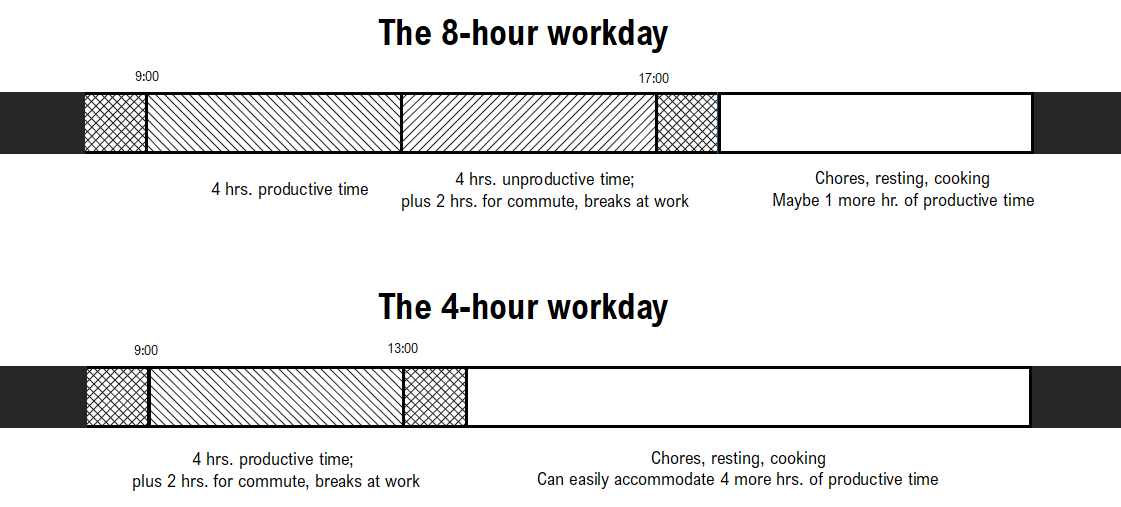
For those who need numbers, during a regular office day it is unlikely that I’ll be doing anything productive for more than 4 hours (either due to useless meetings or because of quiet quitting, loud socialising or medium-loud toilet sessions), followed by an afternoon where I am too drained to work on personal projects. This is, of course, nothing new under the sun—people finding themselves in unfair social relations have since forever used everyday forms of resistance to reclaim some time for themselves.[54] Not to mention how, as in most any office job, a lot of the tasks themselves are bullshit, so even the productive time does not always result in something useful.
If my shifts were shorter, I’d still put in the same amount of productive effort at the job but also have more strength for personal projects in the afternoon. As things are now, rarely can I squeeze in another hour or two of productive time after my office shift. Thus, we see that reforming employment will result in more work overall. The representation below should make quite clear what I mean. This is what a regular day for a corpo drone looks like, although it might apply to some other professions too:
How to fill all those free hours? I personally enjoy writing, but other people find fulfilment in gardening, repairing cars, building weird and fascinating things online or offline, dancing, sports, paintings and all other creative arts, brewing, cooking, and so on. If this short book was written in the little time salvaged here and there after work or on weekends, imagine how much better it could be if I had just one or two more free hours per day. Well, my talent as a writer would likely be the same—this is as good as it gets—but I’d have more time for tinkering. In any case, a better job-life balance will simply allow people to do more of the things they want to.
Not to mention how these activities are not only socially and individually useful because they make life better, but lots of them can be monetised too. Songs and videos will be shared on social media; art will be exposed in galleries; new products, recipes and ideas will become popular products. Most people with free time on their hands don’t loaf around all day long but do stuff. We already see how much tired people achieve in the free hours after work. Imagine how much more well-rested and happier people living in secure societies could achieve.
***
We have reached a point where many of us cannot imagine life without jobs or even what to do with more free time. And if you are one such person, don’t be too harsh on yourself. Jobs offer routine and the money to survive, but why should they also take our souls? Let’s be honest, we know that ‘‘above a certain level of income, GDP growth does not improve human wellbeing.”[55] We then live in this very odd system where so much wealth is created, with ever-increasing gains in productivity, but much of that simply does not translate into improved quality of life, not even for the elites.
But we might soon be forced to imagine just that. We can’t stop technological progress. Artificial intelligence and ever-better robots will most certainly be used to replace as many workers as possible. In some countries, this is seen as a demographic necessity.[56] When the mass layoffs come, what will you do with your free time? Likely die of hunger since you don’t own land and can’t farm, but that is not the topic of this book.
There is also a chance we’ll be ‘lucky’ and won’t have to actually imagine anything. After all, one solution to the issue of unemployment is to simply create more bullshit or entertainment jobs—think of the young Japanese people hired simply to bow in front of customers entering stores. Philosopher John Gray argues this is already the case in rich countries where “industrialisation created the working class. Now it has made the working class obsolete.” As such, “a thriving economy of psychotherapists, designer religions and spiritual boutiques has sprung up. Beyond that, there is an enormous grey economy of illegal industries supplying drugs and sex. The function of this new economy, legal and illegal, is to entertain and distract a population which—though it is busier than ever before—secretly suspects that it is useless.”[57]
However, it is just as clear that it does not have to be this way. Mass layoffs need not be so devastating. Quoting at length from David Graeber’s Bullshit Jobs, “There’s absolutely no reason it [mass unemployment due to technological advance] should have been a catastrophe. Over the course of the last several thousand years there have been untold thousands of human groups that might be referred to as “societies,” and the overwhelming majority of them managed to figure out ways to distribute those tasks that needed to be done to keep them alive in the style to which they were accustomed in such a fashion that most everyone had some way to contribute, and no one had to spend the majority of their waking hours performing tasks they would rather not be doing, in the way that people do today. What’s more, faced with the “problem” of abundant leisure time, people in those societies seem to have had little trouble figuring out ways to entertain themselves or otherwise pass the time.”
Philosopher Bertrand Russell would have agreed. He was not only a proponent of the four-hour workday, but in the excellent essay In Praise of Idleness, he wrote: “It will be said that, while a little leisure is pleasant, men would not know how to fill their days if they had only four hours of work out of the twenty-four. In so far as this is true in the modern world, it is a condemnation of our civilisation; it would not have been true at any earlier period. There was formerly a capacity for light-heartedness and play which has been to some extent inhibited by the cult of efficiency. The modern man thinks that everything ought to be done for the sake of something else, and never for its own sake.”
Russell was particularly piercing on this topic, so I feel obliged to gift you with one more of his thoughts on the matter: “When I suggest that working hours should be reduced to four, I am not meaning to imply that all the remaining time should necessarily be spent in pure frivolity. I mean that four hours’ work a day should entitle a man to the necessities and elementary comforts of life, and that the rest of his time should be his to use as he might see fit.”
To better understand what we could achieve with wise use of technology, we can simply look at the lives of past elites. Some “aristocrats and nobles, for all their obscene privilege and parasitic cruelty, did not spend their idle time staring at a wall. Many became:
-
astronomers,
-
composers,
-
philosophers,
-
inventors,
-
patrons of art,
-
obsessive collectors of everything from butterflies to languages.
They had time and security, and they filled that space with obsessions. We remember their names not because they had jobs, but because they had latitude.”[58]
This should be obvious, but I am not endorsing aristocracy or oligarchy. Indeed, authors like Bertrand Russell, who was born into the aristocracy, and J. M. Keynes, who was of a comfortable background and amassed huge wealth during his lifetime (even his detractors need to recognise that he was successful at least in this area of economics), both argued that the wealthy elites of the past mostly wasted their privilege.
Unlike the aristocrats of the past, we don’t need to achieve leisure by exploiting others. We already have the technology to give every single one of us security and decency. Workaholics need not worry—they’ll most certainly find their place in a more relaxed society. Nobody should stop them from breaking their back building some random stuff or filling out Excel sheets for hours on end if that is what they want. However, the fear that most people would just laze around if they had more free time and basic security is itself nothing more than a lazy assumption. Perhaps this rumour was started to keep the masses afraid and submissive, but quite a lot of decent working people repeat it too. Is it just another one of those unexamined pieces of ‘this is how things are’ folk wisdom? Or maybe a confession coming from people who are secretly lazy? Or is it some psychological defence for people who intuit they’ve wasted years on pointless work and can’t bear to admit it wasn’t all necessary?
Read more:
In Praise of Idleness by Bertrand Russell (1932)—article available for free at Harper’s Magazine.
Straw Dogs. Thoughts on Humans and Other Animals by John Gray (2002)—find the book at your local library.
Weapons of the Weak: Everyday Forms of Peasant Resistance by J. C. Scott (1985)—find the book at your local library.
The How
“If every Man and Woman would work four Hours each Day on something useful, that Labour would produce sufficient to procure all the Necessaries & Comforts of Life, Want and Misery would be banished out of the World, and the rest of the 24 Hours might be Leisure and Pleasure.”
Benjamin Franklin, referencing an unknown source
Compromise or barbarism
Let it be very clear: shorter working hours are just a compromise—and the main winners will still be today’s elites. This is for the very simple reason that this proposal does not fundamentally change the current system; it just brings more fairness and decency for the majority of people. This would allow parents to spend more time with their children; it would give working people time to actually enjoy their passions; it would make for a more relaxed world where people simply get more from life. But it wouldn’t fundamentally change the balance of power... and it doesn’t have to. Most people would be happy with more free time, decent salaries, stability and predictability in their daily lives!
Now, there are alternatives that would fundamentally change the current system, such as universal basic income or workplace democracy (more on that in a later chapter). But such changes would mean quite the huge societal shift, something that most people are not even able to imagine, not to mention strive for. At the same time, I am under no illusion that those whose current wealth and power were built on fundamentally barbaric practices will come to suddenly appreciate morality and democratise work. Similarly, change can be achieved via violent revolt, but such revolts are rarely successful and easily undermined (see the example of the Soviet Union). In any case, there is no reason to think that the rulers of today will follow in the footsteps of Gorbachev and think twice before shooting protesters. Not that Gorbachev was consistent in this; after all, he was the leader of the Soviet Union.[59]
Shorter working hours are realistically easier to obtain and benefit everyone: they offer a much-needed improvement in the lives of the working people, while elites maintain their status—or even see increased profits in some cases. This compromise avoids the violence of fighting, reforms the unnecessarily wasteful or cruel practices of today and makes for a more secure world—for business and for people alike.

The Who
“In opposition to the ‘gospel of work,’ I would assert the gospel of leisure, and maintain that human beings cannot rise to the finer attributes of their nature compatibly with a life filled with labor... the exhausting, stiffening, stupefying toil of many kinds of agricultural and manufacturing laborers. To reduce very greatly the quantity of work required to carry on existence is as needful as to distribute it more equally; and the progress of science, and the increasing ascendency [sic] of justice and good sense, tend to this result.”
J. S. Mill, The Negro Question (anti-slavery article from 1850)
Have you ever happened to read a book that made quite the persuasive argument for change, but offered little to no practical alternative to the status quo!? This sure happened to me when I finished Are Prisons Obsolete? by Angela Davis or the angry pamphlet Abolish Restaurants by prole.info. This is not to say that the two works were bad. On the contrary, they raised quite the uneasy questions about the way our world works. And let me be clear about it—that is more than enough. Not every book has to have practical answers; sometimes it is enough to raise a little hell… I mean, question normality.
I will try, however, to explore the practical side here, at least a little bit. I am no activist, but I know a thing or two about working, for I have had my fair share of jobs:
Physical work: I was a shepherd at 15 years of age; I smashed and gathered stones from the river to sell and make money to travel to high school (fortunately, school is free in Romania); I did various agricultural jobs in my teen years.
Service sector: During university, I was a waiter, general hotel worker, promoter, dishwasher, busboy (again, university is free in Romania… but living in the city is not).
Corpo jobs: call centre operator, content moderator and then trainer in the same project, technical specialist / analyst, online advertising specialist (I quit really fast from this one and never looked back).
After all this, I can confirm David Graeber’s observation: lots of managerial jobs are utterly unnecessary; a lot of corpo or service workers are forced to perform useless tasks; hard work and honesty are rewarded up to a point, but luck and breaking the law will usually count more if one is to join the ‘elites’; most workplaces are authoritarian and will either ‘break’ you like a horse or get rid of you unless you keep your head down.[60]
Without further ado, I have done the work; I have the blood of many animals on my hands and thousands of excuses (i.e., little lies) told to customers on my conscience. Both hands-on experience and my reading for this book made it clear for me: it is time to reform jobs.
Yes, this is a section about practical matters
“This work is ruining my body; I can’t remember the last time I woke up without back pain.” This is what my brother said to me a few years back. I can’t recall whether he was working as a lumberjack or on the meat-packing line at that time. Since then, he sometimes reminds me to be grateful for my cushy corpo job where, in his words, “you just sit all day long on a comfy chair and press random buttons on the computer.”
My brother is, of course, mostly right. What he’s not aware of, however, is that office jobs are slowly eroding the minds of those who have to do them. While physical jobs destroy your body, corpo work often does the same to your mind. Something else he doesn’t know is just how to improve things and make jobs fairer and better for everyone. But he’d gladly have four- or six-hour shifts become the norm.
Where is the four-hour day most needed?
There have been many pre-eminent voices and visionaries calling for a reduction of employment times. Let me refresh your memory: philosopher Bertrand Russell believed that a “moderate amount of sensible organisation” was all it took already in the 1920s to achieve the four-hour workday; the economist John Maynard Keynes, in 1930, imagined a future where technology could easily allow his grandchildren to spend no more than 15 hours a week at work; anthropologists such as David Graeber remind us that human societies did manage to be successful while working much less than we do.
Even though we know for sure that we can already implement four-hour workdays with the technology of today,[61] it is still difficult for many of us to imagine how the whole of the economy could be restructured. There are, however, some specific cases where cutting the workday in half is not just a theoretical possibility but a most obvious necessity! These are jobs so physically taxing or mentally traumatic that no human should be forced to do them for an extended period of time.
I was working for about two years in the content reviewing industry. Luckily, the project I was assigned to contained little disturbing imagery. However, in the same team we had people working with egregious videos of sexual acts and violent imagery. They had to filter the most vile and perverted content on the internet from being uploaded to a popular platform! Thankfully, they only had to do this for five hours and were obliged to spend the remaining three hours in the office resting, reading or talking with a mental health specialist if needed. This was most certainly due to the kind working laws in Poland. Unfortunately, there are reports of workers from India or Kenya who have to watch the worst of human behaviour for ten or more hours a day!
Other examples abound: think of work in large-scale animal farms, meat-packing plants and slaughterhouses; such occupations are so mentally or physically damaging that nobody should be doing them for too long. Or consider certain assembly line, fast food and warehouse work that can be incredibly dull, soul-sucking and even demeaning. And no, it is not because the products made are not useful—many of them are, or at the very least, people want to buy them. It is rather because of the long shifts and bad working conditions that are so harmful for employees.
If something needs to be done, let’s properly pay and care for the people doing it. If it is not useful, let only grifters bother with that. Asking someone to work for eight+ hours a day in a slaughterhouse or factory should be a bad joke or the plot of a cheap horror movie, not something millions upon millions of people are forced to do every day. If billionaires like the current model that much, let them do the same mind-numbing task for eight hours every day. But we need to stop forcing people into such unhealthy toil for that long.
When faced with the demand to reduce work time, some employers move their companies to countries with poorer workers’ rights or prefer to hire immigrants who do not know their rights, are afraid to contact authorities and hence are easier to overwork. This is, of course, not a real solution, since the problem is not solved, merely relocated. And yes, dramatically cutting working hours can successfully be done on a large scale too, as shown by the UK in 1974, when the country adopted a three-day work-week for the first two months of the year!
Back then, the country faced a shortage of electricity because coal workers were protesting inflation. As a result, the government decided to implement a three-day work-week between Jan 1st and Mar 7th. While most everyone expected an economic disaster, it turns out that productivity decreased only 6% during that time.[62] And that happened during a time of crisis—imagine if we actually tried to organise things properly.
Two easy alternatives: the four-day week and the six-hour day!
Wherever cutting the workday in half is not possible, there are two readily available alternatives that should be much easier to implement, especially for larger companies or state workers. These are the six-hour workday and the four-day week. We’ve already seen in a previous chapter that the former can be implemented in practice and increase productivity, so let’s look at the four-day week here.
In 2024, one of Poland’s oldest companies, Herbapol Poznań, transitioned to the four-day work-week. In the words of Tomasz Kaczmarek, the president of the company’s management board, ‘‘The principle we followed was: the employee can only gain from this change, and the company cannot lose.” A news source mentions that, ‘‘while at first Herbapol’s decision was met with criticism and scepticism, also among some employees, it resulted in lower employee turnover, less absenteeism, and the company’s best financial results in many years.”
Even better, the government of Poland has announced a four-day work-week pilot programme, starting in 2026, becoming yet another European country officially experimenting with such a work reform. In the words of Agnieszka Dziemianowicz-Bąk, “More than a century after the introduction of the eight-hour working day, Poles are definitely working more efficiently, better and smarter. It is time for them to start working less”.[63]
Poland is not the only country considering such a change. Pilot programmes have been seen in France, Germany, Iceland, Canada, Denmark, New Zeeland, Gambia. In a recent UK trial, most of the companies that experimented with a four-day week decided to continue with this model of employment after the trial ended. Out of 61 companies, 56 extended the four-day work-week and 18 made it permanent. The usual results followed: improved well-being among employees, with 39% reporting lower stress levels and 71% experiencing less burnout; meanwhile, employers saw their profits increase. Take also the famous case of Microsoft Japan, which saw a 40% productivity increase for employees who worked four-day weeks.[64]
The above examples come mostly from organisations promoting the four-day week, but they are supported by scientific evidence too. As far as current research shows, the shift generally improves worker morale, health, and overall job satisfaction. Although sometimes employees can feel more pressured, companies usually see higher employee retention. Productivity metrics are generally found to increase or the change to be inconclusive.[65] Even if productivity does not increase, the above-mentioned benefits should make up for that. The four-day work-week can most readily be implemented in bureaucratic or other state jobs. Many corpo jobs can also easily transition, but those that demand 24-hour support might find a switch from 3 shifts to 4 shifts difficult.
If you are a worker, try talking to your manager about this organisation (of course, only if this is something you can safely do) or consider joining one of the few companies that offer the four-day week. If you are a company owner or have a leadership position in your organisation, consider contacting the 4 DAY WEEK GLOBAL organisation. They offer really cheap courses and implementing at least some of their findings can increase productivity plus employee retention and satisfaction.
Go to www.4dayweek.com for more info.
A moderate amount of sensible organisation
We have seen that the four-hour workday can certainly be implemented in some areas. We have also looked at two alternatives: the six-hour workday and the four-day work-week. Of course, these options cannot fit for all occupations, especially when it comes to jobs that require workers to be present at the post for a long time or that see activity only for a few months at a time. These include bartending, waiting, cooking or other service jobs, nursing, work in retirement homes, and other hospital work.[66] Some corpo or mass-production jobs might fit this category too.
There are, however, other arrangements than can be put in place, and we know this because it is already happening. These include seasonal work in agriculture or tourism; teaching jobs with long summer holidays; and short-term deployments, such as offshore oil rigs jobs. The latter are examples of professions where long holidays are already an established practice.
As long as there is a will, solutions will be found. In the rest of this chapter, let’s look at some challenges. There are three main areas where work reform in the shape of a four-hour workday or similar can be readily implemented: factories and other organised physical labour; state jobs; and corporations.
When it comes to factory work, deposit jobs, large-scale agriculture and other organised or assembly-line work, transition can happen easily due to how specialised such workplaces tend to be. It would not make such a big difference if such factories had the eight-hour shift replaced by two four-hour shifts. The real issue is that such jobs do not usually pay well enough for workers to afford a decent living with shorter-shift salaries (indeed, in countries with cheap labour, workers often have to clock in much more than eight hours for a survival wage).
This might not be an easy issue to fix when it comes to small employers, but paying better wages should not be a problem for larger companies. In any case, higher wages would be a historical justice too. A certain chart has been making the rounds of the internet for many years now, and for good reason. It shows how the productivity of US workers has doubled since the 1970s, but the hourly pay has grown just a little. Curiously, at the same time, CEO pay went up 997%, while the typical worker’s pay only increased about 10%.[67]
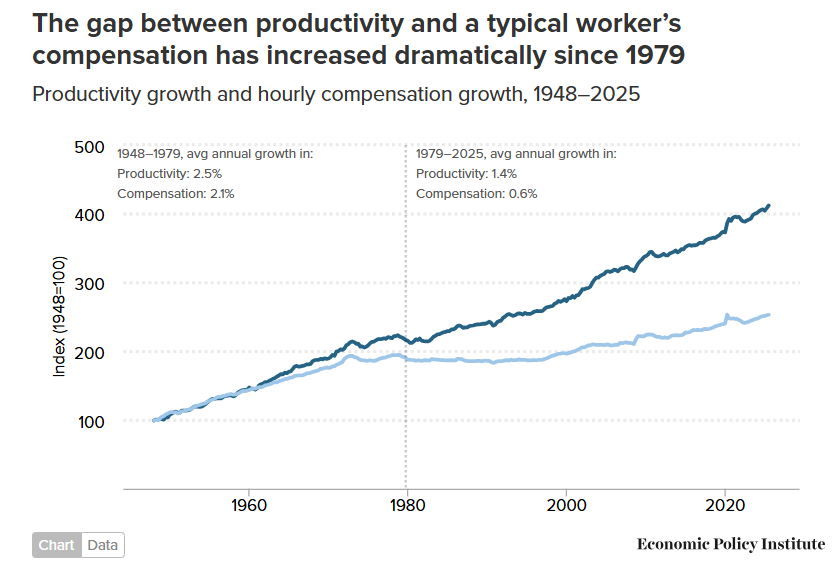
We have seen that in specialised physical work, the issue is not about organising work for shorter shifts but rather about ensuring decent compensation. While corporate work faces this too, an even bigger issue might be the amount of bullshit built into the system. Many a corporate worker suspects that a lot of what they do and, especially, what other employees do, is utterly unnecessary (there are managers who create meetings and ‘improvement plans’ just to show they are doing something; analysts who write reports and presentations that nobody will read; workers that enter data in Excel files nobody will ever use; customer support agents telling hundreds of customers daily that issues with the product will be fixed even though they know the corporation does not care enough to actually solve the issue).
Admitting the bullshit nature of tasks or even entire jobs in corporations is something a surprising number of people are frank about, even when their salaries depend on them not doing so. Perhaps because change is on the way—AI can take over such tasks and thus pave the way for shorter shifts. Another relatively easy fix has to do with corporate culture: in the worst corporations, employees are highly supervised, and toxic work relations quickly become the norm, which translates into high turnover or health problems. And how can it be otherwise when you force people to dedicate eight+ hours to unpleasant intellectual work!? Current corporations produce sadists, depressed people, loafers and social media addicts. No wonder burnout is on the rise. It is high time we solved this. Improving company culture is a much-needed change here, since this is something that even shorter shifts cannot fully solve (although spending less time in a place that makes one ill certainly helps).
The third area to look at is government employment (bureaucrats, clerks, teachers, etc.). The important advantage here is that a government can implement reforms for a whole country, as opposed to private employers that are limited to their own companies. But herein lies the biggest challenge too: the next leader might just as ‘easily’ change things. Take the tiny nation of Gambia, where between 2013 and 2017, public workers had a mandatory four-day week, from 08:00 to 18:00, Monday to Thursday, for a total of 40 hours. This was changed by the new government to a 36-and-a-half-hour work-week, with the half day being on Fridays.[68] Politics aside, if the salaries stayed the same, I believe workers from other countries would gladly embrace either of these options.
We need to simply organise things better. The current system is so incredibly wasteful that we don’t even have to, God forbid, change it fundamentally. Reducing work time for tiring yet necessary jobs and cutting the bullshit from otherwise decent jobs is a good start. Simply reduce some of the waste, make other things run smoother, give more free time and resources to the average Joe to build a decent life—and there you have it.
Read more:
21 hours. Why a shorter working week can help us all to flourish in the 21st century—report by the New Economics Foundation (2010), available for free at neweconomics.org.
4Day Week Global offers solutions for companies that consider implementing the four-day work-week.
Utopia for Realists by Rutger Bregman (2016), especially the chapter “A 15-Hour work-week”— find the book at your local library.

Can we do even more? A post-jobs world
Some readers might be disappointed by the reform proposals from above, but that was the whole point of the book: to defend meaningful change that can easily be achieved in practice and doesn’t require an outright war with the current ruling classes. Or does it? Why don’t we have fair work conditions already?
Wait, those were not the questions for this book! Rather, what if we demanded more? What does a fair world really look like? As already mentioned in this little book, most people around cannot imagine substantial change anymore. However, there are still lots of philosophers, politicians, dreamers and artists who try to see past the machine. Let me share the vision of solarpunk[69] writer Antonio Melonio:
1. “Decouple survival from employment.
-
Universal basic services: housing, healthcare, education, public transit, internet access as rights, not products.
-
Income floors: UBI or negative income tax or whatever configuration works locally. The point is: no one should be blackmailed by hunger into pointless labor.
2. Shorten and soften the remaining work.
-
20–30 hour weeks, distributed.
-
Rotating, voluntary participation in necessary but unpleasant tasks, mediated by tech and compensated fairly.
-
Labor law that treats burnout as structural violence, not individual weakness.
3. Democratize the machines.
-
Public or cooperative ownership of major AI and robotics infrastructure.
-
Taxation of automation gains, funneled back into the commons.
-
Open-source models, citizen labs, community computing centers.
4. Build new temples of meaning.
Not religious temples (though those will exist too) but civic ones: libraries, makerspaces, research hubs, local observatories, theaters, clubs, gardens, game dev collectives. Places where prestige does not come from profit, but from contribution, invention, care.
5. Normalize non-productivity as a virtue.
Leisure is not sin; it is the condition for thinking clearly. Time spent staring at the sky, at the sea, at a blank page, is not “wasted.” It’s where philosophy, art, and everything else that has a soul comes from.”[70]
Is that the sketch of a perfect world? No, so many things could go wrong in that scenario too, not to mention how ideals can easily be betrayed. In any case, we are still free to dream. What else are you gonna do? Work for the whole 8 or 10 or 12 hours the boss expects of you? Screw that, you are not paid enough for that anyway…
Now, on the surface, such lists may seem to be about technology, but in truth they are rather about organising the resources we already have. And we had both technology and resources for quite a while.
Consider the example of Norman Borlaug, who developed genetically modified crops—especially wheat—with the hope of ending world hunger, alleviating poverty and freeing peasants from the drudgery of farm work. And while his crops were extremely successful, the impact of his work was far from what he desired. Despite the increases in crop yields, two out of eight people worldwide still face food insecurity; indeed, we feed factory farms instead of humans;[71] the food production system is very wasteful;[72] poverty is still widespread; many a small farmer has been forced off their lands by corporations; and the biggest winners from these developments seem to be large agricultural and biotech companies.[73]
There are many past examples of visionaries and inventors who hoped technology would solve important human needs. But as philosopher John Gray notes, moral progress does not stack up over time, like technological or scientific progress. The same moral dilemmas remain for each generation to ponder and act upon.[74] Robotics and AI are quickly changing the mechanical and informational landscape and, indeed, the way we live our lives, if only because of the great impact they are predicted to have on jobs.
Will we be able to use new technology better than our ancestors? The most obvious answer to this is that some people will, while others will not.[75] We already see dictators and oligarchs using it for harmful purposes. But, at the very least, there are visions like the one listed above that show the immense potential for good these technologies have. While some past societies managed to achieve quite a lot of the points from that list simply by organising things better, it might very well be that our global civilisation of today can only do that via the use of increasingly complex technology.[76] Time will tell; until then, we’d do well to remember the old saying: hope for the best but prepare for the worst.
***
This is the right time to introduce two concepts: universal basic income and workplace democracy. These two ideas propose important changes to the way we live currently, with the first being mentioned in the list above. Since the goal of this book is far less exciting, I will just briefly describe them in the hope this will inspire the reader to learn more about the topics. The most important takeaway is that both of them have already been successfully tested in practice, so that is out of the way already.
Universal Basic Income (UBI) is not the great equaliser that some people fear but simply the antidote to the artificial scarcity of today. In short, UBI is an unconditional, universal, government-guaranteed regular cash payment. Countless studies have found that such a system reduces poverty, increases the economic activity in the tested areas, and improves the skills and educational level of the recipients. A 2008 programme in Uganda delivered about $400 to 12,000 young men. “The money was all but free; the only thing they had to do in return was submit a business plan. Five years later, the effects were staggering. Having invested in their own education and business ventures, the beneficiaries’ incomes had gone up nearly 50%. And their odds of getting hired had increased more than 60%.”[77] Similar good results have been seen in trials from India to Canada, from Liberia to the UK and the US.
In such a discussion, there are two unavoidable topics: do people ‘deserve’ free money? And can this work in practice? We’ve got so used to thinking that humans do not deserve to live decent lives unless they work hard (=suffer), that we are often blind to ways in which we can actually improve human wellbeing. Indeed, UBI would bring about a much fairer system than the current one. In truth, it might be the only way for employment to ever be fair![78] If you are allergic to moral arguments, UBI increases economic productivity and has a very good effect on wellbeing—and healthy, industrious societies tend to create more wealth.
As for the practical side, it is clear that UBI will cost a lot! However, this should not sound so scary for people who live in countries that provide child benefits or pension plans for the elderly. We could say they already have a kind of UBI for 2/3 of the population—it just needs to be extended to the other 1/3 of the population, i.e., working-age adults. As for the fear that the many people will squander the money on alcohol or other undesirable things, that is fine too, because a good chunk of that money will come back to the government in the form of taxes. Take the example of Ireland, which offered a €325 weekly income to some 2000 artists for three years—the programme has been extended because it became clear that it created more wealth than its net cost.[79] While we might devise intricate programs to make sure squandering does not happen, simply giving the money is likely the better option because enough people will use it in smart ways and we won’t need to hire an entire bureaucracy to monitor the rest.
The bigger danger might actually come from landlords and grocery stores who could immediately raise prices. One way to solve that might just be UBS—Universal Basic Services—that is, as the name implies, to make “housing, healthcare, education, public transit, internet access as rights, not products.” Challenging as these universal safety nets appear, they might soon become an economic necessity if AI, automation and robotics evolve as fast as predicted and replace 80% of the jobs. In such a scenario, without UBI or UBS, there would be nowhere to go, nothing to do, and no one to buy whatever robots and AIs will have to sell.
The main issue for poor people is a lack of cash for the basics; instead of doing something more ‘productive’ with their lives, they have to use the greater part of their time trying to get money in order to afford food, clothes, rent.[80] How many great inventions or works of art have not been created because of that? How much human potential from an economic or political point of view is similarly lost because poor people do not have the time or cash to pursue higher callings? Indeed, this phenomenon is called ‘the lost Einsteins’. Innovation is the engine of economic growth and financial stability is the key to greater innovation. “Children with parents in the top 1% of the income distribution are ten times more likely to become inventors than children with below-median income parents.“[81]
Virginia Woolf’s dictum from a hundred years ago is as relevant today: “A woman must have money and a room of her own if she is to write fiction.”[82] Indeed, anyone who wants to achieve anything will find it much easier to do if they don’t have to struggle from dusk till dawn for the basics.
***
Democracy is such a beloved concept in our times that even dictators like to have it in their countries’ names. Curiously though, we get so little of it when it actually matters, hence why so few people have even heard of workplace democracy. This is a part of the larger concept of direct democracy (citizens participating directly in political decisions) and should need no explanation, but the fact is that we are not used to seeing this as an alternative to the current model of representative democracy, in which citizens vote for politicians and grant them power.
When people first hear about direct democracy, they believe it only worked in some small ‘tribes.’ But it can most surely be practised on a large scale, with Switzerland being the go-to example. In there, regular folk have a much stronger voice in local politics and national referendums for important decisions are common. What about the rest of the world? Even in free countries, most of our waking lives are spent in outright authoritarian institutions (schools, churches, the army, workplaces and sometimes even the family). Thus, we get to experience democracy as voting once in a while. But is five minutes of democracy every four years really what we ought to settle for?
Look at a regular workplace: decisions are passed down, and, if you’re a worker, you’d better obey... or find another job! Those lucky enough to work in a ‘woke’ country or friendly company might get to complain about the bosses’ decisions but, at the end of the day, will still bend their heads and do what they are told. The absurd irony of it all is that teamwork is what actually gets things done much faster and better. Workplace democracy can correct the many contradictions of today’s workplace. Important matters will then be voted for or decided by consensus. For many, this already sounds like the plot of a bland utopian short film, so let’s take a look at the very real example of Mondragon Corporation.
Founded by a Basque priest in the 1940s, the company is among the largest in Spain and employs over 70 thousand people. It takes workers’ needs seriously because, well, workers have a lot of control over the direction of the company. For example, salaries are voted for, and Mondragon executives earn only five times more than the minimum pay for regular workers. The president of the corporation only earns six times more than a regular worker. For comparison, the pay of other CEOs in large corporations is 600 times bigger. It can get even worse—take the Starbucks CEO’s $96 million pay cheque, which is 6666 times bigger than that of a regular employee![83] In such a world, Mondragon sounds like a miracle. But there is nothing miraculous about it. This is simply fairness.
The story of Mondragon has some lessons. The first is that sound morals (in this case, Catholic and humanist) can be applied in a capitalist environment, but this is a conscious choice to embrace social responsibility and not only cold, bloody, financial profit. The second lesson is that corporations where workers have real control can be successful and competitive on the market. The last, and perhaps the most important lesson, is that workplace democracy can be successfully implemented in large-scale institutions.
We’ve seen a successful large-scale example; there are also small businesses that practise forms of cooperative work, ranging from family-owned ‘mom and pop’ shops to community projects, worker-owned businesses and more. We became so used to being ordered around that the very idea of actually having a say important in matters sounds off. Of course, workplace democracy can be tiring or frustrating at times; there’s no denying it. And of course, there can be some comfort in just following orders. But I wager the frustration of having to follow orders no matter how dumb they are is even worse—it is outright dehumanising!
Read more:
The Era of Jobs Is Ending by Antonio Melonio (2025)—article available for free at Wayback Machine archive.
The Discourse of Voluntary Servitude by Étienne de La Boétie (1577)—free on the Internet Archive and other online spaces.
Why WORKERS Should OWN Companies—video by The Market Exit YouTube channel, 2025.
Neo-Abolitionism: Abolishing Human Rentals in Favor of Workplace Democracy by David Ellerman (2021)—find the book at your local library.

Goals for activists
Despite taking part in a few protests and marches, I cannot call myself an activist. People with hands-on experience in political activism would do a much better job at preparing an action plan, so I will just share a few ideas on the topic instead.
Perhaps the most important is to have very clear and achievable goals. You wouldn’t want a great campaign to fizzle out for lack of tangible goals.[84] Sure, everyone should feel moral indignation in the face of unfairness, but that is simply not the case. So activists have to also open doors to new possibilities; those who only make noise are easier to dismiss than those who actually come prepared with clear alternatives. And, in any case, whom should we expect to think of alternatives? Certainly not the people who profit from exploiting other humans (and animals)!
It is no secret that a four-hour workday will be difficult to achieve under current conditions. There are, however, easier goals within reach:
-
Reform the eight-hour day (include commuting & breaks in the eight-hour shifts; push for laws that limit overtime work; promote a minimum salary that keeps up with inflation).
-
Promote work reform worldwide, but adapt the message to local pressure points.
-
Similarly, support democratic economic unions like the EU, as an alternative to imperialism and the bullying of small countries by big ones.
-
Advocate for more freedom for creative work (a results-driven model instead of forcing workers to be in the office every day).
-
Reduce the number of working hours (or days) for physical work or professions where the mental strain is great (slaughterhouses; assembly lines). We are not robots. There is no reason to put at risk the mental and physical health of so many people.
-
The universal basic income is controversial, so you might want to instead promote universal basic services as a pragmatic stepping stone towards UBI.
-
Activists so inclined should become involved in politics; the rest of us ought to always vote for the people who are likely to bring positive change. The activists of today need to organise and become the politicians of tomorrow.
Again, the four-hour workday might be just an ideal, but there is a good reason to ask for it. As a Romanian saying goes, ‘The begging hand that tells no story will receive no alms.’ Campaigning towards the four-hour day is unlikely to succeed unless a lot of other social and political factors are favourable, but it will pave the way towards other reform ideas mentioned in this book.
Finally, do not give up. The classic strategy of politicians opposed to social reforms is to contain, wait or buy off protests. Have patience, persevere and remember that all social rules and legal codes are in a state of constant renegotiation. And if they totally abandon you, learn from FaSinPat.[85]
***
When talking about activism, the subject of violence and illegal actions is bound to surface. So then—are violent, disruptive activities necessary?
From the point of view of the state, the answer is always a resounding no. And that is because in contemporary states, there are usually rules in place for the right to gather, organise and protest. As any intelligent reader already intuits, the big issue here is that such polite, docile marches and gatherings are very easy to ignore by those in power. There are, of course, countries like Russia that jail or kill even peaceful protesters, but the more common response from politicians is to ignore the matter or promise changes that will never be implemented.
Now then, is violent protest necessary from the point of view of regular people? Some of you would be surprised, but it usually takes a lot of suffering and unfairness before they choose drastic measures. Anthropologist David Graeber thinks regular people are often nicer than those who hold power:
“Feminists have long since pointed out that those on the bottom of any unequal social arrangement tend to think about, and therefore care about, those on top more than those on top think about, or care about, them. Women everywhere tend to think and know more about men’s lives than men do about women, just as black people know more about white people’s, employees about employers’, and the poor about the rich.
And humans being the empathetic creatures that they are, knowledge leads to compassion. The rich and powerful, meanwhile, can remain oblivious and uncaring, because they can afford to.”[86]
If this is so, the pensive reader will notice a paradox: those in power are willing to use violence while regular folk are more averse to it, even though it should logically be the other way around.
In the spring of 1907, Romanian peasants revolted for the same reason that so many other peasants did throughout history: land, or more precisely, lack of land, since the vast majority was owned by a few ‘noble’ families and other large landowners. The Romanian army suppressed the protests by killing more than ten thousand people — in a country of fewer than seven million, mind you. Besides the obvious, another lesson of peasant revolts is that they are usually unsuccessful, unlike revolutions led by the second or third echelon of the upper classes, which tend to have a better chance of succeeding.
State violence doesn’t mean just the arrest or killing of political opponents and protesters—that is just the most obvious manifestation. It also means denying basic human rights; forcing people to work long hours for low wages; intentional neglect of certain communities; the building of strong military, police and surveillance systems meant less to fight crime and more to prevent any sort of unrest or challenge to the rulers.
Ever so often, things get so bad that the masses do rise. And it usually takes a great deal of courage or desperation for a regular person to do so because modern police and military forces have tanks and guns. A group of mediaeval peasants could ambush knights in armour and defeat them with some pitchforks and axes. Compare this to facing a modernised police or military force willing to shoot to kill.
From the point of view of activists and people who would prefer not to be killed by the armed forces of their own countries, there are two ways out of this dreadful situation. The first is to promote direct democracy as much as possible: the best example of this working in practice is Switzerland. In such a case, violent protests will rarely be needed since the populace already has political power and can exercise it to affect change.
Another solution is to cultivate a strong culture of protest like in France or Greece: that is, whenever a large group of people gather, politicians and businessmen should start sweating and feel true fear on the back of their necks! Again, kind, good-natured people might not like this idea, but that is often because they fail to understand the nature of today’s politics. To simplify, in democracies, politicians receive a monopoly on violence and power from the people, but when they use said power and violence against the people they are supposed to represent, they have to face consequences.
To be clear, I do not advocate for violence, but I do advocate for disruptive protest. I also believe that regular working people have a right to defend themselves against abusive state or corporate power. And the history of workers’ rights shows that the rights we have today were not won by asking nicely, but by disrupting economic life, by defending against police and thugs hired by oligarchs, by threatening the powers that be with real consequences. I also believe that in the majority of cases, violent protest is simply a response to state violence or unfairness.
Do I expect the four-hour workday to be won like that too? No, not really. Most people are content with the eight-hour day, as long as the salaries afford a decent lifestyle. And, at least in the European Union, things are not so desperate for large-scale protests against the current employment model to arise. This might change if automation goes on to replace 80% of the jobs, as the salesmen of AI and robotics (which also happen to be our tech overlords) insist will happen in the next 20 years or so. In such a case, the four-hour workday will simply become an economic necessity. Otherwise, increasing automation will result in mass layoffs and desperation; the protests born of it might lead to real employment reforms. But they might also just result in the creation of bullshit jobs for everyone. Time will show.
Read more:
Ethics Into Action: Henry Spira and the Animal Rights Movement by Peter Singer—find the book at your local library. A free documentary narrated by Singer is available on YouTube titled Henry: One Man’s Way.
Possibilities by David Graber—find the book at your local library. See especially the essay “On The Phenomenology of Giant Puppets: Broken Windows, Imaginary Jars of Urine, and the Cosmolgical Role of the Police in American Culture.”
Swedish syndicalism. An outline of its ideology and practice by Rasmus Hästbacka (2024)—available for free at the Umeå local union website and other online spaces.
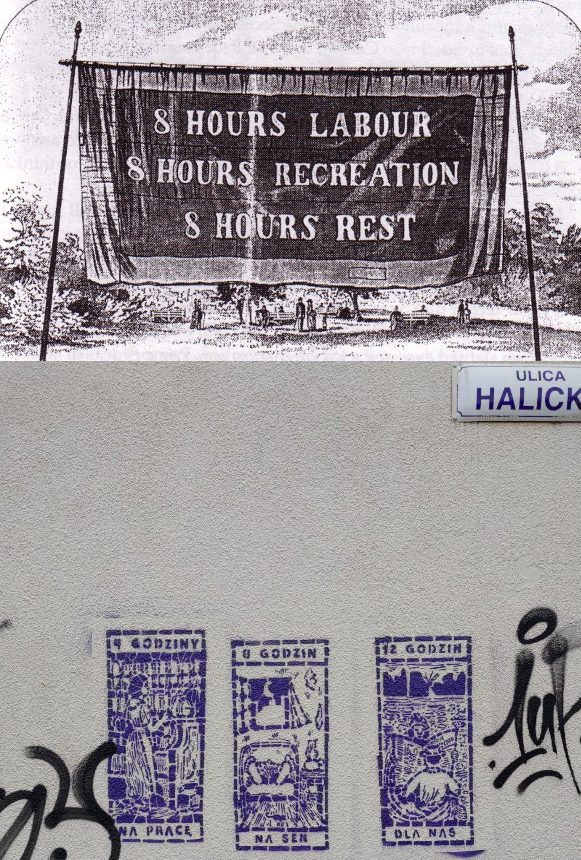
How can employers contribute?
A widely misunderstood quote is Assata Shakur’s, “Nobody in the world, nobody in history, has ever gotten their freedom by appealing to the moral sense of the people who were oppressing them.” The point here is not that violence is the only path towards social progress. The larger message is that we need to act if we want change—and this can mean any kind of disruption, from legal means and peaceful protests to more creative measures that actually inconvenience those in power and make them lose money.
Now for an even more daring claim: appealing to the moral sense of the ‘elites’ can actually lead to positive change, and that is for many reasons. Sometimes people in positions of power simply do not have enough information or don’t bother to care, but when made to consider the reality outside their mansions, some of them will change their ways. Similarly, the elites are humans like all others, and not only can they be part of the change for good, but they should use their influence to do so.
We should not forget that a lot of influential people were born into wealth but chose to take the side of the weak: revered religious figures such as the Buddha are known for abandoning a life of luxury in order to seek a higher meaning; Tolstoy was a Russian noble who chose to be a vegan, a pacifist and to free his peasants from serfdom; Russell, though of aristocratic descent, promoted the idea that everyone deserves leisure, not only the rich. There are also lesser-known examples from our time—think of employers from countries like India who do not force workers to give more than 40 hours a week, even though they could legally do it.
Of course, for every good example there are thousands of bad ones. But the point is that today’s employers can be part of the change. They do not have to become philosophers or devote their lives to non-violence. Rather, they should use their position of power to improve the lives of the people directly dependent on them. This is no call for self-sacrifice; it is just basic human decency and personal moral responsibility. It simply means to use one’s position in life in such a way that it improves or at least does not damage the wellbeing of others. For those allergic to moral talk, it is worth mentioning that it simply makes for a very good image to treat workers well—there is a kind of social respect or even adulation that violence cannot buy.
Employers and the rich are part of our societies. And this comes with certain expectations, not only benefits. It is expected of regular people to work and respect the law, so the most basic requirement for an employer is to treat their workers well. Unless an employer is able to do that, they are failing at their responsibilities and should not have people under their command. So what are employers to do in the context of the four-hour workday? Here are some ideas:
-
Include commuting & breaks in the eight-hour workday. Give extra pay to the workers who have to travel to the job during nighttime.
-
Reduce the working time when possible. If the workday is currently longer than 8 hours, for example, cut it to 8. (I sure hope my employer is reading this and will give me back my 30 minutes...)
-
Stop forcing people to do bullshit tasks. If an occupation has dead hours, do not have workers do useless tasks. I am talking about restaurant owners who force waiters to clean already spotless tables instead of allowing them to relax during downtime.
-
Employers and managers should consider the fact that more humane working arrangements are freeing for them too, not only for the workers. Generally, try to emulate proven Scandinavian workplace practices; shorter hours and stronger trust result in higher productivity.
-
If you are from a country where the eight-hour workday or the five-day work-week are not yet the legal standard, do try to implement these in your business. Lead by example!
To this we have to add that managers, CEOs and a lot of the rich are themselves born in and victims of the toxic work culture of today. These are often people of great talent that are using their lives in such bad ways. Imagine if all those hard-working managers in corporations that answer emails at midnight actually did something useful with their lives. And yes, they often are insufferable bosses. But it doesn’t change the fact that they are a ‘resource’ our civilisation greatly misuses, and many of them are ‘suffering with a smile’.[87]
Some of you will argue that all this—the excesses of the rich and the blatant misuse of talent we see today—is simply the logical outcome of capitalist ideology. But a more accurate diagnosis might be a lack of ideology altogether. You see, too many influential people act basically like the mafia. And this should not be at all surprising; after all, these people spend so much of their time trying to acquire power and then hold to it that they simply do not have the capacity to read some books and stand for a coherent ideology. No wonder that when oligarchs or dictators try to speak about history and philosophy, it usually sounds like a complete mess. Anyone with a bit of self-esteem would not embarrass themselves talking about subjects they can’t master, but in their pursuit of power, many of today’s ‘elites’ don’t bother with humility or actually learning a thing or two. We then need more ideology, not less.
***
I want to stress once again the importance of politics. There is just so much a good-hearted manager, CEO or even oligarch can do. For example, the reason why I enjoy 26 days of paid annual leave plus 14 more days of paid national holidays is not because the American company I work for decided to set these numbers as a ‘benefit’. No, it is because of labour laws in Poland (as opposed to, say, the US, where public holidays are not paid and there is no mandatory number of holidays, as far as the internet tells me)! This is why, remember, if you are not interested in politics, your employer probably is. Oh, you think your job is safe because you have fewer holidays than me so that you bring more value to the company? Are you really so lucky to have an employer that does not think of replacing you with AI or someone who’ll do the same work for less money?[88]
Politics is important because the power of bosses and managers is often limited too. The book Eating Animals illustrated that very well in the context of factory farming, a practice that most people do not like, yet it is still prevalent. What happens is that “we give over immense moral and financial muscle to a small number of men who even themselves have limited control over the machine-like agribusiness bureaucracies they administer to immense personal gain.”[89] As such, we cannot really count on the managers to improve the treatment of animals because of the limited power they themselves have in the face of the profit-hungry machine they serve! This, of course, would not be the case if the law only allowed for humane treatment of farm animals.
The same with working arrangements—good laws prevent abuse; they prevent the worst practices and take power away from arseholes. Good laws, when implemented, lead to healthy workplaces, help create safe countries and allow honest people to shine. Incidentally, Henry Ford’s inspiration for the assembly line was a slaughterhouse.[90] No wonder such work is dehumanising if done for too long. Let’s hope the Fords of tomorrow will be inspired by more humane practices and promote the four-hour workday!
Read more:
Why the Poor Don’t Kill Us by Manu Joseph (2025)—find the book at your local library.
Eating Animals by J. S. Foer (2009)—find the book at your local library.
Benefits and doubts
There are many counterarguments against the four-hour workday and work reform in general; sadly, instead of being challenging, they are mostly disappointing. You see, such arguments usually fall into two categories, those that say change is difficult or even impossible to implement and those that caution about the unintended consequences change might bring.[91] Here are two examples of the second:
“Of course, there is a humanitarian side of the shorter day and the shorter week, but dwelling on that subject is likely to get one in trouble, for then leisure may be put before work rather than after work—where it belongs.” Henry Ford
“There is no reason for believing that more leisure would ever increase the desire for goods. It is quite possible that the leisure would be spent in the cultivation of the arts and graces of life; in visiting museums, libraries, and art galleries, or hikes, games and inexpensive amusements. If the cult of leisure should result in the cultivation of Gandhiism, humanism, or any of the highbrowisms, it would decrease the desire for material goods. If it should result in more gardening, more work about the home in making or repairing furniture, painting and repairing the house and other useful avocations, it would cut down the demand for the products of our wagepaying industries.... The question in the broadest aspect is simply this: ‘do we prefer to take our increasing prosperity in the form of more goods or more leisure?”’ Thomas Nixon Carver
No honest person will deny that it is right to worry about practical matters. However, if there is a why, we will find a how.[92] Humans can achieve so much when they work together: we have built the pyramids, trains, parks, huge cities, the incredible infrastructure that allows for the global trading of today, rockets to the moon and back, and so much more. So we can just as well build a world where no one is forced to be employed for more than 20 or 30 hours a week. We have good enough reasons for that—we have the why. What’s left is for enough of us to want it, and soon the how will follow.
Now to the unintended consequences—as with any change, it is good to be careful, but caution for caution’s sake is an impotent argument. Reading about the matter, one is bound to encounter ideas such as that workers will not know what to do with their free time; that the poor will become lazy and vicious; or even that society will collapse, that anarchy and violence will result when the population is no longer busied with work. Such a way of thinking is not only demeaning to hear from humans about humans, but it raises a very uncomfortable question. If the current system can only be maintained by forcing the masses into arduous and often useless toil, is it even worth keeping it?
As for the chance that many people might ‘waste’ their free time, wouldn’t it be better to prepare ourselves and our societies properly for that? Imagine if someone argued that we have to send young men to war so they can exhaust their natural energy and inclination to violence! No serious person will buy such an idea (I hope), especially when we know that young men can just as well use said excess of energy for sport, physical work and a host of other activities. The same when it comes to employment. Reformers in the US a hundred years ago built libraries and parks and helped workers educate themselves so that they could put to good use their free time. This is exactly what we need today—instead of simply fearing the change, let’s prepare for it.
***
Like so many other social causes in the past, reforming employment will have quite the effect on other areas of life too. This is, of course, not a miracle medicine; it is not a fix-all to our problems. However, employment is so central to our lives and the way our societies are organised that a change is bound to have great influence. As far as the list goes, most of it comes from Rutger Bregman Utopia for Realists (chapter 2), with a few additions of my own.
Stress. There is no denying that the vast majority of people who work shorter shifts tend to be less stressed and enjoy life more. And no wonder, since they have more time for socialising, intimate relationships, building friendships, relaxing, hobbies and so on.
Unemployment. We already know that during past crises, unemployment was reduced by introducing shorter shifts and thus giving a job to more people. Examples of this can be found during the Great Depression (1929 to 1939) and the 2008 financial crisis. With the increased productivity new technologies bring, shorter work-weeks are a much better solution than keeping a large portion of the population unemployed and desperate.
Accidents and illness. This is an obvious one—too much work in a stressful or dull environment leads to accidents and illness, both physical and mental.
Gender equality. As Bregman mentions, “Countries with short work-weeks consistently top gender equality rankings.” And that is because both employed work and household work tend to be more evenly distributed. Let’s also not forget that strong workers’ rights are good for men too: after all, paternity leave and a shorter work-week allow men to better connect with their families, to actually be there for their children and to have more time for hobbies.
Climate change. Bregman argues that a shorter work-week could reduce emissions. The important word here is ‘could’—as other economists caution, free time might also be used in ways that pollute. In any case, more leisure will allow us to look around and see if we really want to protect nature or live in more sustainable ways.
Inequality. It might sound strange, but the countries with the biggest wealth inequality tend to also be those with the worst workers’ rights and longest work-weeks. This also means that for most people, hard work simply does not pay off over a certain point. So let’s distribute necessary work in better ways.
Work-life balance. To sum up, shorter weeks can radically improve work-life balance. If properly implemented, such reforms can do a lot of good. “Gone would be the plague of overwork, which increases the risk of heart disease, diabetes, and Alzheimer’s.”[93]
Moral life. There is quite the chance that a shorter work-week will encourage people to explore morality. As John Maynard Keynes wrote, “I see us free, therefore, to return to some of the most sure and certain principles of religion and traditional virtue—that avarice is a vice, that the exaction of usury is a misdemeanour, and the love of money is detestable, that those walk most truly in the paths of virtue and sane wisdom who take least thought for the morrow. We shall once more value ends above means and prefer the good to the useful.”
The fear of leisure being used in harmful ways is nothing more than a statement about our current societies. Dumb, cruel or violent people have been around since forever, but in healthy societies they remain a small and manageable quantity. If our work-obsessed culture produces so many dangerous elements, it is more of a failure of our model than a commentary about human nature in general.

The Conclusion
“Shorter working hours remains the portal to the “realm of freedom,” offering an eminently more practical and sustainable future than the pursuit of eternal economic growth and everlasting job creation. […] Free people choosing more freedom is the best hope for the future.”
Benjamin Kline Hunnicutt, Free Time
Throughout this little book we have seen plenty of good reasons why the current job system needs to be reformed: it produces too many useless jobs and tasks, while essential ones are often understaffed, underpaid and underappreciated; this situation is directly connected with a rise in mental health problems and other social issues; technological innovations force a renegotiation of our basic assumptions about work and the way our societies are organised.
In this climate, the four-hour workday and similar reform strategies are a compromise that can help us navigate through these turbulent times. If done right, such a change can bring back the prestige of employed work; it will create more space for well-being; it can solve unemployment in healthier ways; and it can prevent the chaos or barbarism that usually results from technological change.
As a quick glance at history will show, the issue was never about technology but about humans organising their societies. What technology does nowadays is force the question in a different way: with the advance of robotics and AI, what will become of the workers who are no longer needed? Is the bulk of humanity doomed to serve and entertain the rich in even more precarious ways than today? Are we headed towards a new (and even worse) form of feudalism, or will we manage to build more dignified social arrangements? Will we rather use new technology to bring decent living and fairer jobs to everyone? Until now, such issues of redistribution, reorganisation and renegotiation could easily be dismissed as politically naïve. Not anymore.
Another quick glance at history will show that new technology by itself is not enough for moral progress, as there are always people who readily use it for immoral, violent ends. A possible escape from this predicament becomes apparent nowadays, but it is equally uncanny. Since we cannot trust humans to manage the details, why not use AI to do it? It could, for example, implement universal basic services besides the mandatory daily hours of work so that nobody is forced into misery and absolute poverty anymore. This does not map well with the idea of humans being freedom-loving, but when having to choose between freedom and security, how many of us will really choose the former? Yes, lasting change can also come in more boring ways (i.e., the activists of today becoming the politicians of tomorrow). Time will tell what human impulses are going to win.

Short reading and resource list
Why a short list? Well, it just fits a book about shorter shifts... and, after all, the topic is not so difficult to grasp. Alright, alright, those are not the main reasons. Reading recommendations were shared already throughout the book, but I see no bad in listing the most important ones again. This is also a good place to mention which of those resources were actually fun reads too. At the end, you will also find a collection of mostly free online resources—because knowledge should be accessible to those who want it.
From the very beginning, please don’t waste your time on The 4-Hour Workweek: Escape 9–5, Live Anywhere, and Join the New Rich (2017) by Timothy Ferriss. While there is some critique of over-work in that dreadful book, the advice basically boils down to ‘start a business, get rich and be a narcissistic arse if you have a job’. We need real reform and improvement for everyone, not more ways to take advantage of people who don’t have the choice to start a business. Perhaps the only lesson from this book is that with enough trust in yourself, you can even publish such a silly book.
Now for some books that I can only half-recommend. The first is Bartleby, the Scrivener (1853) by Herman Melville; while this was an interesting tale and enjoyable read, I really don’t think it has any great teachings on the subject of employment. Then there are books of good reputation, such as The Burnout Society (2010) by Byung-Chul Han and Capitalist Realism: Is There No Alternative? (2009) by Mark Fisher. The issue? They are written in dense, academic prose but contain important insights into the workings of the current politico-economic system. However, if you don’t have the time or simply don’t enjoy such a writing style, these are not for you.
How about some works that are both full of knowledge and enjoyable? I’ve got you. A good place to start for a general picture on the subject of work is James Suzman’s 2020 book Work: A Deep History, from the Stone Age to the Age of Robots. This little book will give you a very interesting insight into the ways our ancestors used to live: Suzman argues that for most of human history, it was leisure and not work that predominated. Only with the recent advent of agriculture did this change. Not only that, but the book also seamlessly integrates discussions about evolutionary theory, biology or cultural anthropology. I found this fascinating and refreshing.
As for good, introductory works, let me mention some that were written a hundred years ago but are still relevant today. First, the excellent essay In Praise of Idleness (1935) by Bertrand Russell, in which the renowned philosopher argues that everyone deserves leisure, not just the rich. Now from a renowned economist, we have John Maynard Keynes’ 1930 short essay, The Economic Possibilities for Our Grandchildren. Both of these directly promote the four-hour workday. For a critique of exploitative work conditions and society based on violence, see the short book The slavery of our times (1910) by Leo Tolstoy. This critique is written from a Christian perspective, and, while I don’t necessarily share his vision of reform, I would love to see more religious denunciations of useless toil—indeed, this is something missing in today’s public discourse. In a similar vein, you do not have to share Peter Kropotkin’s idealism to agree that the better parts of our nature can be cultivated to build societies where people don’t have to use most of their waking hours struggling for The Conquest of Bread (1892).
In his 2025 book Why the Poor Don’t Kill Us, Manu Joseph looks at the delicate balance of power in India that prevents a large-scale revolt of the poor. The many quips and ironical twists in the book make for a very enjoyable read. While the author doesn’t really know how to use the word ‘woke,’ the book is a window into the reasons why the poor continue to be relatively peaceful in extremely unfair societies. An important insight is that technological progress nowadays often ‘happens’ to both increase the profits of the rich and also improve the lives of the poor—in the context of the four-hour workday, this is perhaps the best way in which we can hope to obtain reform.
It is now time to mention the work of anthropologist David Graeber, who was probably my greatest intellectual influence in writing this book. Do check out his 2018 book Bullshit Jobs, as it is not just relatable but also quite the fun read. In there, Graeber argues that the bullshitification of work is much more widespread than we would like to think and tentatively explores some of the reasons for that and ways to solve the issue. Do check out other works from the same author: The Dawn of Everything (2021, co-authored with David Wengrow), Debt: The First 5,000 Years (2011) and the collection of essays Possibilities (2017). A small disclaimer: I have listed the books in order of their reading difficulty.
Now for two books that I wanted to like more. The first one is Utopia for Realists (2014) by Rutger Bregman. This is actually quite the excellent case for universal basic income and a shorter work-week. But any person passionate about history will find the beginning of the book rather insulting to the subject: our ancestors were “poor, hungry, dirty, afraid, stupid, sick, and ugly”; but everything is splendid nowadays, and yet we are miserable and need reform. If you can survive through the beginning, the book actually becomes a good read from chapter 2 onwards. Now let’s take a look at a much worse case: Jason Hickel’s The Divide: A Brief Guide to Global Inequality and its Solutions (2017). The disappointment here comes not so much from diagnosing the sources of global inequality and poverty—yes, colonialism and predatory financial policies are bad. Rather, the book is very poor in its use of data and contains a considerable amount of historical misinformation and dubious ideas. The book is such a disservice to the topic—you will need more time to recover from the misdirections than to simply read it. You’re better off checking some reviews than opening this book.
One book that is rather dense but that I nonetheless recommend is Free Time: The Forgotten American Dream (2013), by B. K. Hunnicutt. The book shows how the US ended up having such a harsh work culture, even though it used to be at the forefront of the fight for better workers’ rights and shorter shifts. This is a wealth of information for non-Americans too because, like it or not, everything that happens in the States affects the rest of the world as well.
A very interesting discussion that I believe has not reached enough people outside of academia has to do with the ways in which many past societies (especially foragers) managed to satisfy the needs and wants of everyone in the group despite not having access to modern technology. The classic read on this subject is Marshall Sahlins’ The Original Affluent Society (1972). This concept is embraced and expanded by authors such as Suzman and Graeber.
As the clever reader has already realised, the main argument from this book is a moral one, but no matter how solid moral arguments might be, the sad reality is that they seldom lead to change on their own. So anyone who promotes social change would do well to read the excellent Ethics Into Action: Henry Spira and the Animal Rights Movement (1998), written by one of the most important philosophers of our times, Peter Singer. The most important insights from the book are that activists need to offer alternatives to the current rules, to target precise issues and that working with the existing structures of power is often the best practical way to achieve tangible change! If the tiny animal rights movement has managed to bring about cruelty-free cosmetics, other movements can achieve a lot too, as long as people organise.
Free Internet Resources
Perhaps the best place to start is by reading the article “Philosophical Approaches to Work and Labor”, available for free at the Stanford Encyclopedia of Philosophy. This is an excellent overview of work, employment, and the most historically relevant ideas about the subject. Do also check the excellent bibliography at the end of the article.
The anti-work section from The Anarchist Library. I am not an anarchist myself, but I certainly appreciate the effort of curating that list of works and allowing free access to them.
The European Network of Workplace Democracy has curated a bibliography on the topic and shared it with the world on a Zotero page.
Martyn Griffin from Sheffield University has put together a great list of academic works on workplace democracy. Find it on his website Democracy to Come.
The Umeå website of the Swedish Worker’s Syndicate has a list of free online resources. See especially the free book Swedish syndicalism and a number of articles about organising workplace resistance. You will find them under the section ‘Book in English’.
The New Economics Foundation offers free online resources at their neweconomics.org website. Of special interest is the free report 21 hours. Why a shorter working week can help us all to flourish in the 21st century.
For overviews of academic literature and resources, check out the Consensus tool. This is a legal alternative to websites such as Sci Hub and Anna’s Archive. Of course, I’d personally never use and cannot recommend websites that are considered illegal, but people online say these are excellent, since they share both regular books and scientific resources for free. Some of you will say that academic resources should be free anyway, since research is founded from public money or the profits corporations make when we buy their products, but you did not make the laws...

Was there some important argument or author that I overlooked? Send it my way at counting.emails.not.sheep@gmail.com. Who knows—I might write an improved version of this little book… If I get some free time from work, that is.
The Extra
“If, at the end of the [First World] war, the scientific organisation, which had been created in order to liberate men for fighting and munition work, had been preserved, and the hours of work had been cut down to four, all would have been well. Instead of that the old chaos was restored, those whose work was demanded were made to work long hours, and the rest were left to starve as unemployed.”
Bertrand Russell, In Praise of Idleness
I wanted to keep this little book clear and to the point. But employment plays such a central role in our lives that so much more could be said about it. What I hope is that the need for change was made clear and that imagining alternatives is now easier. As such, these additional sections will contain my thoughts on related topics that are not necessary to understand the main themes of the book but are nonetheless useful to explore.
Do workers leave their souls in the locker room?
Identity and anchoring
Whether we like it or not, most of us cannot really separate labour from our ‘souls’, so to speak. Even just because jobs take up so much of our time, not to mention the other social roles they play, it stands to logic that they are really important for our identity. Susan Brown writes, “If one’s identity is based on work, and work is based on the employment contract, and the employment contract is a falsehood, then our very identities have at their foundation a lie.”[94]
Now, one does not need to question the fairness of employment contracts as Brown does. The simple fact of the job market being dominated by either bullshit or shit jobs will result in some serious questions about our identities.
There is also a need for a more detailed exploration of the perverse interaction between the lack of predictability and employment. Most humans thrive in predictable environments and societies. For better or worse, jobs used to be anchors in our lives, but this is quickly changing with the advance of new technology. Many corporate workers are adapting to this situation: they have no particular attachment to their work or company mission; they’re painfully aware of how easy they are to replace; they don’t see themselves staying in the same place for more than a few years. Guy Standing calls the group of people with unstable jobs ‘the precariat’ in his book of the same title.
Pleasure
A distinctive element of work during employment hours is how strongly policed it is for productivity—no wonder corporate, factory and service workers in strictly supervised work environments often feel the settings are soulless and the conditions inhumane. Work becomes boring instead of fulfilling. A lot of corporations recognise this and throw some change at well-being incentives or work parties. While these do not solve the underlying problem, I can say from experience that they do help a lot to break the monotony of work.
And the underlying problem cannot be easily solved: work for the sake of someone else’s profit is rarely a pleasant way for a human to spend 50 years of their adult lives, especially when the pay is poor and the free days are few. Besides pay-rises and more holidays, shorter shifts and well-being initiatives at work can be enough to compensate for the need to be employed and give the workers time to actually live their lives. For a pleasant read on beauty, work and satisfaction, one can start by checking out John Ruskin’s excellent short treatise The Nature of Gothic.
Saving you some hours
How can you have a positive impact on the world? Focus on a well-paid career so you can influence decision-making or donate part of your earnings… or at least this is what the 80000 Hours project promotes.[95] That’s all good, but it is a bit like using a bucket to bale out water out of a sinking ship. Sure, it does help and it is good exercise, but fixing the ship would be best. After all, there are only so many desirable jobs; while some people might land them, the rest will still have to work the (bull)shit ones. A lot of the issues we face today could much better be addressed by reforming the work system instead of just trying to use the scraps it hands us for charity.
At the same time, it is just as clear that the world would actually be worse without initiatives like 80000 Hours, the GiveWell charity and the broader Effective Altruism movement. Two things can be true at the same time: these charitable initiatives do a lot of good, even though it would be best if we lived in a world where the rich played their games without ruining the lives of regular people.
Unfairness
Louise Perry in The Case Against the Sexual Revolution argues that technology rather than human agency was the biggest driver of change in sexual norms. A similar case might be made about the work culture of today, which emphasises choice and agency but results in us spending the greatest part of our lives in extremely conformist environments.
Now, it is quite the open question whether humans are naturally freedom-loving and how much. Philosophers like John Gray argue that the idea of humans loving freedom is more of a myth, though it might actually result in more freedom.[96] In any case, workers from truly democratic countries live very dissonant lives, where they are constantly reminded by politicians of how free they are, only to spend the majority of their waking hours obeying every whim of their boss.
Sex and the city
More and more voices argue that the rise in loneliness and sexlessness are direct results of the economic conditions and work culture of today. Not only do we spend a lot of time at work, but so many people can’t afford dating or romantic commitment, not to mention single-handedly providing for a family. The result is hypersexual media in increasingly sexless societies.[97]
This doesn’t mean that a chaste or child-free life is undesirable—indeed, for some people this might be incredibly liberating; just like having children or dating, these should be truly free decisions, not forced by social or economic conditions. It also does not mean that past marriage arrangements were preferable, when women were expected to fully obey their husbands and men to see sex or marriage as more of a status symbol than a joining of people in love. Modern problems require modern solutions. And shorter work hours or UBI might prove to be both ethical and effective.
The problem of land
In the wake of the Industrial Revolution, huge land grabs forced English and later European peasants to the cities; for better or (usually) worse, many of them found work in factories. At the end of the 19th and the beginning of the 20th century, advancements in medicine and agriculture led to huge increases in European populations, the weight of which was diminished by large waves of emigration to the Americas and Oceania.
New technology is set to bring worldwide layoffs, but in an overcrowded world where most people already live in cities, what will be the fate of the jobless masses of the future? When that happens, where are the ‘excess’ people to go? More than half of the human population now lives in cities—they do not know how to grow their own food, and even if they did, they do not own any land. A massive wave of layoffs (or, perhaps, climate degradation) will likely result in unspeakable human misery unless some sort of universal basic services model is adopted.
The ritual of survival
On my way to the office, there is a little pedestrian bridge that I have to cross. At one end of the bridge, almost every morning I meet a man begging. He usually sits on a piece of cardboard, reading a book, and has a little donation box in front of him. I stay in the comfortable office for eight and a half hours a day, doing tasks I often don’t like for a company I don’t care about. He is sitting for even more hours in that uncomfortable place outside, reading and chatting with people.
I have no way of knowing how much that beggar is free to do what he wants—he might have to put up with the mafia that places homeless people in specific areas and takes much of their earnings (if that sort of thing exists in the city where I work). He might also be harassed by police, although the powers that be in this city are rather friendly and paid well enough to actually do their job instead of scamming people. A corporate employee, on the other hand, is fully at the mercy of their bosses and company bureaucracy. Their earnings are based on ‘market averages for your position’, not on the quality of the work, the profits of the company or the rising inflation. Similarly, they have no say in what the company does with the surplus value they create.
***
The greater part of the work we do nowadays is not needed in any strong sense. It resembles more the rituals of self-flagellation, devotional crucifixion and other self-harm practices found in certain religions or sects. In there, the devout harm themselves in order to receive some spiritual blessing, to honour a deity, to have a greater chance of reaching heaven or simply to continue the tradition. This is, of course, an entirely unnecessary and gratuitously gruesome business. In the same way, the current work situation, devoid of almost all practical necessity, resembles ritualistic self-harm more than anything. We harm ourselves (and others) in order to earn a chance at survival.
The employment ritual is much more pathetic than religious self-harm: the latter is an act of cosmic meaning since a deity itself presumably cares about the practitioner’s actions... Or, at the very least, they’re having some fun and physical exercise with the boys. In the case of work-as-a-self-harm-ritual, there is just survival in a faceless bureaucracy. And for humans to find meaning simply in work-as-survival is rather demeaning. There is so much more to human life than that.
So if we are to keep this ritual, why not improve upon it somewhat? Let’s do four hours of ritual work daily in order to ‘earn’ the right to live. After all, even begging is more honest than breaking your back doing work that is unnecessary or even harms other people. Everyone sees the shame in begging, but most do not see that in bullshit jobs. Even more so, consider the irony of living in a society obsessed with health but also with toxic employment; a place where words like ‘climate’, ‘sustainability’, and ‘healthy economy’ are everywhere, but half of the economic activity consists of stirring up bullshit; a place where jobs make people miserable, but the same people end up begging for the job-givers not to leave.
Now yes, of course, all that talk about rituals was little more than an exercise of imagination. In many ritual practices there is quite a large element of freedom, allowing the believers to choose what they want to do. When it comes to work, the choice is between 1) work and 2) good luck finding a way to survive and pay taxes. Religion, for the faithful, is like the only buffet in town. The current work system is an overcrowded buffet where half the people are managers and assistants while the other half are the overworked and underpaid physical labourers.
***
There is then a more profound issue. “Jobs, for all their cruelty, provide:
structure (“I know where to be at 9”),
community (office friendships, shared memes, gossip),
identity (“I’m a nurse / teacher / carpenter,” for the lucky ones),
a script (“I know what next year roughly looks like”).”[98]
Or, as James Suzman writes ‘‘we work to live and live to work and are capable of finding meaning, satisfaction, and pride in almost any job: from the rhythmic monotony of mopping floors to gaming tax loopholes. The work we do also defines who we are; determines our future prospects; dictates where and with whom we spend most of our time; mediates our sense of self-worth; molds many of our values; and orients our political loyalties. So much so that we sing the praises of strivers, decry the laziness of shirkers, and the goal of universal employment remains a mantra for politicians of all stripes.”[99]
In other words, jobs are meaningful to us even for the simple reason that we spend ten+ hours a day on job-related activities. But a lot of employment options nowadays are hardly proper sources of meaning in life: most people doing bullshit jobs are there just because it is the only way to survive (and they know it, with some joking about it); conversely, people doing shit but useful jobs will be tired and sick and come to hate their predicament. Instead of meaningful activity, employed work is increasingly becoming a degrading survival ritual! This is yet another reason why change is needed.

A note on comparing employment to slavery
“The doctrine is too shocking to need refutation, that the great majority of human beings, endowed as they are with rational and immortal powers, are placed on earth simply to toil for their own animal subsistence, and to minister to the luxury and elevation of the few. It is monstrous, it approaches impiety, to suppose that God has placed insuperable barriers to the expansion of the free, limitless soul.”
William Ellery Channing
Throughout this book I avoided using terms like ‘wage slave’ or ‘modern slavery’ when discussing employment conditions. But some of my sources do use such expressions, and I think this is more than an ‘edgy’, exaggerated claim used for emotional effect.
From the start, I believe it is not helpful to generalise and call all employment slavery. While in more extreme cases, the border between the two practices is blurred, it is precisely that such extreme cases show why fair employment is different from slavery. And yet, we are left with an uncomfortable question: just how important is the connection between the two?
In historical terms, employed work replaced self-employment, servitude and slavery, though the other types of work still lingered. Focusing only on slavery, employed work was a better alternative for everyone. Or, at the very least, it was supposed to be better. At the time of transition, the benefits might not have been so clear for all.
This is in no way meant to defend the perverse institution of slavery but rather to point out how bad unfair employment can be. To better show just how complicated the transition was, here are two examples:
For the first, we can turn to Russia at the end of the 1800s, when Count Leo Tolstoy was writing about the results of the transition from serfdom to employment: “If a slave-owner of our time has not an Ivan whom he can send into a privy to clean out his excrements, he has three rubles that are so much wanted by hundreds of Ivans that he can choose any one out of a hundred Ivans and appear as a benefactor to him, because he has chosen him out of the whole number and has permitted him to climb into the cesspool.”[100]
For the second, let’s look at the United States. Once slavery was outlawed in the US, involuntary servitude was only to be used as punishment for crimes. Discriminatory laws and disproportionate enforcement led to the unfair arrests and forced labour of Black people and other ‘undesirable’ groups. Angela Davis writes that “black convict labor remains a hidden dimension of our history. It is extremely unsettling to think of modern, industrialized urban areas as having been originally produced under the racist labor conditions of penal servitude that are often described by historians as even worse than slavery.” (Source: Are Prisons Obsolete?)
Such examples show that unfair employment or forced work reduce people to the level of slaves. For some authors, however, the issue is more fundamental than that: they challenge the view that employment can be fair in the first place. Take Susan Brown, who argues that we are slaves only for the eight or ten hours a day when we do our jobs. This is a clearer perspective, but it erases the legal and practical differences between slavery and wage labour.
Brown’s main argument stems from the observation that employment contracts are fair only in theory but not in practice. And that is because the majority of people (yes, even those who love their jobs) are forced to be employed if they want to survive. Furthermore, “the control the employer has over the employee at work is absolute. There is, in the end, no negotiation — you do it the boss’ way or you hit the highway. […] To sell one’s labour power on the market is to enter into a relationship of subordination with one’s employer — it is to become a slave to the employer/master. The only major differences between a slave and a worker is that a worker is only a slave at work while a slave is a slave twenty-four hours a day, and slaves know that they are slaves, while most workers do not think of themselves in such terms.”[101]
There seems to be, however, some major exaggerations here. Let’s remember the basics: slavery is the selling of people while employment is the renting of people. More so, slaves are sold by someone else or captured in war, so they usually do not decide their fate—indeed, slaves are often thought of as more objects than humans. Employment contracts are signed between people held to be equally free; there is a sense of moral equality, irrespective of the other inequalities that life circumstances have put between them. Of course, a worker is painfully aware that whatever the formalities, she always gets the lower hand, but it doesn’t change the fact that her situation is different from that of a slave.
The legal and practical differences between the two situations are not to be ignored: while a slave master has absolute power over the people they own, an employer is limited by the contract they signed and the laws of the country they do business in. So that, while a slave master can do pretty much as he (and it is usually a ‘he’) wants with his slaves, an employer must use the worker only as they have agreed, despite the fact that, for all intents and purposes, a worker becomes the subordinate of their bosses for the duration of their employment.
Now, while I hope it is clearer why conflating employment and slavery is wrong, there is no denying that employment relations can become the basis of slavery-like abuses. And the subordination that the employee owes the employer is to blame for that. Nowadays, as Tolstoy mentioned, an employer can usually find hundreds of Ivans willing to do anything for some cash. A way to solve this is to divorce employment from survival by instituting a system based on universal basic income, workplace democracy or some other reform. In such a case, the work contracts would become truly fair and free so that neither party would be forced to sign under the threat of starvation.
***
This discussion about slavery and employment is uncomfortable in many ways, but it does point to a fundamental issue with modern employment: it seems to be in conflict with our beloved notion of individual freedom.
While I hope my arguments as to why modern employment is not the same as slavery are clear, we should not forget that the unfair employment and debt-trap tactics have been used and are still used as ways of literally enslaving people. The fact that the current employment method is so conducive to exploitation should raise questions and lead to discussions such as the one presented here.
At the same time, let us not deny the very real freeing effect the same system has in the lives of so many people: it is liberating to be able to afford a house or various goods with the money you earn via fair work. Similarly, employment is liberating for women in the sense that it affords them financial independence after so many thousands of years when it was common for them to be completely dependent on their husbands (that they often were even forcefully married to).
So then, a tentative conclusion is that slavery has a place in the discussion about employment, but we should be more careful how we use this word, lest it lose its power. Employment can be liberating but also take away all the dignity from humans. That is why we need reform to make sure it is more of the former and less of the latter.

The issue of accountability
A particularly frustrating issue of our current system is that of accountability. Whenever a negative economic or natural event happens, we often discover no politicians or corporations to be held accountable. Anthropologist David Graber argues this has to do with the nature of money and especially debt. Let’s see two historical examples to better understand the issue here:
Hernán Cortés was by no means an agreeable man, but one of the reasons he embarked on the campaign that eventually resulted in the demise of the Aztec Empire in 1521 was because he was deeply in debt. The conquistadors indeed amassed an incredible treasure of gold following their victory, but after the initial celebration, the regular soldiers quickly found out that the treasure was not to be shared with them as promised—indeed, many of them became indebted to the people who sold them armour and weapons, to the point that after defeating a literal empire, they were still in debt. The same soldiers went to impose a horrifyingly brutal slavery system in Mexico and forced the conquered natives to work in gold mines until they literally died! An excuse for this brutality was that the men were in debt and needed to extract a lot of precious stones as soon as possible: ‘‘in the moment of enslaving and killing so many people, they felt powerless, they felt like the they had no other choice.”[102]
For the second example, we have the Putumayo genocide, a crime that shocked the world in the early 1900s. What happened is that a company in Peru convinced (or sometimes forced) natives to become indebted, and the only way to pay out the debt was to work for the company in slavery-like conditions. The debtors were horridly punished and exploited, including sexual assault, to the point where up to 40000 people died. It seems like the perpetrators themselves were in debt and thus excused the brutality of their action on the need for cash.
These two cases show that the issue is not just people using plausible deniability to excuse their role in crimes. There is also the issue of an abstract monetary and debt system that can easily lend itself to being used in this way. A more humane economy should not allow for such situations.
Closer to our times, we have seen how the banks responsible for the 2008 global financial crises were largely unpunished and exempt from accountability. Indeed, in many countries, governments used public money to bail them out! Oftentimes, everyone involved refuses to take responsibility. Another very good example for that has to do with animal products that many of us eat every day.
Large-scale farming of animals (factory farming, CAFO) accounts for the majority of meat, milk and eggs people eat. But this is also such a cruel industry that the majority of people do not agree with the standard practices employed. Why, then, is factory farming not reformed or abolished? It seems like everyone involved believes they cannot be held accountable for the industry:
-
The workers in farms and slaughterhouses simply do their jobs as they are told, not because they like it (indeed, how could a healthy human like that?), but because they are forced by necessity. For many of them it is either this or no food on the table.
-
The managers of the farms and slaughterhouses need to reach their quota to stay in business (which results in stressful and dangerous work conditions for employees and the fact that 25% of today’s farm animals suffer so badly they die before being shipped for slaughter).
-
The CEOs of the corporations that control factory farms, slaughterhouses and restaurants are responsible to the stakeholders to deliver profit. The investors themselves take risks (a polite term for gambling, if we are honest), so they demand profit. All in all, the corporate machine becomes impersonal.
-
Finally, the consumer will buy cheap animal products from shops and restaurants due to convenience, necessity or pleasure.
At all steps in this process, everyone can claim they ‘need’ to do their job or buy the product, despite the fact that animals are unnecessarily bred and treated badly; workers are exposed to danger; the whole process is very wasteful; zoonotic diseases are on the rise due to the practice of keeping large numbers of animals in crowded, filthy conditions; and the market is flooded with unhealthy products. We are then in a situation where everyone contributes, but nobody is responsible, and changing something requires a great deal of effort (see the ridiculous social stigma against vegans or the difficulty to procure humane meat).
What is, then, a regular person to do? As J. S. Foer writes in Eating Animals, “It shouldn’t be the consumer’s responsibility to figure out what’s cruel and what’s kind, what’s environmentally destructive and what’s sustainable. Cruel and destructive food products should be illegal.” We can apply this way of thinking more generally: cruel and destructive practices should be illegal, no matter the industry. And one way for this is to put in place systems able to hold accountable the people responsible for them, no matter how powerful they might be. And if it is something we all contribute to, then we should all strive for better.
A technology like artificial intelligence is an even greater danger from this point of view, since the system is not human, so it cannot be held accountable in the same way; the technology provider and the companies or governments using it can simply blame the AI and, again, not be held accountable for their actions. The irony, however, is that we might very well end up relying on technology to build fairer systems since we just can’t seem to get it right ourselves.
The Where… do these notes come from?

For burnout, see Franco, Daniela D. “Employee Burnout Statistics (Guide for 2026).” Meditopia.
[21]The list was found in the excellent article: Odell, Jenny. “how to do nothing.” Author’s Medium blog, 2017.
[78]Employment contracts assume the signing parties are on equal footing. But of course, it is rarely the case. And the issue is not that some people are wealthier than others; the issue is that some people are desperate and hence settle for bad terms. In an ideal scenario, UBI solves this so nobody would be forced to accept bad work terms out of desperation.
[79]Carroll, Rory. “Ireland’s basic income for the arts scheme becomes permanent.” The Guardian, 2026.
[80]As someone coming from a very poor family, I can attest to the life-saving effect childcare money had on our family. I grew up in the late 90s and early 2000s in a Romanian village, where many of the basic implements we now take for granted were rare (fridges, washing machines, tractors). My father did not have a stable job, and my mother had to take care of the housework, children and animals. So the measly childcare money the government was providing at that time was a lifeline our mother could depend on to buy some food or school supplies. Later on, I received a small scholarship for poor but gifted children during high school and college. This again helped me afford a bed in the dormitory—nothing fancy, but enough to survive and continue studying. And that is why I am now able to write such books instead of having to tend sheep in the village. Simply put, that little money opened otherwise unattainable doors to me.
[95]Another example of great work from the 80000 Hours project is the list of resources for people interested in reducing suffering. Take, for example, the excellent article “Factory farming” by Benjamin Hilton (2024), available for free on their website.
[1] These are just two distinct ways in which the word ‘work’ is used. For a more complete exposé of the many meanings of the word, I recommend Work: A Deep History, from the Stone Age to the Age of Robots by James Suzman (2020), especially the “Introduction” and “To live is to work” chapters.
[2] This is the premise of the relatable anime called Zom 100. I wrote more about it here: “Like a Breath of Fresh Air! Zom 100 and the Philosophy of Possibility (Pt. 1)”. Medium, 2025.
[3] For the prevalence of mental illness, see the article “Over a billion people living with mental health conditions—services require urgent scale-up.” WHO News Release, 2025.
[4] Takala Jukka, et al. “Global-, regional- and country-level estimates of the work-related burden of diseases and accidents in 2019.” Scand J Work Environ Health 2024; 50(2):73–82.
Pega, Frank, et al. “Global, regional, and national burdens of ischemic heart disease and stroke attributable to exposure to long working hours for 194 countries, 2000–2016: A systematic analysis from the WHO/ILO Joint Estimates of the Work-related Burden of Disease and Injury.” Environment International, Voi 154, 2021.
[5] Data from State of the Global Workplace 2025 Gallup report. (The most important findings were summarised in an online article by the same name too.)
[6] The Sad Truth About Work (It Doesn’t Need to Be Like This). The Market Exit, YouTube video, 2023.
[7] Clifford, Catherine. “European Court Rules That Commuting Time Is Part of the Workday.” Entrepreneur. 2015.
[8] There are many reasons why this movement is misunderstood, but the name surely doesn’t help. Humans have done some sort of work since forever, and that is perfectly fine; it is work that results from unequal relations of power that is the problem.
Anti-work immediately conjures images of laziness and people who want stuff for free in the minds of so many. For others, it merely sounds like idealism. But this can be changed with a quick PR move. Call it ‘anti-forced-work’, ‘anti-bosses’, ‘pro-real-work’, ‘Make Work Great Again’. Whatever you do, labels matter, and the label ‘anti-work’ just doesn’t work very well as of now; it reminds more of laziness than employment reform.
[9] By analogy, freeing the slaves did not create a new system overnight; it just brought more decency into the lives of the slaves and bettered society overall. Similarly, feminism did replace the old system; it just brought more decency into the lives of women and bettered society overall.
[10] Quote from Kenneth Diao’s “A Tale of Two Ideologies: Part 1 The Failure of Neoliberal Capitalism.” The Lay Abolitionist blog, 2025.
[11] Whole books could be written about this… Wait, someone already did it! See Free Time: The Forgotten American Dream, by Benjamin Kline Hunnicutt (2013).
[12] Graeber, David. Bullshit Jobs. Simon & Schuster, 2019.
[13] Communism in Europe was a mix of authoritarianism and utopian thinking that lent itself well to subversion by jokes. For more on the subject, see Hammer & Tickle: A History of Communism Told Through Communist Jokes by Ben Lewis (2008).
This might not be the best-written book ever, the narrator being quite pathetic at times and conflating the USSR with Russia, even though many other nations were imprisoned under that regime. Despite this, it is a good read and a window into the cultural importance of humour in tough times. History lovers will also enjoy the many examples of jokes found in the book.
[14] For a brief introduction to the promises of modern capitalism, see the subchapter ‘The Development Delusion’ from Jason Hickel’s ‘The Divide: A Brief Guide to Global Inequality and its Solutions’.
This is not the best-written book ever—unfortunately, it is riddled with historical errors and odd data presentation choices, despite the overall message being something we should talk more about: we were promised an end to poverty, and that did not happen. Instead, we see an ever-widening divide between the rich and the poor.
Take everything in the book with a grain of salt, as the author tends to see the matters in very black-and-white terms (West always bad, rest always right).
[15] These and more such remarks are widely documented, so I don’t need to share sources. What I want to share is perhaps the best reply to this mindset from social media user @zwonakanetsh (Lia): “Having worked for someone senior enough — these people don’t run their own lives. They don’t cook. They don’t clean. Don’t do groceries. Don’t do the garden. Don’t pick up kids. Don’t fetch their own medicine or dry cleaning or correspondence. 60 hrs is doable.
FOR THEM.”
[16] From Russell’s 1932 essay In Praise of Idleness, available for free on Harper’s Magazine’s webpage.
[17] Crawford, Jason. “Why Didn’t We Get the Four-hour Workday?” The Roots of Progress, 2023.
[18] All of the quotes and most of the examples in that list are from Graeber, David. Bullshit Jobs. Simon & Schuster, 2019.
[19] Taylor, Margaret. “The Perfect Number of Hours to Work Every Day? Five.” WIRED, 2021.
[20] Graeber, David. “To save the world, we’re going to have to stop working.” Big Issue, 2020.
[22] The ‘fury of the third world’ mention comes from the lyrics of the excellent Indian metal song Gaddar by the band Bloodywood.
[23] Davis, Leesa. “From Strikes to Labor Laws: How the US Adopted the 5-day work-week.” Firmspace, 2022.
[24] Chappell, Bill. “4-Day work-week Boosted Workers’ Productivity By 40%, Microsoft Japan Says.” NPR, 2019.
“Shortened Work Weeks: What Studies Show.” Walden University, 2022.
De Neve, Jan-Emmanuel. “Four-day week trial confirms working less increases wellbeing and productivity.” The Conversation, 2022.
Lufkin, Bryan and Mudditt, Jessica. “The case for a shorter work-week.” BBC, 2022.
Morpurgo, Connor. “Germany’s Four-Day Work Week Proves to Be a Massive Hit.” Euro Weekly News, 2025.
[25] Kallis, Giorgios. et al. “Post-growth: the science of wellbeing within planetary boundaries.” The Lancet. Planetary health vol. 9,1 (2025): e62-e78.
[26] For more on that topic, see the “ProgressTM” section from my article “The stories that keep you up at night are all made up. Exploring the mythology of a mythless world.” Daily Philosophy, 2025.
[27] By ‘Adam’, Keynes means the pathological need to work seen in people who don’t otherwise know what to do with free time. See Keynes’ 1930 essay “Economic Possibilities for Our Grandchildren” from the collection Essays in Persuasion, Macmillan, 1931. Find the free version online at Project Gutenberg.
[28] Callahan, Cloey. “Nearly Half of Workers Say They Work 4 Hours a Day.” WorkLife, 2023.
[29] Mukherjee, Vasudha. “Bai Lan Movement: Why Chinese Youth Are ‘lying Flat’ and ‘letting It Rot.’” Business Standard, 2025.
[30] “Most of our sources from Greek and Roman antiquity are male aristocrats who saw physical labor or service as fit only for women or slaves. Work, Aristotle insisted, in no sense makes you a better person; in fact, it makes you a worse one, since it takes up so much time, thus making it difficult to fulfill one’s social and political obligations. As a result, the punishment aspect of work tended to be emphasized in classical literature, while the creative and godlike aspect was largely seen as falling to those male heads of household rich enough that they didn’t actually have to get their hands dirty but could tell others what to do.” David Graeber, Bullshit Jobs.
[31] This specific quote is from Hickel, Jason. “A Letter to Steven Pinker (and Bill Gates, for That Matter) About Global Poverty” published on the author’s personal website in 2029.
PS: A reader of Hickel should keep in mind that he is an extremely partisan writer and fails to critique non-Western powers. Despite this intentional (or not) overlook, his critique of Western policies is often valid.
David Graeber also mentions how free people had to be coerced to work for the colonists. A quote from Possibilities: “Clearly, “wage-labor” (as opposed to, say, receiving fees for professional services) involves a degree of subordination: a laborer has to be to some degree at the command of his or her employer. This is exactly why, through most of history, free men and women tended to avoid wage-labor.”
[32] See especially Scott, James C. Against the Grain: A Deep History of the Earliest States. Yale University Press, 2017
[33] Suzman, James. Work: A Deep History, from the Stone Age to the Age of Robots, Penguin, 2020.
[34] ‘‘In relation to their needs, most hunter-gatherers are rich. Most of all, their hours of labour would be the envy of any modern wage-slave of today.” Quote from David Graber’s foreword to Stone Age Economics (a collection of essays by Marshall Sahlins). See also Sahlins, Marshall, “The Original Affluent Society”, published for free online by the University of Vermont.
[35] The term ‘gatherer-hunter’ would be more apt to describe the historical reality, but it sounds quite unnatural, since ‘hunter-gatherer’ has been the norm for so long. Despite hunting being more exciting, data shows that it was the more boring gathering that provided the majority of calories. I chose to use ‘forager’ as a way out of this pickle.
[36] Suzman, James. Work: A Deep History, from the Stone Age to the Age of Robots, Penguin, 2020.
[37] This data comes from the otherwise worthy book, The Overworked American: The Unexpected Decline of Leisure, by Juliet B. Schor.
[38] At the time of writing this book, the Mexican government is planning to reduce the workweek from 48 to 40 hours.
[39] Cholbi, Michael. “Philosophical Approaches to Work and Labor”, The Stanford Encyclopedia of Philosophy, Edward N. Zalta & Uri Nodelman (eds.), 2023.
[40] Both quotes about Pacific Northwest societies are from Work by James Suzman.
[41] This argument is made in The Dawn of Everything: A New History of Humanity by David Graeber and David Wengrow (2021). Pacific Northwest societies are mentioned in this book too.
[42] Hunnicutt, Benjamin K. Free Time: The Forgotten American Dream, Temple University Press, 2013.
[43] Giattino, Charlie, and Ortiz-Ospina, Esteban. “Are we working more than ever?” Our World in Data, 2020.
[44] Hunnicutt, Benjamin K. Free Time: The Forgotten American Dream, Temple University Press, 2013.
[45] Press, Alex N. “On International Workers’ Day, We’re Still Fighting for the Eight-Hour Day.” Jacobin, 2022.
[46] Because of how large the human population is nowadays, in absolute numbers, there have probably never been as many slaves as today in the history of humanity. See the map and data about contemporary slavery at the Walk Free foundation.
[47] Davis, Angela Y., Are Prisons Obsolete? Seven Stories Press, 2003.
Now, the book is worth reading despite the author being a vocal supporter of the Soviet Union, where the practices she decried about America happened on an even larger scale. It is a sad reality, but humans are not always consistent in their beliefs, especially when it comes to politics. The intelligent reader, however, can see the value of ideas explored by controversial authors without blindly embracing their politics. Writers are but humans and, like most other humans, few of them ever live up to their own standards, not to mention the moral values of readers from the future.
[48] Data from chapter two of the Working Time and Work-Life Balance Around the World report by the International Labour Organisation (2023).
[49] “In matters industrial, the factor of law was, after the dissolution of the mediaeval order, almost entirely neglected, with the result that, as one eminent economist tells us, “we have been suffering for a century from an acute outbreak of individualism, unchecked by the old restraints, and invested with almost a religious sanction by a certain soulless school of writers.”” From Webb, Sidney and Cox, Harold. The Eight Hours Day, 1891 (quote attributed to H. S. Foxwell).
[50] A typical year of 365 days consists of 52 weeks, which gives us 104 weekend days (Sunday and Saturday). 104 weekend days, together with 42 days off (annual leave plus public holidays), gives us a total of 146 free days per year. And that is exactly 40% out of 365.
[51] The quote here and the previous one, about the unit cost of production, were found in chapter two of Rutger Bregman’s Utopia for Realists (2016).
[52] The quote about “too much time on their hands” and the next two are from the excellent book, Free Time: The Forgotten American Dream, by B. K. Hunnicutt (2013). In the section discussing the reasons why workers, especially men, gave up on the 6-hour day, Hunnicutt often references the equally excellent book Prisoners of Men’s Dreams: Striking Out for a New Feminine Future by Suzanne Gordon (see 1991 ed.).
[53] I’ve tried, to the best of my ability, to not write about ‘consumption’ in the negative. And that’s because people usually love doing to ‘consume’, whether it means ordering an extra-large serving of French fries, drinking one too many beers, spending too many hours on the internet, having more food than needed at a wedding, and so on. For more on this, see the essay “The Very Idea of Consumption: Desire, Phantasms, and the Aethetics of Destruction from Medieval Times to the Present” from David Graber’s Possibilities (2007). The name of the problem is rather ‘over-consumption’, but that is a topic for another book.
[54] That line contains a reference to the excellent 1985 book Weapons of the Weak: Everyday Forms of Peasant Resistance, by J. C. Scott. The book describes “ordinary weapons of relatively powerless groups: foot dragging, dissimulation, desertion, false compliance, pilfering, feigned ignorance, slander, arson, sabotage” used as ways of resisting unfair power and social relations.
What stuck with me the most was how traditional religious celebrations, weddings and other important ceremonies can be seen as unofficial redistribution methods, where wealthier families have a duty to offer gifts or alms to poorer members of the community. In any case, the corporate worker of today is using some of the same ‘ordinary weapons’, but the faceless bosses or bureaucracies are bound by no ritualistic or traditional obligations to their workers.
[55] Kallis, Giorgios, et al. “Post-growth: the science of wellbeing within planetary boundaries.” The Lancet. Planetary health vol. 9,1 (2025): e62-e78.
[56] Kruger, Mark. “Can Robots Help Mitigate China’s Demographic Decline?” YiCai Global, 2023.
Li, Ricky and Shine, Ian, “The future of jobs in China: the rise of robotics and demographic decline are opening up skills gaps.” World Economic Forum, 2025.
[57] Gray, John. Straw Dogs. Thoughts on Humans and Other Animals. Farrar, Straus and Giroux, 2002.
[58] Melonio, Antonio. “The Era of Jobs Is Ending.” The Pavement, 2025. The author deleted his page in the meantime, so you will have to believe me… or check the Wayback Machine archive.
[59] For example, Soviet forces did kill 14 Lithuanian protesters in what is known as the Vilnius Massacre. In Azerbaijan, around 147 protesters died in the January Massacre. Similarly, 21 people are known to have died in the Tbilisi tragedy, Georgia. However, Gorbachev could have used military force to prevent the collapse of the Soviet Union and kill many more people. It is a historical luck that he chose not to. After all, the Soviets and Gorbachev could have repressed the protests in the same way they did with the Hungarian Revolution (1956) or the Czechoslovak Revolution (1968) that saw many more people killed and unknown numbers later tortured or imprisoned.
[60] ‘Breaking’ is the term used by people who train horses to be ridden. Yes, it is appropriate. And no, I won’t share the details. It is too painful a subject, and tomorrow I have to go for the 6 AM shift, so I’d rather not write about such a topic tonight.
[61] See the chapter “A 15-Hour work-week” from Rutger Bregman’s Utopia for Realists, 2016.
See also the 21 hours. Why a shorter working week can help us all to flourish in the 21st century: a report by the New Economics Foundation, 2010.
[62] Example found in the chapter “A 15-Hour work-week” from Rutger Bregman’s Utopia for Realists, 2016.
[63] All the quotes from this section were found in Pyka, Agata. “Poland to Launch Shorter Working Week Pilot Programme.” Notes From Poland, 2025.
[64] Read more:
Stewart, Heather. “Four-day Week: ‘Major Breakthrough’ as Most UK Firms in Trial Extend Changes.” The Guardian, 2023.
Lewis, Kyle, et al. The results are in: the UK’s four-day week pilot. Autonomy, 2023.
“Join the Pilot Program.” 4 Day Week Global.
Chappell, Bill. “4-Day work-week Boosted Workers’ Productivity By 40%, Microsoft Japan Says.” NPR, 2019.
[65] Start here for an overview of the topic from academia (the first article mentions inconclusive productivity finds):
Campbell, Timothy T., “The four-day work week: a chronological, systematic review of the academic literature.” Manag Rev Q 74, 1791–1807 (2024).
Mühl, Arabella, and Korunka, Christian. “You get what you expect: assessing the effect of a compressed work schedule on time pressure, fatigue, perceived productivity, and work-life balance.” European Journal of Work and Organizational Psychology, 33(5), 703–711, (2024).
Wikansari, Rinandita, et al. “Embracing Flexibility: Exploring the Impact and Future of Remote Work, Flextime, and the Four-Day work-week on Productivity and Well-Being.” Athena: Journal of Social, Culture and Society, 2(4), 447–452, (2025).
[66] My friend, who is a trained nurse, thinks that hospital shifts longer than 12 hours are not always necessary and are often the result of poor management (or efforts to cut costs).
[67] Productivity figures from “The Productivity–Pay Gap.” Economic Policy Institute, 2026.
Divide between CEO and employee pay: Mishel, Lawrence, and Davis, Alyssa. “CEO Pay Has Grown 90 Times Faster than Typical Worker Pay Since 1978.” Economic Policy Institute, 2015.
[68] “Gambia’s President Barrow scraps Jammeh’s four-day week.” BBC News, 2017.
[69] The media landscape of today is filled with dystopian visions of the future (The Matrix, Blade Runner, Cyberpunk games). The niche solarpunk genre is sort of an antidote to this and explores a future that is sustainable, optimistic and jolly (see movies such as Strange World and Nausicaä of the Valley of the Wind).
[70] Melonio, Antonio. “The Era of Jobs Is Ending.” Archived article on Wayback Machine, 2025.
[71] Singer, Peter. “Feed People, Not Factory Farms”. Project Syndicate, 2023.
[72] Not only do we have 2 billion people hungry or malnourished, but we also spend so much food and energy on growing 80 billion land animals every year. Even further: about a quarter of all those animals will die before slaughter and be discarded by the industry. Even further: a large amount of cheap and perfectly edible fish is used as fodder for pricy farmed fish instead of being eaten directly by humans. Even further: after all the effort put into producing foods made from animals, a large part of those are also wasted in their turn! Some sources on the matter:
The chapter “When is eating meat good for us?” and the section “A note on food waste” from Nițoaia, Petrică. Plant Kindness, self-published, 2025.
Harish. “Animals we use and abuse for food we do not eat.” Counting Animals, 2013.
Klaura, Juliane, et al. “Animal lives embodied in food loss and waste.” Sustainable Production and Consumption, 2023.
[73] For more on this, check:
Wise, Timothy A. “Learning the Wrong Lessons. Norman Borlaug, Milk Strikes, and the Green Revolution”, Author’s Medium Blog, 2020.
Mann, Charles C. The Wizard and the Prophet: Two Remarkable Scientists and Their Dueling Visions to Shape Tomorrow’s World. Borzoi Books (Penguin), 2018.
[74] “Science and technology are cumulative, whereas ethics and politics deal with recurring dilemmas. Whatever they are called, torture and slavery are universal evils; but these evils cannot be consigned to the past like redundant theories in science. They return under different names: torture as enhanced interrogation techniques, slavery as human trafficking. Any reduction in universal evils is an advance in civilization. But, unlike scientific knowledge, the restraints of civilized life cannot be stored on a computer disc. They are habits of behaviour, which once broken are hard to mend. Civilization is natural for humans, but so is barbarism.”
From Gray, John. The Silence of Animals: On Progress and Other Modern Myths. Penguin, 2013.
[75] This reminds me of Slavoj Žižek’s joke:
“In the mid-1930s, a debate is raging in the Politburo of the Bolshevik: will there be money in communism or not? The Leftist Trotskytes claim there will be no money since money is only needed in societies with private ownership, while the Rightist partisans of Bukharin claim that of course there will be money in communism since every complex society needs money to regulate the exchange or products. When, finally, Comrade Stalin intervenes, he rejects both the Leftist and the Rightist deviations, claiming that the truth is a higher dialectical synthesis of the opposites. When other Politburo members ask him how this synthesis will look, Stalin calmly answers: “There will be money and there will not be money. Some will have money and others will not have it.”’
You can hear the joke online or, if you have nothing better to do, check out the book Žižek’s Jokes, 2012 (ed. Audun Mortensen).
[76] For a fascinating read on past societies, see Graeber, David, and Wengrow, David. The Dawn of Everything: A New History of Humanity. Penguin, 2021.
[77] For a wealth of data and examples on this, see chapter “Why We Should Give Free Money to Everyone” from Rutger Bregman’s Utopia for Realists, 2016. The quote is from the same book.
[81] Bell, Alex, et al., “Lost Einsteins: How exposure to innovation influences who becomes an inventor”, Rieti, 2018.
[82] Woolf, Virginia. A Room of One’s Own, Lowe & Brydone, 1935. Read a free copy at the Internet Archive.
[83] Anderson, Sarah. “Executive Excess 2025: CEO pay and stock buybacks have soared at the 100 largest low-wage corporations.” Institute for Policy Studies, 2025.
Herrera, David. “Mondragon: a for-profit organization that embodies Catholic social thought.” Entrepreneur, 2004. Read for free on Internet Archive.
Malleson, Tom. “What Does Mondragon Teach Us About Workplace Democracy?” Advances in the Economic Analysis of Participatory and Labor-Managed Firms. 14. 127–157, 2013.
[84] Think of vegan campaigns: advocating for ending all animal exploitation (for food, fashion, work or entertainment) did not work. Focusing on specific practices led to better results: foie gras has been banned in many countries; many shops now carry cruelty-free cosmetics instead of products tested on animals; factory farming is increasingly coming under scrutiny; fur farming has been banned in some European countries; and dog farming has recently been banned in South Korea.
Vegans have not stopped fighting for the maximalist goal (ending all animal exploitation), but this shows us that when the main goal is out of reach, focusing on smaller-scale objectives is the next best thing.
[85] FaSinPat is a worker-controlled ceramic tile factory in Argentina. Though at first owned by a private businessman, the company was built from public money on public land. When the economic situation of the country deteriorated, the boss lost interest and workers occupied the factory, later resuming production without the boss’ management supervision. The relation of the worker-owned company with the state and capitalist interests is tenuous, but the company managed to survive and offered a livelihood to workers to this day.
There are more similar stories in Argentina, such as the Brukman textile factory that is now worker-owned too.
[86] Graeber, David. “Caring Too Much. That’s the Curse of the Working Classes.” davidgraeber.org, 2025.
[87] Check out Mark Fisher’s excellent article “Suffering With a Smile”, published in The Occupied Times. I had at least one corporate manager that perfectly fit the type described in there. Boy, was he an ass sometimes, but I can’t help thinking how much of a waste his life was. Here was a hard worker wasting countless hours on Excel sheets for a stupid and largely useless corporate project instead of actually using all that energy for something, anything useful or at least fun!
[88] Stover, Dawn. “The Real ‘Great Replacement.” Bulletin of the Atomic Scientists, 2025.
[89] Foer, Jonathan S. Eating Animals. Little, Brown and Company, 2009.
[90] “Beginning in Cincinnati and expanding to Chicago in the late 1820s and ’30s, early industrial “processing” plants (a.k.a. slaughterhouses) replaced the skilled knowledge of butchers with gangs of men who would perform a coordinated series of mind-, muscle-, and joint-numbing tasks. Kill men, sticker-bleeders, tail-rippers, leggers, butters, flankers, head-skinners, head-chislers, gutters, and back-splitters (among many others). By his own acknowledgment, the efficiencies of these lines inspired Henry Ford, who brought the model into the auto industry, leading to a revolution in manufacturing. (Putting together a car is just taking apart a cow in reverse.)” Source: Eating Animals by J. S. Foer.
[91] This is inspired by the work of Albert Hirschman. He argued that “utopias are initially attacked on three grounds: futility (it’s not possible), danger (the risks are too great), and perversity (it will degenerate into dystopia). But Hirschman also wrote that almost as soon as a utopia becomes a reality, it often comes to be seen as utterly commonplace.” Quote from Rutger Bregman’s Utopia for Realists.
[92] I am, of course, paraphrasing Nietzsche’s famous quote, ‘He who has a why to live for can bear almost any how.’ The quote is from the book Twilight of the Idols (1888).
[93] Schneider, Nathan. “Who Stole the Four-Hour Workday?” Vice, 2014.
[94] Brown, Susan L. “Does Work Really Work?” Kick It Over 35 (unknown year). Find the article for free at The Anarchist Library.
[96] “The overthrow of the ancien régime in France, the Tsars in Russia, the Shah of Iran, Saddam in Iraq and Mubarak in Egypt may have produced benefits for many people, but increased freedom was not among them. Mass killing, attacks on minorities, torture on a larger scale, another kind of tyranny, often more cruel than the one that was overthrown—these have been the results. To think of humans as freedom-loving, you must be ready to view nearly all of history as a mistake.”
Reluctantly, however, Gray admits that while it may be “true that Mill was deluded in thinking that everyone loves freedom, it may also be true that without this illusion there would be still less freedom in the world. The charm of a liberal way of life is that it enables most people to renounce their freedom unknowingly. Allowing the majority of humankind to imagine they are flying fish even as they pass their lives under the waves, liberal civilization rests on a dream.”
Quotes from Gray, John. The Silence of Animals: On Progress and Other Modern Myths. Penguin, 2013.
[97] I have seen this idea in “Japan Is What Late-Stage Capitalist Decline Looks Like.” Drops in the Ocean, 2025.
[98] Melonio, Antonio. “The Era of Jobs Is Ending.” Archived article on Wayback Machine, 2025.
[99] Suzman, James. Work: A Deep History, from the Stone Age to the Age of Robots, Penguin, 2020.
[100] Quote from Tolstoy, Leo. The Slavery of Our Times (1900). Incidentally, the commentary still applies to today’s Russia. Despite the many changes over the past 150 years and the fact that the country has good labour laws on paper and is extremely rich in resources, millions of Ivans from our times still seem to struggle with finding decent jobs and instead are employed to kill people in other countries.
[101] See Brown’s article, “Does Work Really Work?” Available for free at The Anarchist Library.
[102] Graeber, David. Debt: The First 5000 Years, Melville House, 2011.