
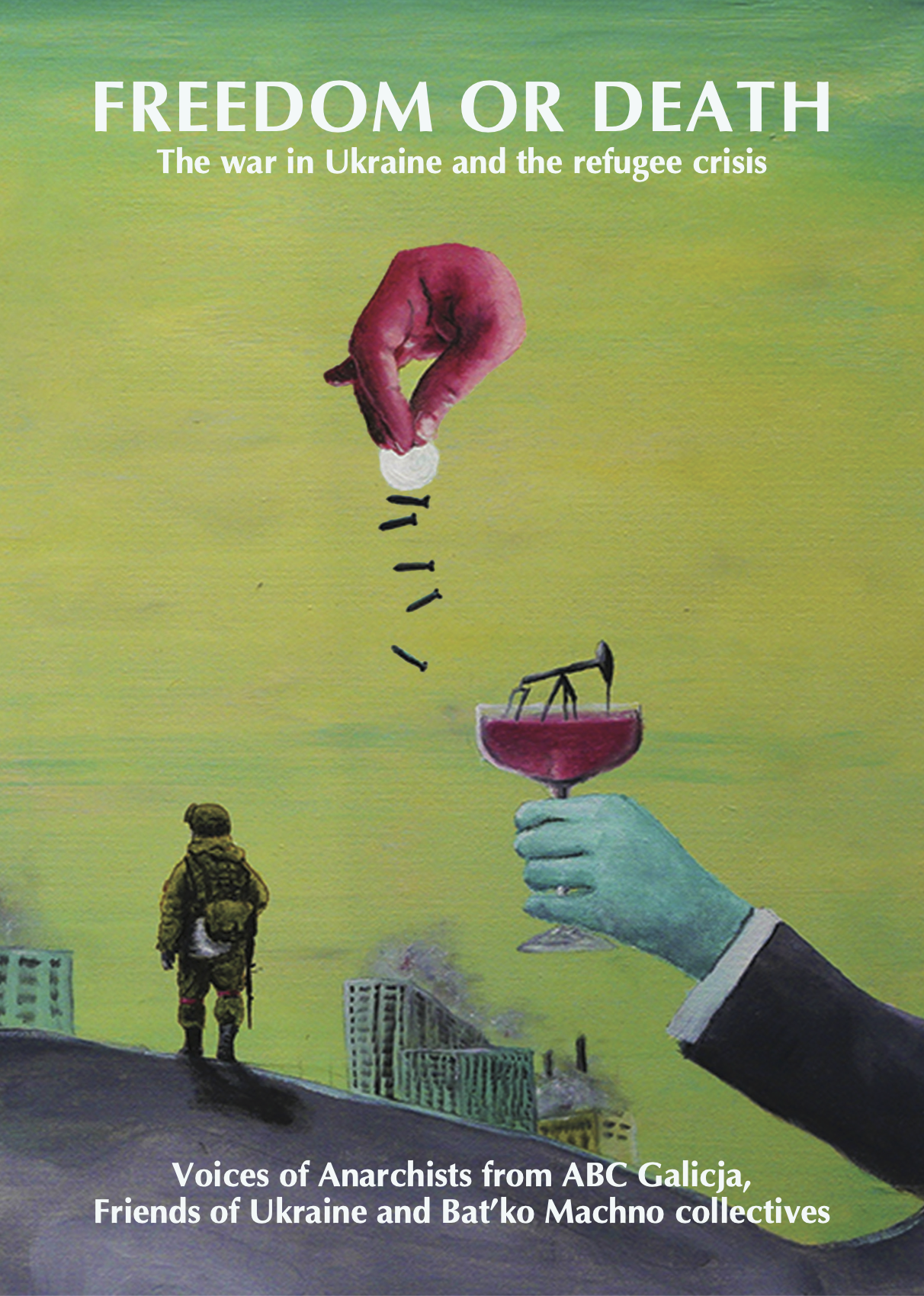
Freedom or Death. The war in Ukraine and the refugee crisis
Voices of Anarchists from ABC Galicja, Friends of Ukraine and Bat’ko Machno collectives
Introduction to the English Edition
On the “Non-Anarchism” of the Ukrainian Anti-Authoritarian Movement
Solidarity cannot be just an empty word
On the causes of movement, non-movement, and feigned movements
In memory of all anarchists and anti-fascists who lost their their lives fighting against Rashism and the Russian Empire.
The reply is evident: It must be supplemented by a promise of direct action. An anti-militarist ought never to join the anti-militarist [a]gitation without taking in his inner self a solemn vow that in case a war breaks out, notwithstanding all efforts to prevent it, he will give the full support of his action to the country that will be invaded by a neighbour, whosoever the neighbour may be. Because, if the anti-militarists remain mere onlookers on the war, they support by their inaction the invaders; they help them to make slaves of the conquered populations; they aid them to become still stronger, and thus to be a still stronger obstacle to the Social Revolution in the future.”
Peter Kropotkin
Anti-militarism. Was it properly understood?
Freedom, Nov. 1914
Preface
Introduction to the English Edition
This is an important book. It should have been released in English a long time ago, but such is the curse of many anarchists: we have too many projects and not enough resources.
As I write this, we are just over 3.5 years into the full-scale Russian invasion of Ukraine. Many of us have been involved in solidarity efforts with our comrades there from the very beginning. We published articles, raised funds, and organized transports of vital supplies and equipment.
The vast majority of Ukrainian, as well as Russian and Belarusian comrades, chose to take up arms against the imperialist invasion. They have been joined by other internationalist fighters—some with prior experience in the Rojava Revolution, others without. They chose to fight not for abstract state borders or nationalistic ideals, but to defend their families, friends, and loved ones. They correctly identified the fate that awaits them should the Russian state succeed in its conquest. Places like Bucha serve as stark reminders of what happens in areas where the so-called “Russian Peace” begins its bloody reign.
We have already lost many comrades, and we will undoubtedly lose more before this is over.
Unfortunately, even after all this time, there is often a shocking lack of knowledge within the anarchist and leftist movements outside of Eastern Europe about the situation in Ukraine. We know that some people will not care about this book. They haven’t cared to learn about the perspectives of our comrades in Ukraine until now. Some have found a token individual or a small group who say exactly what they want to hear—just enough for them to say, “See? I found out what people in Ukraine think!” Instead of genuine engagement, they fall back on empty slogans without practical application—or worse, they try to lecture people who have bombs falling on their heads about what they should be doing better.
Some others parrot the same half-baked propaganda found on Russia Today, repeating the tired lines that it’s all the fault of the West/NATO/CIA, that poor Putin was “forced” to invade, and that Russian imperialism doesn’t exist. This book is not for them.
Instead, we address it to those with a critical mind and enough curiosity to pick it up and broaden their understanding of the subject—even if they don’t agree with everything inside. And to remind people: solidarity can and should be critical, but it should never be conditional on comrades in Ukraine saying or doing only the things we like or approve of.
Nestor Machnowski
On Desertion
This book could be expanded with many additional threads, and one of the key ones is the issue of our attitude toward desertion in both of the warring armies. Such questions, among others, came up during the book’s presentations in Polish cities. We thought the matter was fairly self-explanatory; however, it turned out that we are still being accused of siding with the authorities, especially with the TCK{1}.
We want to emphasize that, during the preparation of the Polish edition of Freedom or Death, this issue in Ukraine was not yet as pressing. However the current gradual intensification of cruelty directed at Ukrainian society deserves a more extensive discussion. Unfortunately, due to publishing/editorial limitations, we are unable to address this matter in detail, though we wish at least to briefly state our position.
First of all, we believe that no one has the right to force a person, a group, or an entire society to participate in war. No government, no authority. Neither Putin, nor Zelenskyy, nor, all the more so, the TCK. Ukraine’s TCK structures negate humanism and are the organs of repression. They are a state machine designed to enslave people.
Desertion and avoidance of military service are the sacred right of every individual, regardless of country of origin. We are glad that many men manage to escape from TCK’s street round-ups and being sent to their deaths. We respect their choice, while regretting that in Russia desertion has not become a widespread phenomenon. At the same time, we consider unconditional support for all those avoiding military service to be inappropriate. Unlike the “deserters” who have connections—the children of oligarchs and politicians—who can buy their way out of the army and live abroad, we feel closer to the stance of people from anarchist and anti-authoritarian leftist circles who voluntarily fight in the ranks of the Armed Forces of Ukraine against Kremlin imperialism.
We doubt that all deserters are people of high moral standards with anti-capitalist and anti-imperialist views. Some anarchist milieus forget this, idealizing and oversimplifying the phenomenon. That someone protects their own life (which is undeniably beautiful and natural) does not mean that we must necessarily be in solidarity with that person. Not every one of them is a proverbial “proletarian.” But each of them can be asked: in the event of a potential revolution or social protests, would you join on the side of the rebellious masses? Have you previously taken part in any form of social activity? In fleeing conscription, are you doing everything you can to help Ukrainian society not only survive, but also prevail?
Of course, not everyone can belong to the socially engaged. However, we want to point out the difference in awareness and self-awareness between deserters and those who voluntarily go to the front. The soldiers we support are people of great self-discipline and firmly formed views, often with extensive experience in organizing and protesting. They do not run from problems—they resolve them here and now, in a situation that is extraordinarily critical.
The fact that someone fights within state structures against the empire does not make them a militarist. Just as anarchist prisoners in captivity are forced to co-exist with criminals, often playing by long-imposed prison rules, so too in the current war anarchists are compelled to make a tactical alliance with the state. In order not to disappear from the pages of history, in order to survive, and in order to continue spreading libertarian ideas and practices in Ukraine and across the whole region of Eastern Europe.
The Authors
Introduction
Anarchism is about constantly asking questions. Otherwise, it risks meeting the same fate as Marxism, which claimed to have all the answers to sociological questions and theoretical problems. The outcome of this dogmatic stance was the liquidation of sociology as an academic discipline in Polish universities during the Stalinist period, replaced by Marxism-Leninism.{2}
Constant questioning means continuously confronting one’s beliefs with the surrounding reality. Failing to do so leads to distorting or ignoring that reality, narrowing one’s views into an isolated bubble of opinions.
This ongoing confrontation of subjective beliefs with reality is a continuous pursuit of knowledge—seeking understanding and comprehension. Fearing this confrontation seems immature, especially when it concerns significant events like the war in Ukraine, which began in February 2022.
Numerous questions regarding the war and society’s response to it arose in my mind, particularly within the anarchist and syndicalist communities with which I feel an affinity. At the same time, I refused to adopt a defensive, convenient apolitical stance, conservative neutrality, or pacifism.
I attempted to answer these questions myself, and I now share my reflections here. I also posed these questions to others with whom, since February 2022, I’ve had the chance to act—sometimes together, sometimes separately—on this issue. This allowed me to compare my thoughts with the perspectives, experiences, and observations of others.
The first part of this work appeared as a comprehensive article titled “Anarchists on the War in the East” in issue 54 of Polish anarchist magazine Inny Świat. This piece was specifically written for the magazine. However, even after the issue was published, we continued to explore the topic further.
In the second part, each participant was invited to ask one question of the others. During the process, the co-authors reviewed each other’s answers, exchanged comments, and shared sources on the topic. The original article has been expanded with additional footnotes, revisions, and supplementary material.
The third part consists of original texts by the participants of this project.
The content has been further enriched with photographs shared on the Telegram channel dedicated to fallen comrades—МЕМОРІАЛ@MEMORIAL (https://t.me/anarchistmemorial)—as well as works by Uladzik Bokhan, a Belarusian anarchist. More of his art can be found on his Telegram channel @uladzik_bokhan.
This publication does not cover actions in support of the people of Ukraine, including comrades fighting against the Russian army, nor does it address the phenomenon of desertion. These topics deserve a separate text, but a thorough analysis will only be possible after more time has passed.
Andrzej Kliś
Part One
In 2017, in her text “When No Pasaran! Means Slava Ukrajini!”,[1] Adelina Adamkiewicz addresses the issue of the anarchist community’s detachment from the two-year-long war in eastern Ukraine. Within the Polish anarchist community, as early as 2015, differences in positions regarding Russia’s aggression against Ukraine began to emerge. The most common stance was to distance oneself from the war, reducing it to a conflict between two states. Some believed that the DPR and LPR{3}. had no connection to the Kremlin, while others claimed that “Moscow is better than Brussels.” However, some began organizing aid and support for the people of Ukraine. Has the anarchist community’s perception of the war in Ukraine changed since 2015, and if so, how? Is distancing from the war still a popular position? What is the reason for this stance?
Andrzej Kliś: As the war continues and with 6 million Ukrainian refugees arriving in Poland to date, distancing oneself from the conflict has become a less comfortable position. Instead, anti-war rhetoric and “concern for the economic security of the working class” have become more prominent. The attitude of a significant part of the anarchist and syndicalist movement resembles Kissinger’s “realpolitik,” Gardner’s “great compromise,” or its Polish equivalent, the “new pragmatism” of Grzegorz Kołodko.{4} These positions advocate “peace at all costs,” which, in their view, is necessary to ensure the “economic security” of empires, states, or the entire globe.
The demand for “peace at all costs” regarding the war in Ukraine raised by anarchist and syndicalist circles has not produced particularly in-depth publications analyzing the topic. In my opinion, this position results from the uncritical and unreflective adoption of tendencies within the Western left, which were shaped in the wealthiest part of the world.
In the Polish anarchist and syndicalist environment, Kremlin lovers and open backers of the DPR and LPR are, at best, a minority within a minority and can hardly be called anarchists. More concerning are the references to the views of Hall Gardner, who was involved with the Russian Council on International Affairs (RIAC), a “non-profit think tank” established by decree of then-President Dmitry Medvedev, with Dmitry Peskov{5}[2] among its board members.
The number of anarchists aiding Ukraine in its fight has also significantly increased. Regular deliveries of aid go to the civilian population as well as to anarchists and antifascists fighting on the front against the Russian army.
Spielverderber: Adelina’s text is from 2017, Jarek’s from 2023 and there have been only a few other texts and posts produced in the meantime. With such “discussion dynamics,” it is difficult to talk about any evolution, changes, or even crystallization of positions. The Polish anarchist movement has suffered for years from a lack of internal discussion that would result in a unified message to present externally, or at least some protocol of disagreements indicating differences on controversial issues. The “politics of statements” dominates, and these statements are not the result of debates within the movement; rather, they are created on its periphery and sometimes even outside it. A statement offers three choices: to support it, to reject it, or, most commonly, to ignore/not notice/forget it. The opening sentence in Adelina’s article, “Poland undoubtedly lacks serious, expert discussion…” is correct and still valid in relation to the movement. Comfortable vagueness and a tendency to avoid difficult subjects are still noticeable: “The facts deviate from the pattern digestible for an activist from the ‘Western’ world and pose dilemmas that the theory of class struggle cannot comprehensively explain.” The movement does not even address issues of geopolitics and the global balance of power, instead indulging in wishful thinking about anarchist troops fighting against both Russia and Ukraine. This raises questions about where such formations would come from, whether those awaiting a “real revolution” are even laying the groundwork, and how this can be achieved in an environment where even proposals to acquire skills related to tactical medicine are met with accusations of supporting militarism and violence.
Another term that divides the movement in the context of the war in Ukraine is anti-fascism. The failure to recognize that, in Eastern Europe, almost everyone on both sides of this conflict claims to be antifascist and labels their opponents as fascists makes this concept so blurred that it becomes inadequate. Moreover, the term “fascism” is often defined through symbolism and history rather than actual actions in the real world, making it easy to reverse roles. One old truth is that the first victim in war is the truth itself. Therefore, it is prudent to cross-check information from several sources, bearing in mind that, as part of the West, we are within the NATO information bubble, while many “independent” sources serve pro-Russian propaganda. Consequently, it will become increasingly difficult for us to agree on the credibility of facts, let alone their interpretation.
When it comes to attitudes and positions towards the war in Ukraine, I have subjectively categorized them as follows:
-
Passivity: This is the most common stance, sometimes framed as neutrality, “waiting for a real revolution,” or hidden opportunism
-
Pacifism/Anti-militarism: This includes both the permanent, sincere, and consistent pacifism, as well as selective pacifism that mirrors the arguments of Russian soft power.
-
Pragmatism: This involves calculation and the expectation of potential benefits.
-
Whataboutism: This includes redirection to other fields of activity, with statements like “it’s better to deal with … [enter any sphere of activity].”
-
Ignoring the Facts: For instance, claims like “The DPR and LPR have nothing to do with the Kremlin.”
-
Pro-Russian Attitude/Russophilia: This includes views such as “Moscow is better than Brussels,” “homeland of the proletariat,” “guarantee of geopolitical balance against a unipolar world,” and history-motivated prejudices against Ukrainians.
-
Pro-Ukrainian Attitudes: This category ranges from those who offer help only to war refugees, to those who uncritically approve of all actions of the Ukrainian government, as well as those motivated by Russophobia.
Aleksander Łaniewski: Let me start by saying that there hasn’t been, isn’t, and probably won’t be a unified position within the anarchist community on the war in Ukraine, even in a small and marginalized movement like the one in Poland. It’s difficult for me to speak for the entire movement, so I will try to present my perspective as an anarchist situated at the crossroads between Polish anarchism and the BUR (Belarus-Ukraine-Russia) movement. My perspective is an Eastern European one that might illustrate the evolving views of a segment of the anarchist community in this part of Europe.
To be honest, my perception of the war in Ukraine has changed. However, my fundamental view of war itself remains unchanged. War has always been, is, and will continue to be, for me, a cruel phenomenon: a total denial of humanism. What has changed is my proximity to it. Back in 2014, I naively believed—an opinion that was quite widespread within the movement—that anarchists should not participate in military operations in Eastern Ukraine because it wasn’t our war, but rather the war of states. If someone wanted to fight, I thought they should do so within Ukraine, Russia, etc. Let the Ukrainian state be defended by numerous representatives of the nationalist movement (although, in reality, any of them did so, but not all, as over the years there were regular attacks by neo-Nazis on feminists, anarchists, etc.). It seemed to me that anarchists who chose to fight were inconsistent in their views, in contrast to the nationalists who did the same. Even though I accepted the choices of some anarchists fighting within the structures of the Armed Forces of Ukraine—SZU (Збро́йні си́ли́ Украї́ни — ЗСУ) to gain experience in armed struggle.
I sympathized with Ukraine, with which I have very strong family and social connections (I regularly visited this country before February 2022). I admit that I was not fully aware of the threat posed by the events of Euromaidan. In fact, during the initial phase of the “revolution of dignity,” I was opposed to anarchists participating in it.[3] It was only after I visited Kyiv at the turn of 2013/2014 that I began to understand the potential and nature of these protests. I will reiterate that, although I speak for myself, I know that many others shared a similar viewpoint. My conversations with some comrades from Belarus, whom I met after the annexation of Crimea and the formation of quasi-people’s republics in Eastern Ukraine (and who are now serving harsh sentences in Lukashenka’s prisons), influenced my—let’s call it—radicalization.
To address the events of 2022: the situation changed significantly. On February 24 of that year, a real war began, and not just somewhere in the east or Crimea (where, to be clear, social trends a decade ago were indeed strongly pro-Russian). In 2022, we witnessed an invasion of Russian forces from Belarus, street fighting in Kyiv, the slaughter in Bucha, the bombardment of Odesa, Kherson, and Mykolaiv, and the heroic defense of Azovstal in Mariupol… There are many other events I could mention. It was no longer just an anti-terrorist operation in East Ukraine; the whole country became a stage of war. War became something tangible, an anaphylactic shock for everyone, similar to the one you experience from insect stings. We were fleeing from war, but it caught up with us. Our distance from it diminished tenfold.
Another issue: Over the past decade, the so-called “people’s republics” have clearly demonstrated what they really are. To simplify, I would describe them as proto-fascist satellites of the Kremlin. There are no workers’ rights, no economic improvement, not to mention basic human rights and freedoms. The Kremlin invaded Ukraine, offering its residents a return to the “motherland” of Russia. This turned out to be nothing more than an offer of poverty (economically, politically, and culturally). The same applies to Crimea—Russia essentially gave nothing to it (although I also recognize that Kyiv did not provide these regions with what they expected and was partly to blame for the separatist sentiments). In contrast, despite numerous unresolved political, economic, and social problems, the Maidan made significant progress in building a civil society in Ukraine. It provided Ukrainians with a chance to break free from the chains of post-Soviet imperialism, which the Kremlin has practiced in Eastern Europe since the collapse of the USSR. Moreover, I believe that Euromaidan was the first serious attempt, a test of maturity. This test was passed, let’s say, with a C. But as we know, a C is still a passing grade. There was a chance to build a new Ukraine, and if we talk about the anarchist movement, there was space for diverse activities, including radical urban partisanship.[4] Without those protests, Ukraine would have been completely occupied and quickly subordinated to Russia in 2022, as Moscow desired.
It’s easier to view these issues in retrospect, as several important events have occurred over the past decade. I’m referring to the unfinished Belarusian Revolution of 2020 and Russia’s role in suppressing the protests. It’s unfortunate that Ukraine didn’t notice this earlier, or perhaps didn’t want to, and, like the West, flirted with Lukashenko. Now there is no doubt that Russian tanks would have entered Belarusian cities if the situation had gotten out of control. Instead, it was limited to sending propagandists and financial aid from the Kremlin and another dose of lost independence from Minsk. We all know what’s currently happening in Belarus. This country is part of a vast imperial machine led by the Kremlin, spreading repressive practices. Anarchists fighting on the Ukrainian side primarily oppose the expansion of these monstrous practices westward.
This brings us to the final point, which I believe is crucial. I’m referring to the internal situation in Russia, characterized by increasingly growing and strengthening authoritarian tendencies. Moscow is reverting to a somewhat updated version of Soviet totalitarianism, manifesting both in internal dictatorship and overt imperialism abroad. The anarchist movement in Ukraine, Belarus, and the Czech Republic, for example, recognizes this threat. I would like to believe that Poland is not an exception.
To summarize, analyzing the situation in the occupied territories of Ukraine and the effects of Russia’s “foreign policy” in recent years, and considering potential scenarios following a Russian victory, anarchists have largely taken a pro-Ukrainian stance. Although one doesn’t have to be an anarchist to understand that a future under Russian occupation is a dystopia. I have no doubt about this. We cannot allow this to happen.
maciej wy: From my perspective, I haven’t seen the so-called “anarchist milieu” adopt a clear position on the issue, and the context is likely too broad to pin down a single stance. For example, some might remember the social media posts from people previously associated with the anarchist movement following the events of 2014. There was an admiration for the supposedly groundbreaking “people’s” nature of the newly formed republics, often adorned with Russian revolutionary graphics and songs. This was quite shocking to me, as I believe the grassroots nature of these new state structures was largely an illusion.
Conversely, nearly no one harbored illusions about Ukraine being a perfect country—it was marked by a corrupt oligarchy and a government largely indifferent to social problems. However, if we had paid closer attention, we might have noticed the development of an advanced training ground for both Russian and NATO forces within Ukraine years ago.
The invasion created an immediate need to assist anti-authoritarians and their families to ensure their safety. No one knew how the Ukrainian authorities would treat anti-government groups that began arming themselves to fight the invader, nor what the Russian occupation authorities would do if they succeeded in taking over the country. Over time, efforts shifted to providing tactical and medical equipment to help them survive and maintain their opposition to strong nationalism. In this aid campaign, there was no intention to replace or indirectly support the Ukrainian government. If feasible, we would also support Russian or Belarusian anarcho-partisans. Distancing oneself from the war is challenging, but it is crucial to remain vigilant about the military and isolationist policies of our own government, Europe, and the growing political influence of NATO.
Leon: The anarchist movement in Poland must chiefly be held accountable for its long-standing neglect of establishing contact with Ukrainian freedom and leftist movements. Apart from sporadic personal connections among individuals in the counterculture, there was practically no structured cooperation. In Ukraine, until the events of 2014, the anarchist movement was similarly fragmented and relatively weak. The Euromaidan protests reactivated and partially strengthened anarchist groups. A notable example is the Autonomous Union of Workers (AST, Авто́но́мна Спілка Трудящи́х), which organized support groups in Kyiv and Kharkiv. AST took over a government building in Kharkiv, creating an autonomous social center and a shelter for displaced refugees from Donbas. Anarchists and antifascists associated with, among others, the Arsenal Kyiv football club participated in clashes with police and government forces and later joined territorial defense forces to protect the population from attacks by pro-Russian militias and mercenaries. The first issue of the Alerta{6} magazine featured an interview with a Ukrainian antifascist who fought against Russian aggression in eastern Ukraine. This interview explored many compelling aspects of involving individuals from anti-authoritarian backgrounds in armed conflict. Unfortunately, this was still not sufficient information coming from Ukraine.
When faced with a military conflict, Ukrainian anarchists realized that society as a whole could be drawn into it. They also recognized the threat posed by the extreme right and Nazis, who, by gaining training, acquiring weapons, and accumulating experience, could significantly influence political realities. After the annexation of Crimea and the occupation of eastern territories by the Russian regime, anarchists began training in tactics and armed combat. They also carried out direct actions, such as attacks on mobile communication towers in Donetsk.
Similarly to the left and liberals, anarchists largely overlooked Russia’s imperialist aggression in 2014. While liberal European elites were reluctant to confront the “Russian bear” and continued business as usual with Putin’s regime, the Western left was captivated by Russian propaganda promoting “left-wing people’s republics” and portraying Ukrainian nationalists as bloodthirsty enemies of Russians. The so-called “anti-fascism” presented by these “people’s republics” could only deceive hardcore communists from Western Europe, largely due to Russia’s extensive propaganda and covert activities in these countries, which distorted the true nature of the Russian state. This distortion reached such a degree that the real events inside the “people’s republics”—including murders, torture, oppressive laws, and rule by warlords—were completely overshadowed by myths about “people’s rule.”
Despite the previous lack of connection with the Ukrainian movement and a deeper analysis of Russian aggression in 2014, the situation today is completely different. The perception of the war changed dramatically on February 24, 2022, the day the invasion of Ukraine began. This shift was evident among some anarchists in Poland and other European countries. The brutal imperial invasion of Ukrainian society, the murders, rapes, and the millions of refugees were shocking, necessitating a swift and decisive reaction.
For us—anarchists living close to the border—the natural reflex was to organize ourselves to provide meaningful help in the early days of the war to the hundreds of thousands of refugees fleeing during those frosty days. The Anarchist Black Cross — Galicja groups from Polish cities Rzeszów and Kraków quickly organized a joint ad-hoc meeting to take immediate steps, prepare for this tragic situation, and initiate activities aimed at logistical and humanitarian support. A decision was also made to establish contact with anarchists in Ukraine as soon as possible and provide them and their families with the necessary assistance. This help was intended to be (and still is) of a military nature for all anarchists, anti-fascists, and leftists who decided to take part in the armed struggle against the invaders.
For our group, it is unimaginable to fence-sit or distance ourselves in the face of the vicious attack of an authoritarian, oligarchic dictatorship on any society. Therefore, we decided to act by implementing the ideas of mutual aid and self-organization. Many anarchist groups in Poland and around the world have also established contacts with us to support and help coordinate our activities. Unfortunately, some organizations and individuals, primarily from Western European countries, view us as “war mongers” at best and “CIA agents” at worst. :)
In 2014, Russia annexed Crimea. In 2020, Crimean anarchist Oleksandr Kolchenko{7}. sang the Ukrainian anthem during his sentencing by a Russian court. “I am an anarchist, and I am Belarusian,” declares a protester in Belarus. In Western Europe, national identity is often associated with nationalism and fascism. This view seems to be prevalent within the Polish anarchist movement. Is there a definition of a nation that you find acceptable? Can an anarchist have a national identity?
Andrzej Kliś: Identifying my cultural identity came naturally to me, but the concept of national identity has always felt somewhat abstract and difficult to grasp. When once asked if I felt proud of living in a country that saw the largest uprising against Nazi occupier durung WW2, I responded:
After reflecting on my response, my interlocutor acknowledged and accepted my perspective on identity as natural. He had previously struggled to understand my lack of national identity, but this conversation helped him appreciate that, although it might not be my case, cultural identity can indeed overlap with national identity.
Thus, if national identity can be defined as a cultural one, I am open to accepting the presence of national identity among anarchists. A sense of national identity tied to cultural connections does not necessarily imply an association with fascism.
Spielverderber: The assertion that “national identity equals nationalism” and even fascism is one reason for the marginalization of the movement and the trivialization of the concept of fascism itself. Too often, traditional, conservative, or critical views are mislabeled as fascist, while those who claim to be highly sensitive to fascism often overlook authoritarian or quasi-fascist practices within their own circles. I believe an anarchist may (but does not have to) possess a national identity, along with ethnic, regional, cultural, or other identities. The issue is not in having these identities but in their excessive prominence and attempts to impose them on others, or in expressing hostility towards other identities. The goal should be to prevent the expansion of one’s own identity in terms of territory, culture, or language.
Aleksander Łaniewski: This is a good and important question. To address it directly: yes, an anarchist may have a national identity, but it is not a requirement. As I mentioned nearly a decade ago: “Not every anarchist is my friend, and not every nationalist is my enemy.” Labels and categories can be quite conventional. What truly matters is not how we define ourselves or what others say about us, but what we do. Our actions towards others, the world around us, and ourselves are what count.
Consider the various identities we have: class, professional, cultural, political, and so on. What differentiates these identities? To me, if they arise naturally and are not imposed, there is no inherent difference. Why is it acceptable for someone to identify with anarchism, feminism, a subculture, or a particular gender, but not acceptable to identify as European, Polish, or Kurdish? At a conference in Priamukhin (Mikhail Bakunin’s birthplace), I once gave a lecture titled “Anarchist Memorial Sites: An Invitation to Discussion”.[5] One Russian anarchist criticized me for allegedly trying to impose an “identity” label on anarchists. He argued that anarchism’s purpose is to dismantle identities, not create new ones. Identities, he suggested, lead to tactical and strategic discrepancies and further divisions. While deeper considerations on this topic are beyond this discussion, I wanted to highlight subjects rarely addressed in the movement and question whether there are any anarchist identities, how they are formed, and where they might lead.
During the protests in Belarus in 2020, I witnessed a discussion where an anarchist participant commented on the Belarusian national flag (white-red-white), which had become one of the symbols of the revolution. They remarked that they had never fought for these colors but now saw them similarly to the flag of Rojava—as symbols of resistance against dictatorship. Ihar Alinievich{9}, known to many Polish anarchists, ended one of his recordings from that period with the phrase “Žyvie Biełaruś” (Long live Belarus).[6] Another Belarusian anarchist, a veteran of the movement, Aliaksandr Kazlianka{10}, concluded his closing speech in court with the slogan “Sława Ukrainie i Žyvie Biełaruś!”.[7] I would never accuse either of them of even the slightest nationalist tendencies. They are ideological anarchists and are sincere in their views.
Returning to Kolchenko’s statement—at that time, it was widely discussed within BUR circles. I must admit that I was among those who criticized him, but that did not stop me from showing solidarity with him. Besides, I’m unsure whether his views have not since evolved toward a slightly less radical and more left-wing direction. I know he is currently fighting in the ranks of the Ukrainian Armed Forces. Over time, especially during the Belarusian revolution, I revised my view, realizing that these slogans, which some might see as nationalist, are actually social slogans. They belong to everyone fighting against dictatorship and occupation; they symbolize a society in struggle. The Belarusian and Ukrainian right-wing have lost their monopoly on these symbols, which both liberals and social democrats in Belarus have used for years. Context is important here.
If Belarusian is the language of protests, that’s great. But if the KGB starts using this language, or if the AMAP [Special Purpose Police Detachment]{11} tortures citizens under the white-red-white flag (a possibility that exists), then anarchists should remind all these “patriots” that they fought for the symbols, not for a new Belarus based on economic equality and direct democracy. The more anarchists use a range of national signs and symbols, the harder it will be for nationalists to exploit chauvinism. Naturally, anarchist “myths” should not be built on symbols that directly refer to statehood, such as Freedom Day.{12} I know some anarchists view it as a “holiday” and dream of giving it a libertarian meaning. However, it is strictly a state symbol—the date of the declaration of the Belarusian People’s Republic in 1918. I don’t believe the libertarian movement will ever be able to claim a part of this holiday. I believe that the real Day, or even Days, of Freedom are still ahead of us.
The situation with languages is different. It’s challenging for Polish and Western anarchists to understand that most Belarusian comrades (and once Ukrainian ones too) primarily speak Russian. In the past, if someone in the movement identified as “Belarusian” in the broad sense, they could face criticism. Now, the situation has changed. If someone speaks Russian in Ukraine or Belarus, does it make them worse anarchists? Of course not. The Russian language does not belong only to Russians, although they may think so. I consider our knowledge of this language, despite their lack of ours, as an advantage. To conclude, in the case of Belarus and Ukraine, these “national” tendencies in the anti-authoritarian movement should be seen as libertarian phenomena.
Having been in contact with the Polish anarchist community for many years, I kept hearing that I was Belarusian; it was always emphasised. So, all these declarations of internationalism are often purely theoretical in the movement. It’s very easy for me because I don’t have a single national identity, I feel like I’m of mixed heritage. I was born in Belarus, but my father is of Polish origin; I speak Russian best, and I was the last generation to go to a Soviet school. I try to talk to my daughter in three languages and read to her in five. For me, the boundaries between BUR and Poland are blurred. But I realize that for a lot of people in the movement, this can be quite difficult to grasp. I am a person from the borders of several cultures and nationalities, and I feel great about it. I am vaccinated against nationalism.
At the same time, I believe that it is necessary to confront imperialism and colonialism, it is worthwhile to defend dying languages and small nationalities in the context of cultural diversity, manifestations of their grassroots struggles and self-organization, questioning of patriarchy by some of them… Only this struggle should not come to the fore. There are no eternal languages, just as there are no eternal nations. These are practices and processes that come and go. These are groups that constantly recreate and reinterpret symbols, myths, traditions and values. It seems to me that what is important in this context is identification with elements of broadly understood culture, but not blind subordination to state or religious canons, which are often retrograde and hypocritical.
Civil society can be a descriptive term for a nation. I would not agree that in the West, national identity is associated with fascism or nationalism. No, rather it is identification with a modern nation, republican tradition, and citizenship. Do German or Greek anarchists deny the fact and are ashamed that they come from a country where Nazism flourished or where a Junta of Black Colonels ruled? Language, culture, political traditions—these are extremely important factors shaping our consciousness, it is not only economic determinism, as Marx said, but existence in the broadest sense of the word: whether we like it or not.
Looking back at the colorful history of anarchism, we find many cases of anarchists’ love affairs with the national question, their mutual interpenetration. You can see it from Ireland to Korea, from Yiddish anarchism to Makhnovism. Depending on social position or political views, the concept of “nation” may have different definitions. It is important to realize that this is not a fixed concept but a variable one, adjusted depending on a number of factors. Nations are not given once and for all, which nationalists do not want to notice. But either way, they are some form of a collective.
I know that for many people this might be the case, but I do not believe— and would not like to believe—that the nation should be reduced solely to the essence of the state (as Max Weber suggests). I don’t claim to have the ideal concept of the nation, though I might find something along those lines in contemporary sociology; however, I am not a sociologist. I lean (but not fully approve) towards the idea that a nation is more of a cultural phenomenon—a convergence of certain cultural values, as discussed by figures such as Florian Znaniecki, one of the founders of Polish humanistic sociology, and Ernest Gellner, a prominent researcher of nationalism. This can include elements like a common language, traditions, historical experiences, and sometimes religion or attachment to a specific geographical area.
By contrasting the concepts of nation and state, I believe that a nation can exist independently of the state. A common national culture (including political culture) may prove to be a more enduring and influential element of social solidarity than a government or any other structure built on myths and hierarchically imposed values. When discussing political communities, I partially align with post-structuralism and the anthropological perspective of Benedict Anderson, who described a nation as an “imagined community.” Members of even a small nation often have no personal contact with most of their compatriots, yet they identify with them and “cultivate the image of the community in their minds.”
As anarchists, we should strive to transcend these limitations by fostering and practicing new interpersonal relationships across borders and nations without rejecting ethnic or cultural diversity. What matters is the awareness or will to belong to a community, or in other words, the choice of identity. However, this should emerge from the grassroots level, not be imposed by authorities, politicians, intellectuals, or other “elites”. And somewhat provocatively: perhaps states and their nationalisms are an inevitable stage in human history? Future generations will have to answer this question. Ultimately, I have no issue with the concept of “nation”, and I do not forbid anyone from identifying with a particular nationality. Nonetheless, my flag is not white-red-white, white-red, or any other national flag. It’s black.
maciej wy: Poles have a historical problem tied to their pursuit of statehood, the right to use their own language, and the ability to name places in Polish. This struggle has deeply impacted those of us born here. Over time, a country with established borders and decades of barriers to international travel became a national stronghold. Moreover, it is a fairly homogenous area in terms of language and identity, naturally closed off from other cultures. Language has evolved into a tool for self-determination and community-building, which has little to do with fascism. Yet, that “little” can become a problem: when administrative structures begin supervising language or identity, and when culture, history, or education come under the control of authoritarian religion, it can lead to an excess of power and even violence. It’s common to redefine the works or people from periods where “national consciousness” didn’t exist as mythical “national heritage”. Nowadays, any criminal case or accusation of an attack on this heritage, culture, or religion becomes the foundation of fascism, but it is not fascism itself.
For me, nationhood is about ancestry and the desire to co-create a certain community. But in today’s world, with its bloated administrative structures, it’s impossible to separate nations from state power and predict if nations can exist independently of a state and what forms that might take. The issue for anarchism isn’t attachment to national identity but the use of any ideology—even the concept of equality—to justify surveillance and restrictions.
Leon: This topic is complex, and it requires a cold and rational approach to avoid falling into an emotional, and therefore clouded, view of the situation. I do not equate national identity with fascism, just as I do not equate patriotism with nationalism. I consider myself an internationalist, and I believe that classic state patriotism is a tool used by the privileged class to maintain control over society. This tool employs mythical, cultural, or abstract ideas to serve the particular interests of the elites. Profit, greed, or the obsession with power have no nationality. The ruling class, whether it takes the form of a dictatorship, aristocracy, or neoliberal state, beats the drum of patriotism to subjugate society whenever they need to divide and rule. Religion often serves a similar function.
This form of national and state patriotism distorts the noble ideas of community, mutual aid, and solidarity, using them in favor of symbols, myths, and abstract bonds that ultimately benefit the ruling class. There are, however, local or moderate forms of patriotism where love for one’s nation does not equate to glorifying state institutions. The concept of a nation itself is fluid and has changed meaning over centuries. Many ardent patriots and nationalists do not realize that the classic nation-state is, in fact, a 19th-century creation. Even the very concept of the nation has evolved. For example, during the time of serfdom in Poland, peasants were not considered “Poles” due to the class-based division of society. Extending the concept of the nation to all members of society often had revolutionary significance—for example, during the French Revolution or the Revolutions of 1848, which aimed to destroy the authoritarian class system and include all citizens in the nation, as a manifestation of equality and freedom.
Unfortunately, “nation” is such a broad and easily manipulated concept that it is often used to incite conflicts between different “nations.”
Reducing all conflicts to class struggle, as some might do, is overly simplistic, in my opinion. Although the elimination of class division is crucial for anarchist and leftist movements, it is not the sole factor that influences society today. In addition to particular economic interests, national, cultural, and religious sentiments often drive modern societies. Anarchists must acknowledge that these sentiments, especially national ones, are often more influential than economic motives. For nations without a state, colonized peoples, and enslaved societies, the primary motivation for their liberation struggles is often a form of patriotism or cultural unity.
National liberation struggles can be co-opted by capitalists, nationalists, leftist movements, and even anarchists. Ignoring or pretending that “nations do not exist” only leaves room for nationalists and capitalists to control the narrative, and more importantly, it isolates anarchists from the people for whom ideas of nationhood or cultural identity matter. This marginalizes the anarchist movement, stripping it of relevance in the eyes of society.
This same situation occurred during Poland’s 19th-century struggles against foreign occupation. Revolutionary organizations like OB PPS{13} or Proletariat{14} successfully combined revolutionary struggles with the fight for independence. In contrast, anarchist groups such as the Revolutionary Avengers{15} or Internacjonał{16}, despite their noble goals and active armed resistance, lacked significant popular support. This is not to say anarchists must abandon their internationalist beliefs. It is important to remember similar examples, like the Irish struggle against British occupation, where left-wing republicans, socialists, and syndicalists took up arms. The Irish Citizen Army, co-created by syndicalist and IWW member James Connolly, and later the Irish Republican Army, were crucial components of the national liberation movement.
One of the most prominent anarchist theorists, Mikhail Bakunin, also recognized the power of national liberation movements and saw the importance of revolutionaries participating in these struggles. He supported the nations oppressed by Imperial Russia and endorsed armed uprisings against Tsarism. Bakunin even made efforts to organize armed aid for Poland’s January Uprising.{17} and advocated for the creation of a Pan-Slavic Federation. In this federation, free and independent Slavic nations would coexist on egalitarian terms, with their internal structures based on anarchist and classless principles.[8]
Falsifying reality for the sake of “ideological purity” will not bring us any closer to a self-organized, stateless society. While internationalism, global solidarity, and the abolition of state borders are goals central to anarchism, this does not mean anarchists should stand aside during national liberation struggles or conflicts, especially when imperialist wars are initiated. To me, anarchism is about standing on the side of the exploited, oppressed, and discriminated, without being alienated from society just because it identifies with the “nation” or refuses to abandon its national symbols. Showing alternatives through action, building horizontal structures in moments of crisis—whether during war, natural disasters, or other tragedies—is key. Engaging anarchists who demonstrate non-hierarchical forms of organization in these situations can offer a real alternative to nationalism.
We must remember that our love for freedom is not an excuse to ignore the fact that not everyone is able to see or understand our goals. People have the right to decide who they affiliate with, the right to freedom of association, and the right to build their communities around regionalism or their own cultures. Local, tribal, or regional communities can thrive in a world without borders—and, ideally, without state institutions. Drawing from history and culture, selectively embracing libertarian elements while rejecting authoritarian ones, may be an effective strategy for our current times.
Historically, even anarchists, such as those during Nestor Makhno’s time in Ukraine, combined their ideology with elements of Cossack culture or drew on cultural traits consistent with anarchist values. Similarly, Kolchenko and other anarchists now fighting the Russian invasion understand that Ukraine is a victim of imperial aggression and conquest. By standing alongside a society defending itself, they—like us—are striving to understand the characteristics and moods of the people. The key here is identifying with society, not the state. The Ukrainian flag, given the current situation, symbolizes solidarity and struggle rather than state institutions. Without idealizing Ukrainian society, one can still see that amidst nationalism rising from war and patriotism stirred under the bombs, there is real self-organization, mutual aid, and international solidarity. Anyone who has experienced Ukraine during this war can recognize how people’s instinct for cooperation and mutual respect emerges in response to crisis. Whether an anarchist chooses to embrace a national identity or not is entirely up to them, but I believe an anarchist can associate with whatever they wish, as long as it aligns with the principles of freedom, does not infringe upon others’ liberty, and rejects authoritarian, hierarchical power structures.
In 2021, Belarus opens new air routes and eases visa procedures for people from the Middle East and Africa. Those arriving in Minsk through these routes are led to believe that reaching the EU border is just a final formality. They arrive at the Polish and Lithuanian borders, where, under the guidance of Belarusian regime services, they attempt to force their way across. They become trapped—hostages of the Belarusian system, used as “living weapons.” This new tactic is designed to destabilize and provoke national and political conflicts. The Polish Border Guard secures the “green border,” mass push-back practices are employed, and a fence is erected to prevent further attempts at crossing. The question arises: Can we prevent similar situations from occurring? How can we stop people from being exploited as “living weapons” and placed at risk of death in border zones?
Andrzej Kliś: Six million people cross the Polish-Ukrainian border. No refugee camps are built, and no relocation centers are established. A new definition of “refugee” is introduced, allowing for a streamlined process that grants the right to residence, work, and social benefits. Five hundred thousand Ukrainian refugees find shelter in Polish homes.
An American doctor and volunteer contacts me. I’m unsure where she wants to work, so I ask:
“Do you want to work near the front? Or in Lviv? Do you have any training in tactical medicine?”
“No, I don’t want to go to Ukraine. I want to work in refugee camps in Poland.”
“There aren’t any.”
“Where are they, then?”
“There are no camps for Ukrainian refugees in Poland.”
The contact breaks off. I don’t think she believed me.
A French volunteer calls me. He wants to go to the border. They are looking for accommodation, but everything is fully booked.
“Can you call for me? They won’t rent to us. Maybe they’ll rent to a Pole.”
I explain: “There’s no accommodation. Refugees are staying there.”
I’m the second person to explain this to them. They didn’t belive a friend from Podkarpacie. I don’t think they believe me.
The wave of refugees arriving in Poland has been met with an unexpected reaction, one that seems inconceivable to the volunteers from the West. This response is likely a surprise not just to the Polish state and its citizens but also to Russian intelligence services. The unpredictability of the situation had a constructive impact. Perhaps this is a promising direction for the future.
Russian war strategists likely anticipated a mass exodus of the Ukrainian population, hoping it would spark a migration and humanitarian crisis, along with nationalistic conflicts. However, this turned out to be a miscalculation. Thanks to the spontaneous reaction of Polish society, there is now an opportunity for the community to believe in itself, and for those in power to place their trust in this community.
But the Belarusian and Russian authorities will not be surprised by border fences or refugee camps and centers. These are just contingencies they’ve accounted for in plans B, C, and X. Therefore, the key elements here seem to be unpredictability and humanitarianism.
Lukashenko needs “living weapons at the border”—or “people in closed centers” functioning as time bombs. Beyond this, these people are of no use to him. To prevent their exploitation, these individuals must have access to accurate information about the real situation at the border and the possibility of entering Europe under fairer, more appealing conditions than those offered by Belarus or Moscow. The current solutions in Western Europe are neither effective nor humane, at least from what I’ve learned from Ukrainians who have sought assistance in returning to Poland from Belgium, Sweden, or Norway. I believe we need a more universal definition of a refugee and their status, modeled on the one created for Ukrainian refugees in Poland.
Spielverderber: Whenever someone tries to cross any border—whether a state border or another kind of boundary—violence arises if one side resists. Philosophically speaking, this can be prevented through submission: by giving in to every request and demand, violence can be avoided. However, you must then be ready to face the long-term consequences of such an attitude. This is the approach the state teaches us: as long as you submit to the demands of those in power, “there is peace.” But when you resist, you trigger violence.
Anarchists have never shied away from violence when it’s understood as a form of resistance. I believe that people trapped at the border deserve rescue and aid. However, I am also aware that these immediate actions won’t solve the larger issue of exploiting vulnerable people as “living weapons.” The cycle of violence will only end when its perpetrators disappear. And yet, even then, it will reemerge elsewhere and at another time, because the tactic of taking hostages is as old as human conflict.
In my view, the migration crisis has multiple causes:
-
Military, political, economic, ecological, or religious destabilization of the countries from which migrants come, in which the West often participates.
-
Migration and social policies of wealthy Western countries. The high social standards in these countries compared to the lower standards of neighboring nations make them attractive destinations for migrants. However, these countries are often unprepared to accept and integrate such large numbers of people on equal terms. Consequently, they try to return migrants to the countries of “first arrival,” to which these migrants do not want to go. This often involves the use of violence or coercion, or the confinement of migrants in closed centers or camps, which also involves violence or coercion. One potential systemic solution the EU could adopt is equalizing social security and implementing a common minimum wage throughout the EU. This would facilitate greater acceptance of migrants, distribute them more evenly, and minimize economic conflicts with the existing population.
-
Random events, such as natural and ecological disasters.
-
Deliberate state policies aimed at achieving specific results, such as the Polish-Belarusian border situation. Migrants are intentionally misled by the regime and then become hostages, risking their lives in attempts to breach the border. Conversely, the pushbacks used by the Polish border guards are inhumane and inconsistent with international law, often resulting in deaths and failing to resolve the issue, while also demoralizing the officers involved.
Possible Solutions:
-
Accept migrants, relocate them according to their preferences within the EU, and provide social assistance equivalent to that of EU citizens.
-
Guarantee freedom of movement and residence in the country of their choice.
-
Encourage people and communities to provide hospitality.
-
Apply pressure on the Belarusian regime to abandon these tactics.
-
Pursue actions aimed at the collapse or dissolution of the regime, either overtly or covertly.
I am firmly against the creation of camps and migrant detention centers, as well as the forced relocation of migrants against their will. Regarding the construction of walls or fences, I believe it is not an ideal solution for several reasons. However, it’s important to note that the desire to build such barriers often correlates with the level of aggression from neighboring states. This principle applies not only to international relations but also to individual interactions.
I also believe that host communities have the right to deny asylum to certain individuals, including fugitive dictators and their families, officials from totalitarian states known for torture, and current or former members of organizations such as Daesh/ISIS.
Aleksander Łaniewski: There are also individuals from South Asia. My father and his friend encountered two half-starved Tamils from Sri Lanka in a village near the border with Lithuania. They had managed to reach Lithuania but were placed in a detention center where they were reportedly beaten by Lithuanian border guards or center staff. The harsh conditions in the center and their fear for their lives drove them to escape and return to Belarus. They wandered through the forests until they met my father and his friend, who provided them with food, a place to wash, and assistance in contacting intermediaries in Minsk. They used the phones of my father and his friend to call their families, who expressed their gratitude and offered financial compensation. One of the Tamils’ sisters was with them, but they lost her in the forests on the Belarusian-Lithuanian border. The Tamils expressed their determination to return home at all costs and stated they would never come back. I share this story as a prelude.
Part of the responsibility for preventing the issues you are concerned about lies not only with us but also with activists in the regions from which these migrants originate. We are partly to blame for not sufficiently publicizing the realities of the Belarusian regime and for our failure to overthrow it. As a result, the world remains largely unaware of the true situation in Belarus—even in Poland. Many Ukrainians, for instance, lived under the illusion that Belarus was a clean, stable, and corruption-free country before February 24, 2022. Prior to this date, many Ukrainians even sympathized with the Belarusian dictator. If Ukrainians, who are geographically and culturally closer, had such misconceptions, what can be expected of people from Asia or Africa?
These individuals, treated as commodities by the Belarusian and Russian regimes, are deceived by propaganda and false promises of an open and democratic Europe. This lack of awareness leads them to cooperate not only with travel agencies but also with militia, military, and KGB operatives. I am aware of the high regard in which Putin and Russia are held in some Asian and African countries, but this reflects a fundamental ignorance among those seeking a better life. While I support their desire to improve their circumstances, I am often alarmed by their naivety and lack of understanding.
The aspiration to move from Belarus to the European Union is a dream for many, but only a few succeed. The lack of basic knowledge about what Belarus and Russia truly represent—dictatorships where cooperation, dialogue, and trust are impossible—contributes to their plight. Even when people have enough money to pay for flights, accommodation, and food (some have even paid exorbitant prices to Belarusian services for basic necessities), they often fail to research their destination thoroughly. I am also skeptical of the blanket assumption that all refugees are defenseless victims of repression. This idealization is a common leftist perspective. For instance, the Tamils I mentioned are a case in point. Their families in Sri Lanka are neither starving nor oppressed. They chose to come to Belarus in hopes of improving their financial situation and could have pursued other routes.
Perhaps we are not active enough on the international stage to warn the so-called “third world” about the dangers of visiting countries where citizens are tortured and imprisoned. It is naive to expect refugees to have detailed knowledge about Eastern European dictatorships when even in Poland, some people still support these regimes.
Much of the blame, of course, lies with the West, as the legacy of post-colonialism continues to impact global relations. I acknowledge that the so-called Global South is divided: some view the USA and the EU through a lens of mythologization, while others idealize Russia. The perception of Russia and Belarus as anti-NATO, anti-imperialist strongholds is influential, partly due to the Kremlin’s significant investment in pro-Russian propaganda. The current situation is a byproduct of centuries of imperial policies by all major powers. Regrettably, the West (including Poland) exhibits hypocrisy akin to that of Belarus and Russia. In the West, the segregation of refugees into categories of “good” and “bad,” and even differentiating between “better” and “worse” Europeans, contrasts sharply with the rhetoric of human rights. This hypocrisy arises from engaging in trade with authoritarian regimes while turning a blind eye to its own severe human rights violations. The incompetence and short-sightedness of Western politicians contribute to crises like these. The West has long nurtured hierarchical philosophies and is now facing the consequences.
What can be done about it? Overthrowing oppressive regimes is one part of the solution. As long as current values persist, we will continue to face issues like the use of “human shields” and preventable deaths. We must address the fundamental values that perpetuate these problems. People need better education and access to accurate information. A practical plan should focus on strengthening solidarity networks in border regions—we need allies on the ground. It seems likely that we will face even greater migrations and crises, driven not only by economic factors but also by ecological issues. The challenge is how to effectively communicate to Polish society that no amount of barriers—however costly—can shield us from growing hatred. It is likely that future conflicts will see even larger walls being erected than the current one on the Polish-Belarusian border.
maciej wy: Transparency of national authorities and their accountability are among the few effective methods to address migration issues. However, beyond these measures, international institutions such as the EU play a significant role. The European Commission recommends that member states enhance the security of the EU’s external borders (e.g., by providing subsidies for wall construction) and intensify efforts to combat illegal migration (e.g., by extending the return of migrants to their countries of origin). Emergency aid in border areas does not address the impunity of uniformed services; these services should be continuously held accountable and stigmatized when their actions are illegal or inconsistent with established procedures. Independent verification of their conduct, prompted by social pressure, may be necessary to effect change.
Leon: First, we must examine the root causes of migration from African countries and the Middle East. The legacy of centuries of colonialism, ongoing wars and ethnic cleansings, resource exploitation, and contemporary neo-imperialist conflicts continue to shape the world’s division between the wealthy North and the impoverished South. This neo-colonial dynamic ensures that poverty, exclusion, and exploitation persist in Africa and the Middle East. International capital operates without borders, with corporations and oligarchs using their privileges to access every corner of the globe, exploit tax havens, and support military juntas and dictatorships to protect their interests. Authorities and nationalists often exploit the immigration crisis to incite fear and xenophobia among the public. The manipulation and dissemination of lies to foster xenophobic sentiments are increasingly common in Europe. For instance, Orban’s manipulation of the European Union through the inflow of migrants, PiS.{18} and the Confederation’s.{19} incitement of racism and fear of “invaders” and “foreigners,” and the Conservative Party and UKIP’s portrayal of immigrants as a catastrophe leading to Brexit, all illustrate how leaders use fear and misinformation to control public opinion and create scapegoats for societal issues while obscuring the real causes of crises.
Death at sea or at the border, smuggling and human trafficking are all avoidable tragedies. Thousands of volunteers and activists rescuing refugees at sea or in forests are a manifestation of the fact that there is still a spark of hope in humanity. Unfortunately, this is a treatment of effects, not causes, but it is a necessary manifestation of humanity that actually saves human lives. Our friends from the No Borders Team or other anarchist groups, saving lives in the forests of Podlasie, are another example that those who die in the forests cannot count on the help of the state, which guns for “push backs”. They can count on people whose skin colour or origin is irrelevant. What is important, however, is that the system that condemns people to exile, death in forests or at sea, does it in “white gloves”, building its influence and wealth on the corpses of people forced to leave their homes. Answering the question of how we can somehow stop it, first of all, is to make society aware of the causes of migration crises, that colonialism exists and has taken a different form, and that capitalism creates exploitation and misery of millions of people. Until society accepts these facts, it will only continue to see consequences in the form of people trying to break through Europe’s walls, and the far right will continue to manipulate people by targeting them.
Death at sea or at the border, smuggling, and trafficking of humans are all avoidable tragedies. Thousands of volunteers and activists rescuing refugees at sea or in forests demonstrate that there is still a glimmer of hope in humanity. Unfortunately, these efforts address the symptoms rather than the root causes of the crisis, but they are a vital expression of humanity that directly saves lives. Our friends from the No Borders Team and other anarchist groups, who are rescuing lives in the forests of Podlasie, illustrate that those dying in the forests cannot rely on state assistance, which often employs “pushbacks”. They can, however, rely on individuals whose skin color or origin is irrelevant. What is crucial is recognizing that the system which condemns people to exile, death in forests, or at sea does so with “white gloves,” building its influence and wealth on the suffering of those forced to leave their homes.
To address this issue, we must first make society aware of the root causes of migration crises. Colonialism, in its modern forms, and capitalism, which creates exploitation and misery for millions, are fundamental issues. Until society acknowledges these realities, it will only continue to confront the consequences of migration, such as people attempting to breach Europe’s borders. Meanwhile, far-right groups will persist in manipulating these issues to stoke fear and division.
Before 1939, French pacifists who protested against the war described the fight against the Nazi army as “adventurism.” Even after the outbreak of World War II, some of these pacifists called for concessions to the Nazis.[9] When the German army invaded France, these same pacifists advocated for close cooperation with Hitler, often aligning more closely with him than the Vichy collaborators did. In 2022, syndicalist and anarchist organizations published statements opposing the war.[10] Is there a discernible analogy between these pre-WW2 attitudes and contemporary ones? Do such attitudes, regardless of their original intent, inadvertently support Putin’s narrative?
Andrzej Kliś: The pacifist tendencies observed in French society in 1939 and the current pacifism in Western Europe evoke a sense of déjà vu. An important question is how pacifist views in Western European societies will evolve in the near future. The historical response after 1939 and the occupation of France by the German army provides lessons worth considering for the future.
I am concerned that for supporters of pacifist attitudes, the outcome of Ukraine’s struggle might be secondary. Any resolution to the conflict that leads to the cessation of warfare, including a complete Russian occupation of Ukraine, may be deemed acceptable within the pacifist framework. This perspective may be at odds with any efforts to resist the occupier or assert sovereignty.
The notion of “economic security of the working class” is also co-opted by large corporations under the guise of “protecting jobs.” This argument is frequently used by multinational companies that have either not withdrawn from Russia or have been found evading sanctions. The interdependence of economic security for the working class and corporations is a hallmark of corporatism.[11] This doctrine blends aspects of socialism, nationalism, and syndicalism, creating a unity of interests between employers and workers.
When this community of interests is viewed through both free market and Marxist lenses, nationalism can transform into a form of internationalism, potentially leading to a transnational “fascism.” For the Spanish new right, the rejection of nationalism as part of a far-right stance is not theoretical. The fall of the Russian Empire could disrupt this symbiotic relationship.
The attitudes of the Polish anarchist and syndicalist community, as expressed in their statements,[12] closely mirror the Western European pacifist paradigm; they are essentially carbon copies of it. Supporters of this approach often look to Western neo-Marxists and Trotskyists as their models, viewing themselves as mentors to what they perceive as a less advanced Eastern Europe.
The Kremlin anticipated mass protests in Russia under the slogan “No war!” when planning their full-scale invasion. Media reports highlighted some brave individuals and small groups engaging in acts of sabotage and armed struggle. While some managed to flee, the protests were ultimately suppressed without significantly impacting the Kremlin’s objectives.
Pacifist attitudes do not challenge Putin’s narrative, and peaceful methods are inadequate for countering the Russian state. Furthermore, the Western left’s approach does not include a strategy to overthrow the Russian regime. Such attitudes, in varying contexts, may either aid Russian propaganda or be deemed insignificant. They certainly do not obstruct the Kremlin’s plans.
In 2020, Belarusian society rose against the government, with mass protests evolving into unprecedented street fighting. As repression intensified, the opposition sought refuge in Poland and Ukraine, where they also prepared for future struggles. By 2022, these individuals were fighting alongside Ukraine against the Russian invasion. The outcome of Belarusian protests was the formation of military units ready for combat. In my view, this approach represents the most effective means of resisting a dictatorship. I see no viable alternative.
Spielverderber: The analogies between past and present pacifist attitudes are striking and share similar foundations. It’s important to note that pacifists of the early 20th century had far less access to information than we do today. However, contemporary pacifists are not a monolithic group. There exists a broad spectrum of views within this movement, ranging from genuinely principled pacifists and anti-militarists to individuals who, while outwardly espousing pacifism, may actually be Kremlin sympathizers masking their pro-Russian stance behind selective interpretations of pacifism. Between these two poles wander “followers of the homeland of the proletariat”, useful idiots, economic beneficiaries of the previous situation and religious sectarians.
I can understand the neutral stance of pacifists from post-colonial countries, who might view the war in Ukraine as a conflict between European powers and thus prefer not to engage. However, the overall effect of these varying attitudes seems to favor Russia by giving it time to bolster its position.
Aleksander Łaniewski: I find this attitude naive and damaging both to the anarchist community and to the victims of the war in Ukraine. While it’s true that such pacifist positions can inadvertently benefit Putin, I would go further and label them as “useful idiots.” Imagine if women were to view defending themselves against rapists as “adventurism” and, if they were assaulted, were told they provoked it by their attire or behavior. Such a stance is absurd; it reflects a victim mentality and cowardice.
Similarly, pacifism in the face of aggression is misguided. It assumes that adhering to certain philosophical or religious principles, such as those held by Tolstoyans or anarchists, is sufficient. Respect for such views is valid, but not opposing evil equates to collaborating with it. If you choose not to fight or don’t know how, that’s one thing, but spreading defeatism and obstructing those who are fighting for their beliefs and survival is harmful.
Criticize the aggressor, not the victims. Ukraine has every right to defend itself, to use force against its invaders, and to pursue military action as necessary. Just as a raped woman has every right to castrate her rapist or even put him to death.
Quoting Hall Gardner also aligns with the criticisms I’ve expressed. Gardner, much like Noam Chomsky,[13] takes a controversial stance by advocating for Ukraine to abandon its pursuit of “total victory”. He places his faith in global diplomacy, suggesting that Russia might agree to a “partial victory”.[14] This perspective seems excessively naïve. Gardner essentially echoes Russian propaganda, claiming that NATO provoked Russia into murdering Ukrainians.
I am convinced that any peace agreement with Russia now would only be a temporary reprieve. Given the deep-rooted competitive mindset between Russia and the West, it’s likely that Russia would seize any opportunity to launch further invasions. The West, with its Russophilia in France and business ties with Austria, Germany, and Italy, merely represents fear and bribery. This sentiment was aptly captured by Daria Navalnaya, the daughter of Alexei Navalny (whose views are alien to me), who observed at the Council of Europe a year ago that “under the argument of pragmatism hides cynicism, hypocrisy, and corruption”.[15]
In my humble opinion, the issue requires a broader perspective. This war isn’t driven solely by economic factors, though they may be peripheral; it’s deeply rooted in demographic and historical reasons, which fuel larger geopolitical manipulations. Putin’s failure to fully control Ukraine has led him to pursue its complete destruction. The cost of rebuilding Ukraine if Russia were to win would be immense. The Kremlin’s ambitions extend to reclaiming territories that were once part of the Russian Empire, reflecting a broader desire among many Russians to restore past grandeur.
Moreover, Russia is grappling with significant demographic challenges.[16] Over the past three years, its population has declined by approximately 2 million people, a trend exacerbated not just by the pandemic but also by the ongoing war, which has claimed around 200,000 lives. The share of ethnic Russians in the population has dropped from 78% to 72%. Russian men, who die on average 18 years earlier than their counterparts in Japan, are becoming increasingly scarce. This demographic decline prompts us to consider why Russians are resorting to the abduction of Ukrainian children. Putin is acutely aware that neighboring Asian countries, like China, do not face such issues; rather, they are experiencing demographic growth.
The problem with pacifism is multi-layered. In theoretical discussions, removed from the immediate impacts of conflict, it’s easy to condemn war as utterly evil. But when a war erupts in your own backyard, when you witness the murder of your child, the rape of your loved ones, or severe personal injury, perspectives often shift drastically. In such dire circumstances, survival becomes the priority, and that usually means engaging in combat. This highlights a crucial point: theory must always be informed and refined by practice.
Even if we accept pacifism as a principled stance, reconciling its diverse trends[17]—such as liberal versus anarchist pacifism—poses significant challenges. The global pacifist movement of the 1930s faced similar divisions: Peace on what terms? Would capitalism persist unchanged? Who would enforce peace? The UN? An as-yet undefined international military force? The ineffectiveness of such structures today mirrors past failures.
Pacifism is akin to illness and treatment. Just as a healthy person might resist chemotherapy but embrace it when faced with cancer, pacifism is good for preventing conflict but less practical during wartime. After all, some French pacifists, e.g. various associations of World War I veterans, believed that the fellow veteran Hitler, knowing all the atrocities of the war, would not allow it to happen! In the West, they think about Putin in a similar way, he is seen as a “guarantor” of stability in our part of Europe. For most of them, Ukraine or Belarus are exotic lands, historically located in Russia’s sphere of influence.
This mindset parallels the revolutionary zeal seen in both the French left and some contemporary Russian anarcho-syndicalists. For instance, KRAS{20}. and individuals like Oleg “Zhuk” Smirnov—a self-identified antifascist and the leader of the BRIGADIR band defending his bandmates working in a plant manufacturing drones for the Russian military—advocate for disarmament and reconciliation between Russian and Ukrainian forces. Or that it is better to support Russian soldiers because they are the proletariat than to fight under the command of the Ukrainian bourgeoisie (and NATO).[18] I would like to be wrong, but I suspect that these so-called anti-militarists do not stand outside the barracks and agitate Russian military personnel, nor do they derail military trains. Such views, termed “anarcho-Putinism”[19] by Ukrainian anarchist and historian Anatoly Dubovik, often ignore the deeper realities of the conflict.
In contrast, Western societies exhibit less militaristic propaganda compared to Russia or Belarus, where war is deeply embedded in political culture, education, art, and economy. Pacifism during wartime can thus serve narrow, self-serving interests and can be exploited by Kremlin propaganda. And one more extremely important thing: it’s not NATO or Zelensky, but the Ukrainian nation that should be perceived as a political entity. They don’t understand this in the West.
Just as some pacifists once distrusted the USSR, many today are skeptical of the West and NATO. The 1938 Munich Agreement, which was supported not only by some trade unionists but also by intellectuals admired by anarchists—such as Jean-Paul Sartre and Simone Weil—resulted in the dismemberment of Czechoslovakia and its incorporation into the Third Reich. Fortunately, a similar betrayal did not occur in 2022. However, the rhetoric of France and Germany in the early stages of the war suggested a troubling willingness to repeat the mistakes of the past, potentially accepting a division of Ukraine akin to what happened with Czechoslovakia and Poland. Despite formally not recognizing Crimea as part of Russia, Europe has, de facto, accepted this status quo. This illustrates the dangers of appeasement policies.
Anti-fascism faces a situation analogous to that of pacifism, with Russia manipulating it to its advantage. Just as the USSR did 90 years ago, contemporary Russia is blinding the European left. The emergence of movements like Z-Antifa, and the self-identification of groups like the DPR and LPR as “anti-fascist,” show how Russia exploits antifascist rhetoric. Here, I must agree with Churchill who observed, “Future fascists will call themselves antifascists.”
maciej wy: The use of terms like “supporting Putin’s narrative” or “being a supporter of US or NATO dictates” can often apply to the same individuals. For example, anarchists who support comrades fighting against Putin while also critiquing Polish and Ukrainian nationalist trends or the increasing militarization of these countries embody this complexity. A neutral stance towards the war can inadvertently benefit China, which, by maintaining relations with Russia, is gaining from the crisis and planning its own future actions, such as a potential attack on Taiwan.
Pre-war pacifists may have believed that workers’ solidarity could defuse conflicts, but this solidarity had long been a myth or had vanished by the time of WWII. Today, capital solidarity seems more effective, as evidenced by companies that continue operating in Russia. Supporting companies like Auchan or Heineken inadvertently supports Russia, much like ill-considered statements do.
Leon: Pacifism, the aspiration for lasting peace, and anti-militarism are noble ideals worth pursuing and guiding our actions. Historically, pacifism has manifested in various forms. For instance, civil disobedience movements against the Vietnam and Iraq wars had a noticeable impact on societal consciousness. However, pacifism can also take extreme forms, such as an uncritical opposition to all wars without distinguishing between “defensive” wars or the use of violence in self-defense.
I am not a pacifist, although I regard war as a senseless accumulation of violence driven by territorial, economic, or ideological motives. War, as a manifestation of institutionalized violence, should be examined on a case-by-case basis. Individuals have the right to defend themselves and their loved ones against violence, and societies have the right to defend themselves as well.
While war epitomizes institutionalized violence, we must differentiate between aggressors and defenders. Murders, rapes, and robberies are unjustifiable regardless of who commits them. However, principles often collapse in wartime, affecting both defenders and attackers. We need to judge the use of violence within its specific context—considering, for example, the moral distinctions between Nazi SS units committing crimes and partisans fighting against them.
The approach of French pacifists, as illustrated in historical contexts, often seems naive and even harmful. It risks portraying the attacked society as passive and submissive, potentially leading them to collaborate with their oppressors to ensure their own safety. Is “physical security” so paramount that we are willing to sacrifice freedom, dignity, or our principles for it? Peace at all costs could lead to more tragic outcomes. If the world had not resisted Hitler and instead surrendered to avoid bloodshed, we would have faced a world of false peace with countless victims.
Every armed conflict has unique causes and contexts. Often, these are obscured by the aggressors under the guise of lofty ideals or manipulated fears. For instance, imperial wars driven by economic interests are frequently based on fabricated threats. The U.S. invasions of Afghanistan and Iraq, with NATO’s involvement under U.S. leadership, exemplify how fear and manufactured enemies can be used to manipulate societies. Despite the exposure of lies, such as those about Iraqi weapons of mass destruction, aggressors face no real consequences for their deceit.
Russia’s actions, including the two Chechen wars and the ongoing brutal invasion of Ukraine, reflect a similar pattern of manipulation and on societal consciousness. However, pacifism can also take extreme forms, such as an uncritical opposition to all wars without distinguishing between “defensive” wars or the use of violence in self-defense.
I am not a pacifist, although I regard war as a senseless accumulation of violence driven by territorial, economic, or ideological motives. War, as a manifestation of institutionalized violence, should be examined on a case-by-case basis. Individuals have the right to defend themselves and their loved ones against violence, and societies have the right to defend themselves as well.
While war epitomizes institutionalized violence, we must differentiate between aggressors and defenders. Murders, rapes, and robberies are unjustifiable regardless of who commits them. However, principles often collapse in wartime, affecting both defenders and attackers. We need to judge the use of violence within its specific context—considering, for example, the moral distinctions between Nazi SS units committing crimes and partisans fighting against them.
The approach of French pacifists, as illustrated in historical contexts, often seems naive and even harmful. It risks portraying the attacked society as passive and submissive, potentially leading them to collaborate with their oppressors to ensure their own safety. Is “physical security” so paramount that we are willing to sacrifice freedom, dignity, or our principles for it? Peace at all costs could lead to more tragic outcomes. If the world had not resisted Hitler and instead surrendered to avoid bloodshed, we would have faced a world of false peace with countless victims.
Every armed conflict has unique causes and contexts. Often, these are obscured by the aggressors under the guise of lofty ideals or manipulated fears. For instance, imperial wars driven by economic interests are frequently based on fabricated threats. The U.S. invasions of Afghanistan and Iraq, with NATO’s involvement under U.S. leadership, exemplify how fear and manufactured enemies can be used to manipulate societies. Despite the exposure of lies, such as those about Iraqi weapons of mass destruction, aggressors face no real consequences for their deceit.
Russia’s actions, including the two Chechen wars and the ongoing brutal invasion of Ukraine, reflect a similar pattern of manipulation and deception. Putin’s government has created an imaginary threat of Ukrainian “bloodthirsty Nazis” to justify its “special operation.” This is akin to the strategies used during the Iraq War, where fabricated threats and neocolonial ambitions were masked as geopolitical necessities. Russia’s denial of any form of independence within its sphere of influence often ends in severe repression. Understanding these dynamics is crucial, as both naive pacifism and unchecked imperialism can have devastating consequences.
Anti-war positions are entirely valid, but they must target the Putin regime—the primary perpetrator of the current tragedy in Ukraine. Employing anti-military rhetoric and misapplied pacifism to maintain a “neutral position,” halt aid to Ukraine, or pursue “peace” at the expense of Ukrainian territories and victims amounts to equating the victim with the aggressor. Such attitudes are naively justifying the imperial and neocolonial ambitions of the Moscow regime. What is even more astonishing is the support for these misguided actions from anarchist and leftist circles, which recently condemned the Western invasion of Iraq and supported the Iraqis in their struggle against occupation.
This support can be attributed to a combination of factors: ignorance, a prejudice against anything deemed “Western” despite benefiting from “Western” privileges, or years of propaganda and surveillance targeting some segments of the Western left. Additionally, there is no shortage of so-called “useful idiots” who label us as “trench anarchists,” “war troublemakers,” or even “CIA agents.” This is paradoxical, given that our efforts in Ukraine aim to assist war victims and support anarchists resisting the imperialist aggressor.
The attitudes of some anarchist and syndicalist circles in Poland seem to align with slogans like “It’s not our war!” or “Both sides are to blame!” There is a certain parallelism to the Western stance that is evident. Is this justified? How would you comment on this attitude? Is it acceptable? Would it have been acceptable in 1939?{21}
Andrzej Kliś: The argument “This is not our war!” is explained by the syndicalist milieu as meaning that the only “just war” can be a “class war”, not a war of “two nationalisms.” Reducing Russia’s attack on Ukraine merely to a conflict between two states seems to be a major oversimplification. Such a view could perhaps be considered in a situation where the aggressor state’s army attacks the institutions and/or army of the victim state. In this case, however, Russia has primarily attacked the civilian population and civilian infrastructure. Thus, what we are dealing with here is a deliberate, calculated extermination of the Ukrainian people. That is why this conflict cannot be reduced to a “conflict of states” or “two nationalisms.” The attack of the largest country in the world—the Russian Empire—on the inhabitants of Ukraine is also a class war. The Putin regime was convinced that the working class would not resist the Russian army. The subjugated society/nation would become a class of laborers working for the empire. It was wrong.
The relentless attacks on residential areas, schools, hospitals, factories, and universities are revenge for resistance, directed precisely against the working class. The attack of the Russian Empire is also an extermination of the entire Ukrainian nation, similar to the extermination of the Jewish people by the German Reich. The symmetry of attitudes towards the war ultimately led to the Holocaust. This is precisely why such a view cannot be accepted if we recognize that human life is more important than “economic security” and “peace at any cost.”
Another argument that often appears is that of a “proxy war” between two imperialisms. In this narrative, Ukraine is to play the role of a CIA agency. The role of Russia is presented both as a “provoked aggressor” and as a country defending “rebellious republics” and “Russian-speaking populations.” From this emerges the narrative of a “civil war,” in which the aggressor is not so obvious. Such a stance aligns with the position of Western Marxist sympathizers, which a part of the Polish anarchist milieu is attempting to reconcile with anarchism.
Spielverderber: The Western left’s idealized view of the USSR and, by extension, Russia—seen as its successor—can be attributed to several factors:
-
Lack of Firsthand Experience: they have never lived behind the Iron Curtain and thus lack a direct understanding of the conditions involved.
-
Fascination with an Alternative: Russia and the USSR are often romanticized as alternatives to the flaws of Western systems, appealing to those disillusioned with their own socio-economic conditions.
-
Bipolar Geopolitical Views: A simplistic NATO vs. Russia binary view of geopolitics.
-
Influence Campaigns: Russian lobbyists, agents of influence, and direct financial support for certain Western groups and individuals have shaped perceptions and policies.
-
Alternative Media: Russian propaganda and disinformation are often seen as counterpoints to mainstream media, providing a skewed alternative narrative.
-
Economic Dependence: Western countries, and the left in particular, have become economically dependent on Russian raw materials. There is reluctance to confront the potential hardships of cutting off these resources, which complicates the ideological shift as well as the shift towards green energy.
This idealization can be partly understood in the context of Ukraine’s pre-war corruption and oligarchic rule. For the Western left, maintaining neutrality may serve as a convenient avoidance of confronting the contradictions in their long-held beliefs.
In Poland, however, such attitudes are less justifiable. Here, there is no excuse for ignorance or lack of firsthand knowledge. The question arises: how would neutrality stand up to the real-world consequences of war, such as the displacement crisis following a potential Ukrainian defeat?
The uncritical adoption of Western leftist attitudes, including on the Ukraine conflict, is a dead end. This movement in the West is large enough to persist but too weak to effect significant change. Those who believe that the West and Putin’s Eurasia are equally viable should test this belief in practice.
The “It’s not our war” stance, driven by a desire for peace and security, has historically failed to deliver either. Instead, it often merely postpones the inevitable and fails to address the fundamental issues at hand.
Aleksander Łaniewski: Such voices will always exist, but they remain a niche within a niche. I agree that if we view the conflict through the NATO-Russia lens, we might argue that both sides share some blame. However, the Ukrainians are unequivocally not at fault. Russia’s culpability is even more pronounced, a fact that hardly needs elaboration.
It’s understandable that armed conflicts in South America, Southeast Asia, or Syria might seem “distant” to some, given their geopolitical context is not something everybody would be familiar with in “our” part of the World. But this should not be the case for the left, and certainly not for anarchists. The tendency to cling to “ideological purity” while avoiding engagement seems naive. It mirrors the beliefs of early 20th-century anarchists who thought that a social revolution or general strike would magically solve all problems and usher in an anarchist utopia. Such views might have been common among young anarchists during the 1905 revolution or French trade unionists before the Great War, but they are out of touch with the realities of 21st century. While every perspective is valid, this one is, for me, unacceptable.
The mantra of “It’s not our war, it’s not our revolution…” raises a crucial question: When will we start engaging with something we see as ours? The war in Ukraine is ongoing, and we must respond. Historical examples like Makhno and the Spanish Civil War demonstrate that anarchists have participated in armed conflicts before. Should anarchists have abandoned the fight against Francoists? And do the Kurds not have the moral right to benefit from U.S. military aid?
To be clear, NATO is an anti-humanitarian organization, and the West certainly has blood on its hands – a point we emphasized in Krakow in 2009.{22} However, the world is not simply black and white; it contains many colors and shades. Anarchists, particularly in Europe, need to reconsider and redefine their positions on armed conflicts, drawing from their experiences and analyses of the current war in Ukraine.
This leads us to the “intellectual void” among some anarchists, who struggle to engage with contemporary issues in a relevant way. War is one such challenge. I hope that confronting the realities of war and similar crises will help anarchists bridge this gap and refine their demands to better align with the modern world.
Speculating on whether this attitude would have been acceptable in 1939 is challenging. Some within the movement failed to learn from 1914, clinging to the belief that a general strike could address all problems, including geopolitical ones. We can criticize the West, but the immediate reality is that people are dying in Ukraine, often at the hands of Russian forces. Belarusian prisons are filled with political prisoners, largely due to Kremlin influence. Despite the imperfections of “European democracy,” its political culture is preferable to the totalitarianism of the “Russian Mir.” Victory over the Russian Empire could be a chance for meaningful change in this part of the world. Otherwise, we may face a future described in Yevgeny Zamyatin’s novel We{23}, written exactly one hundred years ago.
maciej wy: To shift the perspective a little: helping those who are defending their homes (i.e., the Ukrainians) represents the highest level of what we already do in other areas—whether it’s defending local environments like parks, forests, rivers, or factories (against police repression or shutdowns), protecting villages from industrial displacement, or shielding housing estates and tenement buildings from developers. The only real difference here is the scale of the defense.
The pacifist strategies in the lead-up to World War II were probably deeply influenced by hierarchical politics, even if they stemmed from trade union activism. The left was entangled in complicated international alliances, particularly party-driven ones, which, personally, I find difficult to grasp today.
In today’s discussions about the war in Ukraine, one crucial question seems to be missing: “What did the support for Chechnya’s fight against Russia achieve for the anarchist movement?” And weren’t those who believed such efforts could lead to the dismantling of the Russian Empire, at least partially, correct?[20]
Leon: The slogan “It’s not our war!” mentioned in the question seems more aligned with the stance of Polish nationalist circles than with anarchists.
I also disagree with the claim that anarchists in Poland widely adopt this position. While a few groups might criticize the essence of war from a pacifist standpoint, the vast majority of Polish anarchists have been actively or indirectly involved in supporting Ukrainian society.
From the early days of the war, anarchists associated with ABC Galicja in Rzeszów and Krakow started building a logistics base near the border. The Food Not Bombs teams quickly mobilized as well, providing hot meals, drinks, and material aid to thousands of people fleeing across the border in the Podkarpacie region. In addition to their border support, local ABC groups began offering long-term assistance, including transportation, housing for displaced families, and the establishment of a logistics base. This base included a large warehouse, accommodation facilities, and vehicles for delivering humanitarian aid and equipment to anarchist volunteers.
Through international connections, fellow anti-authoritarian groups in Poland and across Europe were able to support these efforts, delivering vital supplies to the warehouse. This network enabled logistical support for newly formed anarchist and anti-authoritarian groups in Ukraine.
The informal support network quickly grew to include ABC Warsaw, No Borders Team, 161 Crew, and many international teams and individuals who worked from the ABC base in Podkarpacie. Deliveries began reaching Bucha, Kyiv, Lviv, Mykolaiv, and Kharkiv, with more recent trips to Hulyaipole and Bakhmut. Collaboration also developed between anarchist groups in Poland, such as Rescue Rangers{24} and XVX TacticAid, {25} leading to a wider range of actions. I could continue listing the activities, but the time for summaries will come later.
Returning to the original question, although pacifism has noble aims, it cannot be imposed as the sole valid path for the anarchist movement. War is undoubtedly evil, bringing death and destruction. However, in moments of crisis, both individuals and societies have the right to defend themselves. There have been criticisms that anarchists participating in the Ukrainian army have betrayed their principles by joining state and hierarchical structures.[21] While it was undoubtedly a difficult decision for those combatants, the establishment of “anarchist units” was not feasible, despite the brief autonomy granted to the Territorial Defense early in the war. Modern warfare, particularly against a power as formidable as Russia, is not possible without the involvement of the Ukrainian army and international support.
Historically, anarchists and socialists have fought within military structures. For example, during World War II, underground organizations in Poland worked with the army and the underground state. Similarly, during the Warsaw Uprising{26}, syndicalist units joined forces with the Home Army.{27} Although these comparisons reflect only part of the broader picture, given the different times and circumstances, accusing Ukrainian anarchists who are dying for their cause of betraying their ideals is, in my opinion, both wrong and unjust to those who have taken up arms in defense of their loved ones.
Part Two
Andrzej Kliś: Social movements often face critical turning points, one symptom of which is the loss of the seemingly natural ability to engage in internal dialogue. One common phenomenon is the rise of a “leader,” whether an individual or a small group, who consolidates their position as a spiritual, intellectual, or opinion-forming authority. Over time, this can lead to a situation where the only people remaining close to the leader are those for whom meaningful discourse no longer matters. The leader, in turn, becomes trapped in the illusion of unconditional support, gradually losing touch with reality.
Another significant phenomenon, whether intentional or not, is the shifting of priorities when an organization becomes an end in itself, rather than a tool to achieve its aims. Such an organization, once merely a tool, becomes ineffective when faced with new realities. The attachment to the structure becomes so strong that attempts to modify or replace it are perceived as direct attacks on the organization itself. This creates a trap in which criticism of the organization is misinterpreted as criticism of the underlying idea. The organization is seen as the embodiment of that idea, and soon the argument “if you’re not with us, you’re against us!” emerges. This attitude leaves no space for meaningful discussion.
Losing touch with reality makes it impossible to exert any real influence on it. This lack of influence, in turn, fosters a defensive stance, which is then presented as the only rational and viable position. This attitude tries to justify the absence of discussion by invoking the right to hold different opinions, while simultaneously treating any attempt to confront these opinions as an unjustified attack on the “leader” or the “organization = idea.”
Could these processes be contributing to the increasingly visible “lack of internal discussion” within the Polish anarchist community? Or are they rooted in other phenomena? Can we attempt to diagnose or define these issues? Or perhaps they don’t apply to the anarchist movement at all?{28}[22]
Spielverderber: The “cult of the avant-garde” is strongly present in the contemporary Polish anarchist movement. While it’s easy to point out and criticize examples of this dynamic, I’d like to focus on the underlying causes, based on my observations from working within various groups. The reasons I’ve identified are as follows:
-
Lack of Clear Admission Criteria and Standardization: Many groups lack defined criteria for admission or standardized processes, especially if they have multiple branches or sections. This includes a failure to set clear expectations for new members, provide reliable information about the group’s principles, goals, methods, and the process for leaving or being removed. Often, new members don’t receive this information, leading them to feel unsure of their role or what’s expected of them. As a result, they adopt a passive attitude, don’t fully identify with the group, and can’t effectively represent it. This contributes to passivity, inflated expectations, and a misunderstanding of the political nature and methods of the group’s functioning.
Increasingly, the movement is treated as a social outlet or even a “therapeutic” space for individuals to work through personal issues. There’s no shortage of people who see anarchism as merely a way to spend free time, satisfy cultural, sports, or hobby-related interests. This creates a situation where some members passively expect a leader, an organizer, or even a therapist to take charge. Even when entry conditions are articulated, the tasks and responsibilities during participation remain vague, and there’s often no clear process for leaving the group. Consequently, some members don’t know whether they’re truly part of the group, others aren’t sure what they’re supposed to be doing, and some have already mentally or practically left without informing their comrades. -
Passivity Due to Ignorance or Burnout: People who are supposedly “involved” often remain passive due to ignorance, shyness, lack of time, poor mental health, or burnout. This leads to stagnation and a waiting-for-change attitude, further exacerbated by the absence of leadership or guidance.
-
Entitlement: Some individuals assume that the group is responsible for catering to their needs, gaining their attention, or even competing with commercial forms of entertainment. This misplaced sense of entitlement diminishes the sense of mutual responsibility that should exist within the movement.
-
Misunderstanding of the Group’s Purpose: Some participants don’t fully understand the group’s nature, purpose, or goals. This misunderstanding often leads to attempts to steer the group towards their personal interests or to hold unrealistic expectations of the group.
-
Overemphasis on Practical Action: There’s often an attitude that focuses solely on practical action and a task-oriented approach, which dismisses and discredits discussion or theory as “boring” or unnecessary.
-
Lack of Independent Thinking and Initiative: A lack of critical thinking or the expectation of receiving instructions can foster learned helplessness. This ultimately weakens the group’s ability to make decisions or resolve conflicts effectively.
-
Excessive Involvement in numerous groups and initiatives, often with conflicting goals, and the expectation that someone else will reconcile these contradictions can lead to conflicts of interest between different areas of activity. This, along with clashes of loyalty to various ideas and values, can create a need for authority figures, which disrupts the group’s dynamics.
-
Dogmatism towards classic figures or canons, attempts to recreate historical groups, and the need for a moderator, a guardian of tradition, or a sort of master of the game.
The observations mentioned above illustrate the foundation on which leadership structures, including authoritarian attitudes, are built. These examples highlight the environments in which leaders or leadership groups often emerge. What I mean by this is that the phenomenon of leadership may also stem from the passivity of other participants, rather than a mere appetite for power on the part of the leader or group. The attitude of others often forces people into specific roles and prevents them from withdrawing or rotating out, because no one wants to take over a given function.
Evidently, the existence of leadership groups, coteries, and authoritarian or over-ambitious individuals hinders the free exchange of ideas within the movement and is destructive to it. Even when a group successfully defends itself against the tendencies of a leader, it often results in private animosities or disintegration. For long-term and effective operation, it is beneficial to ensure that the group structure remains as horizontal as possible, that functions are duplicated and rotated frequently, and that participants are aware enough to prevent leadership tendencies from taking root. However, I believe that merely eliminating leadership tendencies will not automatically awaken the dormant potential of previously passive individuals and ignite a lively, creative, general discussion. Instead, I advocate for the dissemination of various tools that enable the free exchange of views, testing new methods and decision-making processes, rotating and dispersing functions and tasks, and mutual learning of skills and competencies. Universal, uncensored, open discussion is an essential element of the movement’s functioning, as is openness to various solutions, testing, and experimentation.
Regarding the phenomenon of organization as an end in itself, this tendency makes the structure increasingly static, often unrealistic, and discouraging of creativity and innovation. Nonetheless, the movement must define itself, establish its framework, set political boundaries, and answer the question: what constitutes the core of the movement, the essence of its activities, and what are the peripheral aspects, fads, or temporary political situations? By internal discussion within the movement, I refer to the exchange of diverse views, experiences, techniques, and strategies, and a collective assessment of their effectiveness, rather than a general discussion about anarchism by various “experts,” “researchers,” temporary sympathizers, or fellow informal leaders, etc. I am opposed to externalizing internal discussions, as this would turn the movement into an object of research and feed various sages and prophets who position themselves outside the movement, as its reviewers or members (sympathizers) of other movements, parties, or ideas with differing goals and often hostile attitudes toward anarchism itself.
Andrzej Kliś: Aside from its humanitarian aspect, could opening the Polish-Belarusian border, in a manner similar to the Polish-Ukrainian border, help alleviate the migration crisis caused by Lukashenka? Could it stop the Belarusian regime from using people as “living weapons”? Might it undermine Minsk’s plans to some extent?
maciej wy: I’m unsure of the specific plans Minsk may have had, but it seems to me that even treating migrants humanely—i.e., not pushing them back to Belarus—would not necessarily undermine those plans. Given the government’s significant investment in building the wall,{29} I doubt the border could be opened without substantial geopolitical changes. While such a move would greatly improve the situation for migrants and save many lives, it seems that Polish migration policy at this section of the border is deliberately and significantly different from that at the Polish-Ukrainian border. This discrepancy involves top-down secret procedures and approval of inhumane practices by uniformed services, regardless of legal standards and circumstances. Moreover, once migrants cross the border, even illegally, their lives are largely at the mercy of the uniformed forces and specific officers. The fate of entire families— including children, women, and the elderly—can be dire, involving months of imprisonment in the border zone of both countries, with risks of violence, beatings, humiliation, fraud, theft, and even death. Current laws also allow these officers to assist immigrants and change their life stories almost immediately.
After meeting with individuals from ABC Belarus, I had a related thought about Lukashenka’s potential strategy for the Belarusian border with Poland. Following the mass protests in Belarus in 2020, many anti-government activists fled the country, and many were imprisoned. However, Lukashenka did not fully regain control. Having Poland close its border with the EU could have been very advantageous (and cost-free) for the Belarusian regime: opposition members would be unable to return, their families might be imprisoned or subjected to blackmail, and logistical support for the resistance movement would be hindered. This would allow the regime to operate with greater ease.
The Polish-Ukrainian border is not fully open either; several thousand, or even tens of thousands, who refuse to serve in the Ukrainian army have been turned back or detained. Additionally, we may be viewing the border with Belarus too locally. It is also an EU border, and the EU is actively defending its borders against immigrants. Poland participates in military missions in Turkey and Sicily to “monitor migration routes to Europe” and to “emphasize NATO’s presence in that region”. In the Mediterranean, pro-migration volunteers face significant obstruction by the Italian government, which contributes to further deaths, while Greece boasts of preventing 260,000 attempted border crossings.
Andrzej Kliś: Anarchists and antifascists fighting the Russian invader are highly skilled in armed struggle, which cannot be said about the movement in Europe, including Poland. The announced maintenance of universal access to weapons in Ukraine is also supported by the anarchist movement there. Do you think that anarchists in Poland should support and accept the proposal of universal access to weapons?
Leon: Anarchists and antifascists in Ukraine were unprepared for the events of February 2014. While many participated in the street protests and clashes during Euromaidan in 2013, only a small number had trained in shooting, tactics, or battlefield medicine. During the Russian aggression in 2014, some antifascists, including FC Arsenal Kiev fans, took up arms and fought against the Russian invasion. After the hostilities, there was a widespread belief in Ukraine that such a situation could recur, with Russia potentially attacking the entire country. Those who gained relevant experience in 2014 continued their training, anticipating another imperialist aggression. It was only after the Russian invasion in February 2022 that anarchists began to take up arms and engage in serious training. They had much to catch up on, but within a short period, anti-authoritarian volunteers began appearing in various roles and sections of the front, and international comrades with varying levels of combat experience joined them. Positions such as operating surveillance and combat drones, reconnaissance, mortar operators, and battlefield medics are just a few examples where anti-authoritarian views found their place. Besides basic skills like shooting, their roles require specialized training, some of which can be acquired during peacetime.
Encouraging martial arts or self-defense training within the anti-authoritarian movement is a positive way to develop skills and self-discipline. Expanding knowledge in shooting, tactics, survival, and battlefield medicine also enhances preparedness in crisis situations. While wars are not won with small arms alone, modern equipment, logistics, and supplies play crucial roles. Certain skills are invaluable during crises, and anarchists who gain tactical experience can apply these skills in various situations, not just wartime. The war in Ukraine has sparked interest in safety, crisis management, and tactical training. In Poland, members of the anarchist community have shown interest in such training. Some groups have undertaken joint training, exchanged information on tactical and rescue topics, and sought to expand their knowledge and skills together. Worldwide, the anti-authoritarian movement’s awareness of joint training and education is growing, with examples including groups like Yellow Peril Tactical, John Brown Gun Club, Soup & Brass, Guerilla Tactical, and Medical Self Defense Network.
Regarding my personal perspective on gun ownership and the liberalization of laws in this area, I view it as a matter of individual responsibility and awareness. I support gun ownership, practice shooting, and believe these skills are valuable. It also pertains to self-defense, a lack of trust in government institutions, and being prepared for crisis situations. An armed society can counterbalance the state, which holds a monopoly on violence and defense. The left’s reluctance towards weapons and arming society is, to some extent, unjustified. While the parliamentary left may willingly surrender individual rights and freedom to the state, the radical, anti-authoritarian left should explore alternatives and methods of self-organization and self-defense during times of danger and crisis. In the USA, the left has increasingly taken gun ownership and training seriously, both to protect against the organized and armed extreme right and to challenge the state’s monopoly on weapons. Karl Marx himself believed that “weapons and ammunition should not be requisitioned under any pretext; any attempt to disarm the workers should be thwarted, if necessary, by force”.[23] However, authoritarian communist states often forgot these principles and disarmed society upon gaining power. In Poland, the anarchist postulate of universal access to weapons emerged in the late 1990s and early 2000s, but should it be a current focus for anarchists? Some groups in Poland are renewing their interest in security and self-defense within the anarchist movement, indicating that this issue warrants reconsideration.
Andrzej Kliś: You mentioned that “pacifism is good for preventing conflict but less practical during wartime” and likened pacifism to an illness. This suggests that you see pacifism as suitable only in times of peace, while during war, it becomes obsolete and should be replaced with a more militant approach. If the pacifist stance contradicts the wartime stance, the latter will only be effective if one learns to use it, which may be a challenge under time constraints. How can one reconcile pacifism during peacetime with preparation for war? Is it possible to balance both, or must one “catch” the illness of pacifism and learn to “treat” it, or even avoid it entirely?
Aleksander Łaniewski: I guess I wasn’t clear enough earlier, so I’ll try to explain my thoughts more precisely. I’ve never liked war or anything associated with it, despite my father being a soldier. The whole military environment—its laws of the strongest, hierarchy, and violence—has always been distasteful to me. I still believe that as anarchists, we should work towards eliminating wars from our culture, though I recognize this is a very distant goal.
At the same time, I support the right to possess firearms, and I believe this right should be genuine, not just a privilege. I would even go further: I think it would be beneficial to teach how to use weapons and provide other types of training in schools. While perhaps not in primary school, high school students could certainly benefit from learning about weapons and first aid. After all, children are exposed to weapon use through films and video games. Teenagers should understand what weapons are, how to use them, and how to provide first aid. Survival courses—covering skills like terrain orientation, finding food, and building shelters—could be valuable. These techniques could be useful in extreme situations, whether caused by war, natural disasters, or other crises.
However, we must remember the most crucial point: we should not turn weapons and violence into a cult. They should not be idealized or treated as sacred.
An imperfect but interesting example is Switzerland, where military service is essentially compulsory but spread over many years. It is a relatively pacifist country due to its neutrality. By undergoing such service, if you don’t want to engage in combat during a war, you will still know how to act, where to hide, and how to cope. This ensures you are not caught unprepared. In war, it’s not just weapons that matter—medical assistance, logistics, and intelligence are also crucial. I am referring to the knowledge of at least some of these skills.
Perhaps I am too lenient with the concept of “pacifism,” as it encompasses a wide range of ideologies. For me, it’s important not to glorify war, but also not to extol pacifism at all costs. It’s like with martial arts—mastering various techniques is for self-defense. You should not be a victim, you should not be caught off guard, and you should not surrender, but you should also not be the aggressor, especially not against a weaker opponent. You do everything to avoid unnecessary conflict, but in the event of conflict, you do everything to win. I’m not sure if my words are clearer now.
Aleksander Łaniewski: Who, and on what basis, would define concepts like “refugee,” “migrant,” or “displaced person” in a more “universal” way? Would it be Brussels, the International Court of Justice, sociologists, activists? I ask because I have a lack of trust in these structures and see that the so-called “human rights”—allegedly “universal”—often do not work as they should.
Andrzej Kliś: I do not believe that the ICJ, Brussels, or any other institution can effectively handle this task. Not only do they lack the tools to react to the rapidly changing realities, but they also have no intention of creating such tools. At most, they might accept proposed solutions out of fear of destabilization, much like how individual countries accepted Fridtjof Nansen’s proposal.
After World War I, Europe saw an influx of people who were forcibly deprived of their civil rights, most often as a result of Lenin’s Decree, as well as citizens from states that had ceased to exist and stateless individuals. European countries, unprepared for the sudden arrival of such a large number of post-war refugees, feared destabilization. Gradually, they adopted the solution proposed by Fridtjof Nansen, which led to the issuance of a special international document known as the “Nansen passport” starting in 1922. This document, developed by Nansen, was a response to unforeseen events and the inadequacy of individual governments. Initially adopted by 39 countries, it was in use by 52 countries by 1943. The issuance of these documents continued until 1938.
After World War II, the Geneva Travel Document, based on the Geneva Convention, succeeded the Nansen passport. Despite being recognized by a larger number of countries, it significantly restricted the rights of its holders. While signatories to the Geneva Convention recognize this document, many implement its provisions inconsistently or impose restrictions through national legislation.
It is not only the Russian aggressor state that violates the Geneva Convention. Currently, individual Western European states are openly ignoring its provisions. The rights granted to those holding the Nansen passport were generally greater than those provided by European institutions and countries today, and this trend of diminishing rights is deepening.
In my opinion, a significant departure from this trend was the granting of special status to refugees from Ukraine through the “special act”.[24] Although this status is granted only to a specific group—Ukrainian residents fleeing the war—it significantly facilitates, simplifies, and speeds up many procedures. While these solutions are neither perfect nor universal, what stands out is their departure from the prevailing European trends. Like you, I do not trust “these structures.” I believe that Nansen’s proposals were more focused on the needs of refugees as equal individuals compared to the current ones. I view “refugeehood” as a holistic phenomenon and the associated problems as tasks to be solved. For European institutions, “refugees are a problem,” rather than addressing “refugeehood” itself and its underlying causes. This critique also applies to politicians who claim to be the most open-minded of the open-minded.
The recognition of stateless persons is noteworthy, but this tool can be misused when the status is granted coercively, forcing individuals to flee. The UN itself aims to eliminate statelessness and, through granting citizenship, bind individuals to a given state.
I think the international community lacks the will to create solutions on the scale of Nansen. Today’s problems are more complex, and they will undoubtedly become even more complicated in the future. I don’t have a ready-made solution for today, but I see interesting examples worth drawing inspiration from.The originator of the Nansen passports was one individual, not international institutions or states.
Aleksander Łaniewski: Don’t you think that Polish anarchists (at least those from the turn of the 1990s and 2000s) overly idealized Ichkeria’s{30} fight against Russia? Can we really compare the wars in Chechnya with what is happening in Ukraine?
maciej wy: Although a lot of time has passed, three key aspects of the support for the Chechen resistance against Russia stand out in my memory. First, there was a clear resistance against Russian imperialism and a strong stance that Moscow was the aggressor, with civilians being among the victims of the conflict. Second, there was an understanding that Chechnya was not a typical state. The conflict often involved guerrilla warfare rather than conventional military engagements, and Chechnya’s social structure, based on family and clan structures, was markedly different from the European model.
This intrigued anarchists, as it demonstrated that alternative ways of living, outside or beyond the state structures we are accustomed to, were possible. Third, there was a reflexive support for a community defending its rights. Even though this community was different from ours, there was a belief that Russia was depriving them of their right to self-determination—a principle that resonates deeply with anarchists.
It seems to me that while anarchists recognized that the Chechen Wars, particularly the Second Chechen War, had little to do with anarchism itself, they viewed it as a symbol of the struggle for self-determination and armed resistance against the Russian empire, which had only withdrawn from Poland in 1993, just three years before the Chechen conflict began.
Comparing the Chechen and Ukrainian conflicts is likely difficult, given the differences in religious spheres and combat methods. Additionally, there were no known reports of European volunteers fighting on the Chechen front.
Aleksander Łaniewski: How could the EU agree on “equal European social welfare and minimum wage throughout the Union”? Don’t you think this postulate is too abstract, given that they can’t even agree on a single currency? How can we convince powerful countries like Germany, France, or the Benelux nations to “share” their capital? And what about Switzerland, where even other Europeans struggle to settle? Generally speaking, how can we “unify” EU policy when there is a tradition of state hierarchy in Europe itself?
Spielverderber: To briefly address this question, the EU often “decrees reality,” so it is possible that it could introduce a law on equal social welfare or minimum wage. I don’t consider this postulate abstract; in fact, I believe it touches on fundamental issues rooted in the International Covenant on Economic, Social and Cultural Rights.[25] What seems more abstract to me is the continued development and integration of the EU, where all rights and freedoms are harmonized except for social and economic ones. Whether the EU evolves into a United States of Europe, a Europe of Homelands, or a centralized Superstate, it will need to address this issue. In the long run, abandoning national egoism in favor of broader regional development could be economically beneficial for the entire EU. While I don’t know how to compel “old Europe” countries to share their wealth, I believe convincing them that it is in their best interest is crucial.
Regarding the right to mass settlement in attractive but small areas (like Switzerland), excluding national and economic criteria, this is a complex issue at the intersection of ethics, economics, and politics. I don’t have ready-made solutions, but I am interested in exploring such concepts. Balancing freedom of movement and settlement with the constraints of small areas and limited resources is a challenging problem.
Aleksander Łaniewski: Isn’t it the case that internationalism is based on the idea of “friendship between nations,” while internationalists do not question the subjectivity of these “nations”? Meanwhile, the nationalist worldview is confrontational, focusing on the narrow group interests of the “nation,” which will inevitably clash with the interests of other “nations.”
The fragmentation of humanity into “nations” seems to condemn us to a certain level of confrontation, which cannot be overcome by remaining within the framework of “national” discourse (and internationalism, by its very name, remains within this framework). On the other hand, cosmopolitanism focuses on forming the broadest possible non-national community of people, aiming to overcome nationalism entirely. Of course, such a society would not be free from conflicts, but these conflicts would occur on a different, non-national platform. Could you elaborate on the definition of internationalism?
Leon: “The workers have no homeland,” Karl Marx proclaimed in the Communist Manifesto, reflecting the idea that it is not nations that are the subjects of history, but rather classes and their conflicts of interest. Marx believed that belonging to an exploited class—whether working class or peasantry—should unite individuals, not their race or national origin. Although Marx did not deeply explore the theory of the nation, he was a pragmatist and supported national liberation struggles in countries under imperial rule, such as occupied Ireland or Poland. Similarly, Mikhail Bakunin and other revolutionaries of the time supported national liberation, despite their criticism of nationalism as a tool used by authorities to obscure class struggles. This focus on class struggle, rather than national identity, unfortunately did not prevent the frequent return of national issues or the use of “national approaches” by communist regimes in the 20th century.[26]
Anarchist thinkers like Pierre-Joseph Proudhon and Mikhail Bakunin did attempt to address the national question, but the issue persists whenever authorities use national rhetoric to incite ethnic conflicts or imperial wars. For instance, during the Russian invasion of Ukraine, the national question surfaced prominently on both sides of the conflict. The Russian state, through propaganda, promotes the myth of a “Great Russia” under siege by the rotten West, portraying the fight as crucial for national survival. Patriotism has been weaponized, with dissenters labeled as traitors.
Conversely, in Ukraine, patriotism is largely a response to imperial aggression, reflecting unity and resilience. Despite the emergence of nationalist sentiments or the cult of Bandera,{31} the national question in Ukraine has adopted an internationalist character, with volunteers from various backgrounds—Jewish minorities, Belarusians, Poles, Afroamericans, and Brits—joining Ukrainian units. This is reflected in the solidarity of international volunteers who rescue people and animals, organize aid, and provide shelter to refugees. The phrase “Today you are all Ukrainians” highlights that the cause uniting us is more significant than any biological or geographical affiliation to a “nation.”
Here we return to the question of what a nation truly is. Is it something universal, natural, substantial, and biological, as nationalists proclaim, or more of a conventional and temporary construct? Despite, for example, Bakunin writing that “(…) nationality is a historical fact, which like other real and harmless facts has the right to be universally accepted” and considering himself a “patriot of all homelands,” the mere recognition of the existence of a national identity does not limit us to perceiving humanity as a higher form of unity of mankind, where common goals and needs unite humanity in joint action without cultivating national differences and divisions.[27]
As long as we do not view nation and culture as biological monoliths, but rather see these phenomena in the perspective of continuous change, subject to transformations and fluidity of their internal factors, the acceptance of nation or culture as a conventional value does not have to negatively impact their perception in relation to anarchist goals of societal liberation. If the goal is the liberation of all humanity from power and economic exploitation, this path can take different routes depending on local and cultural conditions.
Existence and upbringing in cultures based on national identity create a matrix of perceiving reality, but finding common goals and platforms of agreement with other people from different cultural or geographical circles, while simultaneously eliminating chauvinistic, xenophobic, and racist attitudes, are the first steps towards anarchist internationalism. Common goals and interests of the working class or individuals striving to maximize freedom do not exclude racial, ethnic, or cultural diversity. What matters most is the alignment of the goal.
Internationalism, whose foundations in anarchist thought were initiated by Proudhon and continued by Bakunin, proclaimed that only what is universal and common to all humanity can be its overarching principle. Nationality does not meet these conditions. Going beyond nationality, it is freedom and justice that are the universal values that should be beyond national interest and unite people in joint action to achieve them. Internationalism aims to unite individuals in a common struggle within the framework of universal values and for specific, material gains for all excluded and oppressed individuals.[28]
Cosmopolitanism, as an idea originating from ancient Greece, posits that we are all citizens of the world. What exactly do Diogenes’ words “I am a citizen of the world” mean? Does it imply that we should relinquish all territorial, cultural, and political divisions? While such unity might seem an ideal goal, its realization appears to be a distant future, and currently, an internationalist approach seems most rational. The abolition of nations in a cosmopolitan vision does not immediately equate to humanity’s liberation. One can envision a single globalized empire where there are no nations or cultural differences, but instead a centralized authoritarian power and hierarchy, with unified individuals still subjected to exploitation and hierarchical control despite the absence of national or ethnic boundaries and conflicts. Cosmopolitanism, in such a scenario, could emerge as part of a globalized capitalism. This is, of course, a rough sketch, and the answer to the question posed carries more question marks than answers, but it is worth pondering and analyzing these issues in new contexts.
From an anarchist perspective, it is also worthwhile to consider issues of rootedness and territoriality. Self-determination and autonomy, as opposed to isolationism, are positive aspects that can exist among cultural, territorial, or national social groups. As long as there is no coercion or terror of belonging, voluntary forms of rootedness in local, cultural, or ideological communities, if they are a free, conscious, and individual choice, stand in opposition to nationalist or fascist ideas of national superiority over the individual. In such ideologies, state and nation are practically synonymous, and individuals are supposed to be subordinated, obligated, and merely components of a higher—national entity. Identifying with a region, village, or city, and feeling responsible for a specific place, does not inherently contradict freedom-oriented ideals.
Despite the passage of time, the healthiest approach to internationalism and nationalism, in my view, is encapsulated in the words of the anarchist Rudolf Rocker:
Leon: After winning the war, will Ukraine become a hub for neoliberal economic experiments, and is resistance against such a direction possible?
Andrzej Kliś: I am convinced that it will become not only a hub for economic experiments, but also for social ones. The extent to which it will be neoliberal, or whether it will be neoliberal at all, depends on many factors. By “winning,” I mean the withdrawal of occupying forces from all of Ukraine’s territories, including Crimea, and I will refer to this perspective.
Neoliberalisms in the EU
The economic potential and resilience of Ukraine will determine whether it is treated as an object or manages to assert its subjectivity in relations with Western economies (such as Germany, still the strongest economy in the EU). According to the practices of the old Union, countries from the former Eastern Bloc were treated as lacking “Deutungshoheit” (interpretive sovereignty), meaning they did not have the right to their own interpretation of socioeconomic phenomena. Interpretive “supremacy” or “authority” was reserved for countries like Germany and France. Directly or through European structures, aspiring EU countries were often forced to adopt “solely correct neoliberal solutions.”The full-scale war has exposed the hypocrisy of such policies. Gestures like Olaf Scholz’s and Emmanuel Macron’s flirtations with Vladimir Putin, along with Western European countries evading sanctions, do not lend credibility to the validity of these countries’ neoliberal policies. Therefore, I believe that the implementation of European-style neoliberal economic models in Ukraine is highly unlikely. These models have discredited themselves in a harsh manner.
Ukrainian Neoliberalism
The representation of neoliberal supporters in Ukrainian society, both before the full-scale war began and currently, seems strong to me. However, it is no longer the sole vision for Ukraine’s future economic system, as social concepts are equally strong and equally articulated.
In my opinion, neoliberalism lacks effective mechanisms to meet social needs during war and in the reconstruction period of a war-torn country. Whether neoliberal politicians promote various forms of “realpolitik”, advocating for submission and continuing business as usual, or adapt the economy to wartime conditions, seeking to profit from war.
Oligarchism
I believe there will be no return to an oligarchic system because its representatives are largely perceived by Ukrainian society as traitors or cowards.
Non-European Models of Neoliberalism
Abandoning discredited European economic-political models does not negate other forms of neoliberalism. Despite the emergence of opportunities for more socially-oriented economic solutions, there remains a significant threat from Western neoliberalism, which will denounce its opponents as heirs of the USSR, as was the case in the 1990s in countries of the so-called former Eastern Bloc.
Neoliberalism positions itself as a proponent of peace at any cost, an advocate for wartime economy, or a “builder” of a ruined country. It adapts to any conditions, seeking ways to profit. The role of “builder” seems most attractive to many economic concepts as it promises an investment boom. The motivation for rebuilding Poland after World War II was more about a sense of duty to create conditions for societal development and meet its needs, rather than solely believing in the emerging communist regime. I am convinced that if Poland’s economic-political history had unfolded differently, societal enthusiasm would have been equally strong because its source lies within society, not in official ideology.
Awareness of this is necessary to defend against attempts to deprive society of the merits resulting from future country rebuilding and attributing (appropriating) them to “superior economic systems.” In a war-ravaged society, neoliberalism proposes its vision of the world, declaring to “meet all social needs.”This is a marketing strategy.The verbal message contains what the war-torn society wants to hear. It seduces to create conditions for the introduction of economic coercion. The understanding of words spoken and heard is different, which is not revealed until it seduces.
Neoliberalism aims to reduce the scope of “social needs,” claiming that some of them are erroneously perceived by society as essential or genuine “social needs.” It asserts the right to interpret reality over the interpretation of the community and individuals. It offers governments and state institutions to take over social tasks, redefining the meaning and scope of “social needs.”The state becomes at most a mediator between citizens and private service providers.[30]
Now the fate of Ukraine’s future economic system hangs in the balance. What it will be depends on the strength of arguments, proposals for concrete social solutions, and the ability to defend against criticism from neoliberals. It is also crucial to clearly convey that the construction of Ukraine’s future society cannot be based on post-Soviet or neoliberal foundations. Depending on how successfully this intention can be realized, it will equally serve as an inducement for other countries in Eastern Europe.
Ukraine as Fertile Ground for Cooperativism
In an economic system where private enterprises dominate over state-owned ones, support for the cooperative idea is on the rise. The potential of the workforce is measured against a free market backdrop where cooperative enterprises must compete with private ones under neoliberal principles.
In an economic system where state-owned enterprises dominate over private ones, support for the cooperative idea does not increase. Workers’ motivation to change the rules of employment relations is low, stemming from reluctance to assume collective responsibility for their workplace from the state.
In the event of the inefficiency of the state work system and simultaneous incapacity for comprehensive replacement by private enterprises, cooperatives appear to be the most effective form of work organization. The need for building from scratch, on the ruins, seems to provide fertile ground for the development of cooperatives in post-war Ukraine.
Understanding the concept of labor cooperatives, I see it as an organization managed on the principles of direct democracy, operating as a distinct economic sector that stands in opposition to both private and state-owned enterprises. Simultaneously, individual economic entities and other forms of work organization based on direct democratic principles do not oppose cooperatives. Cooperatives, understood as a third, independent economic sector, can be found, for example, in Italy.
Healthcare in Poland
The economic transformations in Poland after 1989, known as “shock therapy,” which were proposed to the Polish society, affected all spheres of life, including healthcare. However, healthcare largely remained unprivatized, contrary to what early proponents of capitalism had planned. This unfulfilled scenario represents an attempt to transform the “state healthcare system—socialist” into a “private healthcare system—neoliberal.” Free healthcare included not only counseling and diagnostics but also free medicines during hospitalization and typically partial reimbursement of medications outside the hospital. These benefits were intended to be limited or abolished. Medical services were to become paid—either directly or through private insurance companies.
Healthcare in Ukraine
Ukrainian systemic solutions in healthcare from the times of the USSR until February 24, 2022, remained practically unchanged. Unlike in Poland, a person admitted to the hospital was entitled to a bed, examinations, medical consultation, and medical care, but pharmacotherapy was already chargeable. In practice, the patient’s family received a prescription, which they took to the pharmacy to purchase medications, and then delivered them to the hospital. It is worth adding that the Ukrainian state did not reimburse medications, so their prices were purely commercial. Such practice was common throughout the Soviet Union. Today, it can be safely said that these solutions were more neoliberal than those used in Poland before and after 1989. I brought up this example to show how differently some systemic solutions can be recognized as neoliberal.
After February 24, 2022, the Ukrainian healthcare system would not have been able to meet the needs of the largely impoverished society without international solidarity and convoys of humanitarian aid. These medical aids became indispensable. Payment for medications in hospitals was abolished. Will the Ukrainian government decide to return to old post-Soviet and simultaneously neoliberal solutions after the war? Will the society agree to this?
“Once We Have Gained Weapons, We Will Never Surrender Them”
The establishment of voluntary territorial defense battalions back in 2014 was motivated, among other reasons, by the reluctance of many “volunteers” to join the ranks of the National Guard and their unwillingness to submit to government control.[31] It was already clear at that time that volunteers would not be willing to disarm when demanded by the authorities. Therefore, these units were formally integrated into the Armed Forces of Ukraine. The mere presence of voluntary battalions was an expression of distrust toward the government and its oligarchic structures. Possessing weapons became a symbol of security guarantees against a corrupt authority.
Universal Access to Weapons
Universal access to weapons in Ukraine, introduced on the eve of full-scale Russian invasion, is likely to be maintained even after the war. According to surveys conducted through Дія,{32} it is supported by 60% of citizens.[32] An armed society with military experience will find it easier to resist the oligarchization of the state or the anti-social policies of the authorities.
What will Ukrainian society be like after winning the war?
To answer this question, we first need to attempt to describe the vision of future Ukrainian society. In my opinion, it will be:
-
Critically oriented towards the European version of neoliberalism, whose representatives prioritized profits over the Ukrainian people’s right to self-determination, including those stemming from cooperation with the Kremlin.
-
Critical of systemic, economic, and social solutions that proved impractical or useless in the face of war.
-
Open to new technologies. One example of this is the digitization already implemented on an unexpectedly large scale, thereby reducing pervasive bureaucracy.
-
Conscious of various systemic solutions existing in individual countries, their effectiveness in resolving crises (war, mass migration, epidemics), and their susceptibility to their effects.
-
Determined in the pursuit of deoligarchization of the country.
-
Armed. Universal access to weapons as a guarantee of external and internal social security.
-
Aware of the economic potential globally: agriculture (including grains, oil), deposits (lithium resources crucial for high technologies).
Society that is armed
Certainly, neoliberalism will be one of many economic concepts offered to and by Ukrainian society. It will also have to contend with other visions, including social ones. Entirely new concepts may also emerge. Opposite politicians and representatives of various economic models will stand Ukrainian society, a society that is armed.
Leon: Looking at the war in Ukraine, two camps are emerging within the broader left and within the anarchist movement itself. One camp supports those fighting against the Russian invasion, while the other claims that Ukraine is merely a pawn of the West and that NATO’s expansionist policy is responsible for the conflict. After the war ends, do you think this division will permanently fracture the anarchist movement into opposing camps? Will continued collaboration be possible after mutual accusations and conflicts?
Aleksander Łaniewski: We don’t know what the future holds. It may turn out that Russia wins, and then anarchists, amidst crisis and repression, will have no choice but to unite their forces. This was the case in the 1920s and 1930s in the Soviet Union, when the strategy of the movement boiled down to survival and support for imprisoned and repressed comrades. However, I would like to believe in a better scenario.
Regardless of the outcome of this war, states will not disappear, and anarchists will have to continue operating on various internal fronts, such as the economic sphere. Rebuilding the destroyed country will require considerable effort; numerous new jobs will appear, and there will be those who try to profit from it, much like they profit from war currently. Corruption and financial scams among officials, entrepreneurs, and even military personnel thrive during wartime. Therefore, in supporting the fight against Russia, I am aware of how much work and struggle still lie ahead in Ukraine against the culture of enrichment and the idolization of capitalism.
There may also be another situation if Ukraine emerges victorious and the West begins to do everything possible to subjugate the country to the maximum. Then, advocates of pacifist solutions and “ideological purity” will say to us, “Didn’t we warn you?” It will be important not only for them to speak but also to take action. There will be plenty to do. Assistance and cooperation with Western initiatives that are willing to help Ukraine as they are doing now will be needed—expertise, finances, people. I truly hope that this won’t lead to further divisions and voices saying, “Oh no, don’t accept help from the West, it’s Western capitalism trying to enslave you…”
Another issue is that divisions are not just tied to attitudes towards the war. There are also other ideological topics, let’s say, of ideological nature or dividing the movement based on tactics and methods used. Not to mention the movement’s favorite: personal conflicts. I am afraid that conflicts will cross and overlap. We will not avoid disputes.
Responding to the question—political practice and its specific directions can unite, for example, environmental activism. We already know how severely nature is suffering in Ukraine right now. It seems that a common theme will also be striving to strengthen local communities, build strong local governments, and citizen initiatives. Perhaps the fight for the right to universal firearm possession as well. Certainly, various political forces will oppose the cult of Zelensky’s personality, strengthening the president’s power, and his compromised Servant of the People party, which has been sheltering oligarchs and pro-Russian forces. Lustration and accountability (including through radical measures) of all these parasites could also foster cooperation.
Social dimension. Nationalist sentiments will rise – they already have. This trend will need to be countered. Anti-fascism could unite both sides. I’m not just talking about combating overt, military, right-wing paramilitaries, but also those that are covert. In the future, veterans might join private security firms, which will surely legalize after the war, as well as the ranks of police and intelligence services. For now, dealing with the right wing has understandably been put on hold. After the war, this will undoubtedly change. It will also be important to work towards deconstructing nationalism to show that further radicalization of chauvinistic and nationalist sentiments (especially towards Russians and Belarusians) could lead to new levels of escalation. I may be jumping ahead, but it’s possible that even in the realm of historical politics, anarchists will have to fight for their “good name” in the face of another wave of de-communization. They may remind us of Makhno, May 1st, and so on.
Another aspect. Despite everything, the anarchist movement will need to be rebuilt anew: after losing comrades, after gaining wartime experience. There will be a need for gatherings to summarize the war and outline future directions and strategies in the new post-war realities. Generally speaking, it seems to me that there will be a desire to understand where the movement stands and how cooperation can proceed between its different segments. Just as it was in the face of war, when various initiatives came together and organized Operation Solidarity (now Solidarity Collectives) and the Resistance Committee.
Let’s not forget one more important thing. After the war ends or during its course, there may be further socio-political changes in the region, and then the accents and priorities of anarchists from both camps may shift. Let’s recall the Great War and the year 1917. At that time—despite the ongoing war—anarchists from the former Russian Empire had to operate under completely different conditions. New coalitions will emerge, as well as new divisions.
Peter Kropotkin, along with a handful of other libertarian activists, who supported anarchists’ participation in the war on the side of the Entente, was ostracized by the vast majority of the anarchist movement, mockingly gaining titles like “anarchopatriot,” “social-chauvinist,” “anarchomilitarist,” “governmental,” and “trench anarchist.” Nevertheless, the movement—although it never forgot this—did not renounce such an esteemed and meritorious figure for the common cause. Against this background, the “prince of anarchy” even quarreled with Rudolf Rocker, who viewed anarchists’ involvement in armed conflict as a betrayal of ideals. Regardless, Kropotkin remained on friendly terms with him. In December 1914, Rocker was arrested and remained in camp until 1918. Kropotkin even sent him his book to the camp. In one of his letters, he reportedly wrote—and these words I would like to address to all of us—”Fundamentally, it’s a matter of convictions. A person should never defend their cause unless they put their heart into it. This terrible catastrophe will end, and then we will be together again, as before, in the great cause of human freedom, which is the cause of us all.”
Leon: Anarchists fighting in Ukraine are accused of betraying ideals by some anarchist groups, mainly in Europe. Does fighting within military structures during an armed conflict contradict the anarchist idea?
Spielverderber: Adhering strictly to theoretical orthodoxy can lead to the conclusion that merely living within any state constitutes a betrayal of anarchist ideals. When we assess our daily activities, we find that most of our time is spent working (contributing), paying taxes, or being educated (indoctrinated, formatted) in service to the state. The remaining small portion of our “free” time is devoted (or not) to opposing, criticizing, or deconstructing it. Comparing this time, energy, and resources, we realize that the majority are allocated to the state, while our anarchism is relegated to “free” time, where it competes with entertainment, rest, and social life. All this occurs in the wealthy, safe, and privileged parts of the world, during times of peace. Under these comfortable, sheltered conditions, European anarchism has stagnated, ceased to develop, or expand the spaces of freedom.
It remains to ask: isn’t this a betrayal of anarchist ideals? Isn’t stagnation, inertia, and the lack of creating grassroots institutions capable of replacing and displacing the state from various spheres of life a form of betrayal? It’s worth asking: is it a betrayal of anarchist ideals to not prepare for revolution, to not set long and short-term goals to bring it closer?
War is a fact, not a theoretical abstract construct, which ruthlessly exposed and highlighted the weakness of the anarchist community, its lack of preparedness for sustained, consistent action in unstable situations. It also showed that we haven’t created material or even theoretical alternatives to state violence. In the past, war was seen as an opportunity for revolution, especially in times of weakened states. However, contemporary war has demonstrated that nobody seriously considers such a revolution anymore.
Many of our comrades suddenly had to face the brutal reality of war. They had no influence over its timing, form, location, or character because they were not the architects of these events. They also didn’t have the comfort or time for theoretical considerations like “wouldn’t it be better if this war were more revolutionary and less nationalistic?” The fact of war, planned and implemented by Vladimir Putin, made fighting a necessity rather than a choice.
They did not await this war with enthusiasm; it unexpectedly descended upon them, stripping away the comfort of planning and limiting their choices. I understand that often the decision to engage in armed conflict within military structures was necessitated by the current situation rather than someone’s preference. However, in no situation would I judge the actions of people functioning in circumstances I have never experienced myself.
I believe that in the current situation, as anarchists, we should make every effort to ensure our anarchist comrades fighting against fascists receive all necessary assistance, so they can return from this war whole and healthy. They should be able to tell us firsthand about their experiences, moral dilemmas, and motivations.
Engaging in armed conflict within military structures indeed contradicts anarchist ideals. However, what real alternative do ideological purists propose in response to such actions? Issuing statements like “we are withdrawing from this war,” waiting it out while pretending nothing is happening, or anticipating a “true revolutionary war” that should occur during peacetime and not interfere with areas of duty and leisure?
Part Three
On the “Non-Anarchism” of the Ukrainian Anti-Authoritarian Movement
Sometimes on the internet, you can come across voices claiming that Ukrainian anarchists have made wrong choices, supposedly “supporting” war, NATO, and nationalism. This is a fairly common trend in the West but does not reflect reality. I will try to debunk a few of the most popular myths about the Ukrainian anti-authoritarian and anarchist movement.
Russian anarchists call for desertion – Ukrainian anarchists join the army.
First and foremost, the overwhelming majority of Russian anarchists, both inside Russia and abroad, have expressed support for the Ukrainian people. Only a few marginal, armchair anarchists advocate for desertion through… statements on the internet (!). How many Russian military personnel have been agitated by these theorists? Are they standing outside barracks every day handing out leaflets? Perhaps they’re delivering fiery anti-militaristic speeches on the front lines, causing hundreds to drop their weapons or turn their bayonets against politicians and capitalists? Something tells me they’re stuck in the historical fantasies of the early 20th century and have lost touch with reality. In reality, they should not spread their fantasies on obscure internet pages but engage in vigorous opposition against the Kremlin within Russia. But who would do that? Most have left and are involved in relief efforts for Ukraine. Those who stayed behind to theorize have taken comfortable positions. Let them agitate for Russian desertion. But what would happen if a wave of desertion swept through the Ukrainian Armed Forces? The country would be occupied by Putin’s regime. This by no means implies that we support conscription into the military or that there are no deserters in Ukraine. They exist, and we respect their rights. However, the majority of Ukrainians are fighting consciously. To paraphrase the statement: Russian anarchists are masturbating, Ukrainian anarchists are defending their own lives, the lives of their loved ones, and their homes.
Russian anarchists fight against their state by carrying out sabotage actions without casualties. Ukrainian anarchists do not fight against their state; instead, they kill people who were forcibly conscripted into the Russian army on behalf of their state.
Those conscientious Russian anarchists who carry out direct actions within Russia are ideologically and organizationally connected with Ukrainian and Belarusian anarchists. Individuals espousing the views contained in the statement either have no understanding or a weak understanding of the Russian anarchist movement. The most well-known covert group currently, the Combat Organization of Anarcho-Communists (BOAK), had among its ranks one of the most prominent contemporary anarchists in the BUR (Belarus-Ukraine-Russia) region, Russian anarchist Dmitry Petrov, who fell in battle on April 19th 2023 near Bakhmut. Both Ukrainian comrades fighting against the Russian army on the front lines and Russian comrades sabotaging railways are links in the same chain.Those on the front lines are not killing “people who were forcibly conscripted into the army” but rather occupiers who torture, kill, rape, and destroy. Every Russian “soldier” has a choice – they can avoid the military, flee, go to prison, but voluntarily they choose to kill Ukrainians. I put “soldier” in quotes because on the Russian side of the front, there are many degenerates from the Wagner Group or mercenaries from Central Asian countries fighting for money or the promise of obtaining Russian citizenship.
Ukrainian anarchists over the past decade have been actively engaged in activities against both the Ukrainian state and nationalists. Despite their ecological, union, educational activities, among others, they initiated anti-military actions. They actively participated in Euromaidan, organized numerous direct actions, sometimes expropriations (especially in Kyiv), trained, learned to use weapons… But of course, Western (and Polish) anarchists know nothing about this because they prefer to read internet statements and occasionally participate in demonstrations that do not challenge the status quo.
Russian anarchists participate in peaceful protests and actions against the war, while the majority of Ukrainian anarchists support the war.
I don’t know a single Ukrainian anarchist or group that supports the war. They support a determined struggle against the occupier and imperialism. Ukrainian anarchists represent the agency of Ukrainian society, something both Western leftists and Putin’s Russia deny to Ukrainians. Ukrainian anarchists want to end this war as quickly as possible, but those Russian anarchists (I just don’t understand who and where?) participating in peaceful protests are fighting wind – you can’t stop the Kremlin with posters and statements. Only through force, and that means military force. It’s rather the “peaceful” demonstrators who support the war because they delay its end. If Ukraine gives up part of its territory, it’s only a matter of time before Moscow reaches for more areas. Moreover, in a situation of total intimidation of Russians and harsh repression even for social media posts, it’s worth pursuing concrete rather than symbolic actions. The anarchists from BOAK articulated this well: currently, it’s impossible to operate legally and openly, but they cannot do nothing. Since there’s a risk of imprisonment even for such statements, they prefer riskier but more effective actions.
Russian anarchists show the right direction, but Ukrainian anarchists prefer to seek allies among Ukrainian nationalists and armies sponsored by NATO countries.
Which Russian anarchists are we talking about? The right direction refers to BOAK, one of whose founders fought on the side of Ukraine. I also don’t know any Belarusian anarchist who considers fighting in the ranks of the Armed Forces of Ukraine to be a disgrace for an anarchist. Fighting alongside nationalists doesn’t make someone a nationalist. It’s easy to comment on the internet, far away from falling shells and burning cities. Ukrainian anarchists truly had (and have) no choice; they had to act decisively, otherwise they would simply perish and lose their credibility as people who always stand with the oppressed. If Russia wins, unimaginable repression will begin in the occupied territories. Anarchists, trying to prevent this, support not Zelensky, not NATO, but the Ukrainian people. They defend Ukrainians’ right to geopolitical choice and do not drop bombs on civilians. One must be blind to repeat, like a mantra (following Russian propaganda), the myth of pervasive Ukrainian nationalism. It’s the Kremlin that generates chauvinism under the banner of empire; therefore, true antifascists are anarchists fighting against Russia.
Aleksander Łaniewski
Solidarity cannot be just an empty word
Solidarity, internationalism—these words are slogans of almost every leftist or anarchist movement. Unfortunately, as often happens, they can also be empty, meaningless words. In this text, I refer to the so-called Western left, although this is a very imprecise term, simply referring more to the left outside Eastern Europe or the former Eastern Bloc.
Within our circles, there is generally no shortage of condemnation of Western imperialism—the USA, UK, France, Israel, wars in Iraq or Afghanistan, Turkish attacks on Rojava—all of these have met with our opposition and protests. Unfortunately, at the same time, some imperialist powers receive some form of leniency for their actions. This is particularly evident among the Western left. We don’t often hear criticism from that side against China or Russia, and too often it’s based on the principle of “America bad, so its opponents must be good.”We could clearly observe this phenomenon in full swing since February 24, 2022, when Russia launched a full-scale invasion of Ukraine. Any attentive observer of the leftist scene would have noticed this earlier—Russian invasions and war crimes in Chechnya, Georgia, overt support for dictatorships in Belarus or Kazakhstan—none of these typically elicited significant outrage in the West. The criticism oChina’s expansionist policies, economic imperialism, the suppression of protests in Hong Kong, or the severe persecution of Uyghurs are similarly infrequent.
While in 2014, after the Maidan and the annexation of Crimea, when fighting broke out in Ukrainian Donbas, the situation seemed tangled and unclear, since then—eight years have passed until the outbreak of full-scale war—and there was rather time to educate oneself about this conflict and realize that it is another aggressive step by Russian imperialism. However, some still have not done their homework.
When Russian bombs and rockets began to fall in Ukraine in February, three main attitudes emerged in the global leftist and anarchist movement:
-
Full solidarity and throwing oneself into the whirl of aid. Here, teams from the former Eastern Bloc led from the beginning, probably because due to the former and closer history, the nature of Russian imperialism is much clearer and more understandable here. Certainly, direct proximity to Ukraine also mattered, but it must also be said that strong support also came from the German anarchist and antifascist movement, as well as from other parts of the world. Many people engaged in humanitarian aid for those fleeing the war. Many people also took up arms or found themselves on the front lines as medical personnel. Networks of logistical support for fighters quickly emerged, because—especially at the beginning—there was a lack of everything there—personal armor, helmets, equipment. Over time, drones, cars, or various types of specialized equipment were added, organizing combat field medicine training, etc. An additional aspect here was involvement in countering Russian propaganda narratives on social media, spreading information, writing articles—a difficult and painstaking propaganda work, which turned out to be more than necessary.
-
A stance of non-involvement or waiting. In this category, we have, for example, “No war except the class war”, which unfortunately has become—from a revolutionary slogan against imperialist wars—the leftist equivalent of “We pray for you.” Unfortunately, it is very popular to say, “I stand on the side of people, it is a fight of governments,” after which they completely ignore what these people themselves say and what kind of support they ask for. Equating imperialist Russia with attacked Ukraine is very common, just as common is the ignoring of the voice of Ukrainian leftists or anarchists.
-
Pro-Russian stance. Here we have various degrees of this approach. Typical statements include: “I don’t support Putin, but…”, followed by a litany of justifications for Russia, explanations why Putin “had to” attack Ukraine, and why it’s all the West’s fault. At the furthest extreme, we have outright endorsements in the style of various fans of communist totalitarianisms. Here, Spanish, Basque, and Italian communists particularly stand out, who since 2014 have been spreading propaganda tales of “antifascist republics” and some of whom have even fought or continue to fight on the Russian side.
Regarding solidarity and assistance from our side, much has already been written, so I won’t dwell on that. Here, I will focus on expressing my opinion about those in options number 2 and 3, namely the Kremlin’s useful idiots who openly support Russian imperialism.
For some time now, some of us have become increasingly aware of the extent to which Russian propaganda can confuse even very intelligent people. Russia Today, Sputnik, and the supposedly “leftist” Redfish (now “red.”) have effectively implanted Kremlin narratives in the West (partially successful even in former Eastern Bloc countries). People living in Western countries, in the so-called “imperial core”, watch these programs and see that they show uncensored protests, riots, strikes, social upheavals, but… only those in the West. Over time, seeing that these media outlets portray a picture of their reality that is close to the truth, they start to increasingly uncritically view reports from other parts of the world. Meanwhile, there’s the “Nazi Ukraine,” the U.S.-sponsored “coup” on Maidan, and legitimate concerns of Russia, which simply must defend itself. It’s not about people buying into this propaganda entirely. It’s enough to sow doubts, so that someone is constantly questioning whenever they hear anything about Ukraine. It’s about creating confusion, not necessarily pushing a simplified version of the truth. And propaganda has been fulfilling this task perfectly, at least until recently.
Western leftists, comfortably distant from falling bombs and rockets, often with surprising arrogance, explain to the people being attacked in Ukraine or their neighbors how weapon supplies “prolong the war,” or how all soldiers should turn their guns against their officers. They completely disregard both the realities of this war (often incorrectly comparing it to great power struggles in World War I) and the fact that practically the entire Ukrainian society, for various reasons, wants to fight against Russian imperialism. They talk about solidarity with Ukrainian society, but all the solutions they propose are empty slogans and vague fantasies. They also ignore practically the entire Eastern European anarchist movement (including the Russian one), which firmly supports armed resistance, and many activists are fighting on the front lines.
All of this causes their proclaimed solidarity to be effectively meaningless, just empty rhetoric. Some go even further and begin to dedicate their time and energy to writing lengthy articles attacking those anarchists or leftist individuals who either fight with arms against the Russian invasion or support those who do. Sofa-based initiatives like antimilitarismus.org get disproportionate attention because they say what some parts of Western leftists and anarchists want to hear. After reading their arguments and discussions, it becomes clear that Ukrainian resistance is simply inconvenient for them. They would much prefer Ukraine to quickly lose and be under Russian occupation or under the rule of their puppets. Perhaps sometimes they would be outraged by murders, tortures, filtration camps, perhaps they would even write an article about it. But for now, Ukraine continues to fight, disturbing their comfort. Unfortunately, such attitudes are present not only in the West but also in Poland, even among “prominent” anarchist activists and collectives. The worst part of all this is that this war will eventually end, and in my opinion, part of the anarchist movement will never recover from political oblivion to which they push themselves with such attitudes.
Lastly, I leave the third group, although there is hardly any need to dwell on it here. Kremlin lackeys in the form of various fans of totalitarianism under the hammer and sickle, ecstatic about “people’s republics” and fervently believing in the “de-Nazification” of Ukraine, deserve only our contempt and hostility. Let’s hope this settles the matter of fantasies about “leftist unity” once and for all. And let’s permanently remove these people from our spaces.
From our side, through our daily actions, we strive to show that solidarity and internationalism are not empty phrases for us. That anti-imperialism means opposition to any imperialism, not just Western imperialism. And despite the overwhelming situation and new challenges, we are ready to face them head-on and not retreat into philosophical ivory towers.
Nestor Machnowski
On the causes of movement, non-movement, and feigned movements
By understanding the perspective of others, I broadened my own. I viewed the reaction of the Polish anarchist community towards the war in Ukraine with little optimism. The lack of discussion, the absence of deeper analyses regarding this war, precautionary attitudes, apolitical stances, infantile pacifism, symmetry, convergence with Western left-wing patterns—none of this inspired confidence. Perhaps because these voices were the first to articulate. Simultaneously, many more people than I initially thought actively participate in the fight against the Russian Empire. That is heartening. However, I still try to comprehend the approach of those individuals who are appalled by the sight of anarchists fighting armed against the world’s largest country.
Biological perspective
From a biological standpoint, mammals distinguish three basic defense mechanisms when faced with danger. Feigning death (usually accompanied by fainting, defecation, and urination), flight, and fight-defense. There is also a characteristic persuasion perhaps unique to humans. It could be bluffing, playing for time, attempting to divert attention before the brain’s decision-making center signals: die, flee, attack. Persuasion probably aims to convince the opponent of the senselessness of their attack. It is ineffective once the attack has occurred.
Applying a biological perspective not only to individuals but also to a group—the anarchist community—I observe both the fight-defense mechanisms manifested in strong support for Ukraine under attack, and those mechanisms with which I strongly disagree, namely calling for persuasion over a year after the full-scale war began, the extermination of civilians, systematic murders, rapes, child abductions, and looting.
Social perspective
When an individual suddenly finds themselves in unforeseen circumstances, reality collides with their imagination. Imagination, protected within their “ideological bubble,” blocks criticism and internal discussion. Neither targeted action nor even a realistic concept of such action arises. This lack of agency and understanding of current events, unforeseen for the individual, appear to be a natural reaction, provided they are temporary. This is not the case over a year into full-scale war. Therefore, it must provoke anxiety (not fear) and a sense of helplessness in the individual, who then seeks support in longing for a world that is understandable and predictable, where they feel agency (influence over surrounding reality). The processes observed in the anarchist environment, in their longing for lost status quo, resemble reactionary tendencies.
In summary: it is the loss of the ability to understand subjective reality. The “ideological bubble” becomes a “bubble of disoriented subjectivity,” igniting longing for the old understood world. It also exhibits a sign of certain social immaturity, observable not only in individual cases but also as a collective phenomenon within social groups. The mentioned lack of agency, misunderstanding of current phenomena in some individuals, eventually passes, enabling effective, creative action and abandoning the object of longing—the lost status quo.
Simultaneously, I hope that just as the overwhelming majority of Polish society actively and creatively engaged in actions for Ukrainian refugees and continuously supports those fighting against the Russian aggressor, a similar proportion of anarchists (domestic ones) also acts in favor of the Ukrainian cause.
If proponents of infantile pacifism or persuasion towards the aggressor do not perceive their senselessness in time, the only chance for survival may be pretending to be a corpse with a hand in a puddle that will credibly authenticate their concern. Unless it’s already too late for pretending.
Andrzej Kliś
Order reigns in the Empire
From information provided, among others, by the Meduza portal{33} and leaked Russian reports, from the state research center for public opinion (ВЦИОМ) regarding the attitudes of Russian society towards the war, we can learn that approximately 50% of respondents aged 18–34 believe that the war with Ukraine should be ended. From other sources, we can also learn that 70% of respondents “do not want to go to the trenches.”[33]
Does an anti-war stance translate into an anti-government stance? Is this verifiable?
Currently, conducting in-depth studies of this kind is very challenging due to the ongoing war, and the results are difficult to consider reliable. Independent opinion polls replicate a pattern according to which even 90% of respondents refuse to answer survey questions. This translates into a lack of possibilities for obtaining reliable results, even due to the small sample size. The last reliable surveys conducted years ago before the full-scale outbreak of the war, and among these, young Russian generations consistently positioned themselves as apolitical and pragmatic. The fundamental life goals define personal wellbeing, safety, and high income.
They point to work in civil service (state apparatus) and state corporations (Gazprom, Rosneft) as the fulfillment of career dreams. Success in professional life requires apolitical attitudes. In this stance, holding political views, whatever they may be, appears as an obstacle to one’s career. Views different from the government’s define the candidate as a “potential oppositionist,” while views aligned with the government’s as a “potential competitor” in the professional hierarchy.
Is there thus a real social potential in young Russian generations to force the government to end the war through pressure? Everything depends on how many supporters of ending the war simultaneously hold the stance of apolitical pragmatists. Available studies indicate a significant correlation between these two attitudes. Representatives of this generation also declare readiness to abandon their views in favor of career advancement (state apparatus, state corporations).
According to independent studies, 50% of young people support ending the war, but it is unclear under what conditions. 20–50% of respondents support participation in the war (according to the Kremlin, 70%), with 23% declaring readiness to participate in it. It is difficult to infer from the above data that the stance of supporters of ending the war is linked to anti-government or pacifist attitudes.
Apoliticalness in Russian society has been steadily increasing since the 1990s and has currently reached its peak. Interest in political activity is minimal, with simultaneous high interest in working in institutions and corporations closely associated with the government. For many years, apolitical pragmatism has dominated the Russian population, as confirmed by both independent and state data from opinion research centers. However, I consider it possible that both government and independent studies, for various reasons, cannot be considered reliable, regardless of the intentions of the researchers themselves, if only because of the aforementioned small sample size. Let’s assume, therefore, that among young Russian generations, the anti-war attitude is significant and not dictated by pragmatism, and furthermore, it is strongly correlated with anti-government attitudes. The question then is: Where to look for these attitudes?
Alexey I — Opponent of the Russian Empire
Can we find social potential among the participants of protests organized by Alexey Navalny that could compel the authorities to end the war? Navalny, who identifies himself as a nationalist and lawyer, advocates for limiting the influx of culturally foreign residents from the Caucasus and Central Asia into Russia. He refers to the former as “cockroaches” and calls Georgians “rodents.” He claims to want to protect “non-Slavic” people from Russian radicals’ xenophobia — a nod to European liberals. He contests Putin’s imperialism while simultaneously stating: “Crimea is ours,” and “Belarusians and Ukrainians are Russians.”[34] According to various sources, support for Navalny ranged from 20 to 30% of potential voters.[35]
Hopes for a rapid anti-authoritarian transformation in Russian society, as anticipated by the West during anti-corruption protests organized by Navalny before and after his imprisonment in a penal colony, are more unsettling than reassuring.{34} Navalny’s xenophobic nationalism is already acceptable, provided there is a promise to return to economic cooperation with Western Europe.
A critical point for Russian society was the transition from authoritarianism to totalitarianism by the state. The most visible symptom of this was the announcement of universal mobilization, which sparked mass protests. They were weaker and more peaceful than those in Belarus in 2020, regardless of the various motivations of their participants, and did not breach the Kremlin’s walls.
Neither Navalny’s opposition, nor the anti-war protests, nor the apolitical segment of society with its opportunism pose a threat to Kremlin policy. An internal conflict between structures and forces within power seems more likely.
The Third Way of the Two Other Russias
Among the Russian “democratic opposition” in exile, it is also worth mentioning two initiatives: Free Russia Forum, associated with Garry Kasparov and Mikhail Khodorkovsky, which organizes conferences in Vilnius (Lithuania), and the Congress of People’s Deputies of Russia (CPR), whose first congress took place in Jabłonna (Poland) on the initiative of Ilya Ponomarev.
The Congress of People’s Deputies of Russia (CPR) in Jabłonna, as reported by the media, “attempted to establish a Russian government in exile.” Ilya Ponomarev, a politician from the Fair Russia party (Справедли́вая Росси́я) and founder of the Left Front (Левый Фро́нт), which includes the Vanguard of Red Youth (Авангард Кра́сной Молоде́жи), jointly co-created the anti-Putin political movement Other Russia (Друга́я Росси́я). Ponomarev gained fame for voting against the annexation of Crimea, criticizing the unnecessary haste in action.
The Free Russia Forum was convened by Garry Kasparov, founder of the United Civil Front (Объединё́нный Гражда́нский Фрон́т), a party described as “democratic and oppositional.” Kasparov is one of the two leaders of the anti-Putin political movement Other Russia (Друга́я Росси́я),created jointly with Eduard Limonov, leader of the National Bolshevik Party. Mikhail Khodorkovsky, once the richest man in Russia, participated in FWR in 2004, along with Ilya Ponomarev, who established a competing group (CPR). The opposition, self-described as anti-Putin (and thus anti-government) on exile, also shares sympathy for national Bolshevism within Other Russia.[36]
Where are the Russian anarchists?
The voices of the anarchist community in Russia are not consistent, particularly regarding their stance on the war. In general, Russian anarchists can be found among partisan groups blowing up supply trains for the Russian army, among volunteers of the Ukrainian army, and among saboteurs setting fire to Russian draft offices. The answer to the question “Where are the Russian anarchists?” would be: “They are fighting on the front against the Russian Empire.” There are also communities that Anatoly Dubovyk, a Ukrainian anarchist and historian, described as anarcho-Putinists. However, it is difficult to find anti-government potential among them.
The Twilight of the Empire
Seeking the potential to overthrow the Russian Empire solely within Russian society seems to me a mistaken assumption. The ambitions of Navalny, Ponomarev, Kasparov, and Khodorkovsky are much greater than their potential. Would their rule really differ significantly from Putin’s? There are identities of free nations, as well as anti-authoritarian and anarchist identities. Perhaps it is time for the pursuit of overthrowing the world’s largest state to become a universal demand among anarchists.
Andrzej Kliś
Appendix
This annex serves as an expansion of the information on several concepts and events discussed in the book and provides a list of relevant publications for readers interested in further study.
“Marxism-Leninism” is understood here as a current of postwar Polish Marxism, also referred to as “official Marxism,” as well as those currents of Western neo-Marxism and “Polish neo-Marxism” that replicate the aspiration to become a total social theory.
See:
Postwar Polish Marxism{35} is quite clearly divided into three currents: official Marxism, academic Marxism, and Polish neo-Marxism.
Official Marxism. This is essentially a closed system of theses derived mainly from the textbook version of historical materialism and some ideologically important party documents. The logical link of this system—in Eastern Europe often called ‘Marxism-Leninism’—with Marx’s own work is disputed. The structural properties of this system make its empirical control difficult and create the possibility of flexibly interpreting events in various spheres of social life. In scholarly life, this system currently has little significance, except for its (unpopular) role in university teaching.
On the liquidation of sociology at the University of Warsaw and Adam Mickiewicz University in Poznań: https://ws.uw.edu.pl/wydzial/historia/ [accessed 09.09.2025]
socjologia.amu.edu.pl [accessed 09.09.2025]
On the liquidation of sociology in Russia and the USSR: In Russia, sociology existed until the early 1920s. Then everything was subordinated to historical materialism = Marxist sociology. Sociology was proclaimed a “bourgeois pseudoscience” (the slogan appeared already in 1929). After Stalin’s work “On Dialectical and Historical Materialism” (1938) was published, sociology, as a non-scientific discipline (unlike philosophical materialism), was finally abandoned. It only began to revive in the mid-1950s. For example, in 1955 Russian scholars were allowed to participate in the 3rd International Sociological Congress in the Netherlands.
New Pragmatism – an economic theory close to the concept of Realpolitik, created by Poland’s former Deputy Prime Minister and Minister of Finance Grzegorz Kołodko. Kołodko denied the likelihood of a full-scale Russian attack on Ukraine; after its outbreak, he advocated ending the war by the Ukrainian side and refraining from punishing Russia. He is an opponent of providing Ukraine with military aid.
On anarchists and syndicalists in the Warsaw Uprising:
Stanisław Komornicki, Na barykadach Warszawy, Warszawa, MON, 1981, ISBN 83-11-06658-2.
Stefan Śmigielski, Na barykadach Starówki. 104 kompania ZSP-AK w Powstaniu Warszawskim, Warszawa, 1992.
Michał Przyborowski, Syndykaliści w Powstaniu Warszawskim [w:] numer 1, A-tak, 1999 r.
Rafał Chwedoruk, Ruchy i myśl polityczna syndykalizmu w Polsce, ELIPSA Dom Wydawniczy i Handlowy
Włodzimierz Ulicki, Warszawa, 2011, ISBN 978-83-7151-010-6
Grzegorz Zackiewicz, Syndykalizm w polskiej refleksji i rzeczywistości politycznej I połowy XX wieku, Wydawnictwo Avalon, Kraków, 2013, ISBN 978-83-7730-088-6
Rafał Górski, Powstańcy spod czarno-czerwonych sztandarów, Kraków 2017 [w:] ulotka z okazji 73. rocznicy Powstania Warszawskiego. Ulotka zawierała także reprint gazety: Syndykalista. Syndykalistyczne Porozumienie Powstańcze, Rok I., Warszawa, dn. 20 września 1944 r., Nr 12.
See: https://fakrakow.wordpress.com/2017/08/01/powstancy-spod-czarno-czerwonych-sztandarow/ [accessed 10.09.2025]
https://fakrakow.wordpress.com/wp-content/uploads/2017/08/syndykalista-ulotne-lekcje.pdf [accessed 10.09.2025]
See: Syndykalista. Syndykalistyczne Porozumienie Powstańcze, Rok I., Warszawa, dn. 16 września 1944 r., Nr 8.
https://www.jbc.bj.uj.edu.pl/dlibra/publication/502304 [accessed 10.09.2025]
Syndykalista. Syndykalistyczne Porozumienie Powstańcze, Rok I., Warszawa, dn. 19 września 1944 r., Nr 11.
https://www.jbc.bj.uj.edu.pl/dlibra/publication/502307 [accessed 10.09.2025]
Syndykalista. Syndykalistyczne Porozumienie Powstańcze, Rok I., Warszawa, dn. 20 września 1944 r., Nr 12.
https://www.jbc.bj.uj.edu.pl/dlibra/publication/502308 [accessed 10.09.2025]
Syndykalista. Syndykalistyczne Porozumienie Powstańcze, Rok I., Warszawa, dn. 21 września 1944 r., Nr 13.
https://www.jbc.bj.uj.edu.pl/dlibra/publication/502309 [accessed 10.09.2025]
Confederation of Revolutionary Anarcho-Syndicalists (KRAS-MAT) [Russian: Конфедерация революционных анархо-синдикалистов, КРАС-МАТ] – the Russian section of the International Workers’ Association – Anarcho-Syndicalist International. KRAS–MAT was formed in 1995 in Moscow and aims to develop the anarchist trade union movement in order to facilitate the transition from modern capitalist society to a stateless communist system. Despite extensive international contacts, the organisation has no influence in either the Russian anarchist movement or the trade union movement. The long-standing leader of the organisation is historian and professor Vadim Damjer. After the outbreak of full-scale war between Russia and Ukraine, KRAS found itself in opposition to the majority of anarchist groups and organisations in BUR (Belarus-Ukraine-Russia). Under the guise of ‘classical anarchist internationalism’ KRAS opposed support for Ukraine.
Freedom Day [Belarusian: Дзень Волі] is an unofficial holiday in Belarus celebrated by the Belarusian opposition on 25 March to commemorate the declaration of independence by the Belarusian Democratic Republic. The declaration was proclaimed by the Rada of the Belarusian People’s Republic, which was dominated by socialist members, on 25.03.1918. The state symbols of the Belarusian People’s Republic were the white-red-white flag and the Pahonya coat of arms, and the state and obligatory language was Belarusian.
The barrier on the Polish-Belarusian border (commonly called “the wall”) began to be constructed by the Polish government in 2021, justified by “migration pressure and an attempt to destabilize the situation in the region,” following a sharp increase in the number of people migrating along this route (destabilization orchestrated by the Belarusian Lukashenka regime and its services, initiating commercial international migration connections that ultimately lead to the border forests with Poland).
By 2025, it is over 180 km of steel construction, 5.5 m high, topped with barbed wire and embedded with electronics, running mainly through forests; other watery and marshy border areas are protected only by electronic systems. The barrier has permanently blocked natural animal migration routes.
The EU initially did not want to co-finance the construction of the physical barrier itself, which cost about €380 million, but it did fund technical and electronic solutions related to the project with about €78 million. In 2024, the European Commission agreed to fund its expansion with an additional €52 million.
See: https://isap.sejm.gov.pl/isap.nsf/DocDetails.xsp?id=WDU20210001992 [accessed 07.09.2025]
https://www.sejm.gov.pl/Sejm9.nsf/PrzebiegProc.xsp?nr=1657 [accessed 07.09.2025]
https://pl.wikipedia.org/wiki/Bariera_na_granicy_polsko-bia%C5%82oruskiej [accessed 07.09.2025]
Aliaksandr Kazlianka – Belarusian anarchist, political prisoner.
See: https://abc-belarus.org/en/2021/03/07/alexander-kozlyanko/ [accessed 04.09.2025]
Ihar Alinievich – [Belarusian: Ігар Уладзіміравіч Аліневіч], Belarusian anarchist, political prisoner of the Lukashenka regime. Member of the group “Black Banner” [Belarusian: «Чорны сцяг»]. Members of this group are also referred to as “Belarusian anarcho-partisans” [Belarusian: «беларускія анарха-партызаны»]. Alinievich is an author of the book: Jadę do Madaganu [Russian: «Еду в Магадан», Belarusian «Еду ў Магадан»]
See: https://abc-belarus.org/en/2020/10/30/ihar-alinevich/ [accessed 04.09.2025]
https://abc-belarus.org/en/prisoners/ [accessed 04.09.2025]
https://black-mosquito.org/en/ihar-alinevich-on-the-way-to-magadan. html.html [accessed 04.09.2025]
Telegram channel reporting on the situation of Belarusian anarcho-partisans https://t.me/a_partisans [Право на восстание — Дело беларуских анархо-партизан]
See also: [6PL]
Oleksandr Oleksandrovych Kolchenko [Ukrainian: Олександр Олександрович Кольченко] – Ukrainian anarchist and political prisoner of the Putin regime, imprisoned after the annexation of Crimea by Russia. Released in a prisoner exchange in 2019. After returning, he joined the ranks of the Armed Forces of Ukraine (ZSU).
See: https://abc-belarus.org/en/2014/11/21/aleksandr-kolchenko-i-am-not-a-terrorist-i-am-a-citizen-of-ukraine/ [accessed 05.09.2025]
https://life.pravda.com.ua/person/2014/11/13/183786/ [accessed 05.09.2025]
https://pl.wikipedia.org/wiki/O%C5%82eksandr_Kolczenko_(aktywista) [accessed 05.09.2025]
https://en.wikipedia.org/wiki/Olexandr_Kolchenko [accessed 05.09.2025]
Meduza [Russian: Медуза] – Russian independent news portal, one of the most popular opposition media in Russia.
See: meduza.io [accessed 05.09.2025]
Chechen Republic of Ichkeria (Chechen: Noxçiyn Respublik Noxçiyçö / Нохчийн Пачхьалкх Нохчийчоь), commonly: Chechnya – a Caucasian republic proclaimed in 1991. The response to the declaration of independence was the intervention of the Soviet army, as well as the First and Second Chechen Wars (1994–1996, 1999–2009).
See: https://en.wikipedia.org/wiki/Chechen_Republic_of_Ichkeria [accessed 06.09.2025]
Rescue Rangers — a collective founded by Kuba and Kamil in response to the outbreak of the full-scale war in 2022r. They were engaged in evacuations and humanitarian aid in liberated and frontline areas.They provided assistance in, among other places, Ivankiv, Kharkiv, Izium, Kherson, and Bakhmut. Support from within the country was provided by Margo and Sowa. The collective brought together anarchists and antifascists. They supported and were supported by the ABC Black Galicja.
See: www.facebook.com
TacticAid — is a grassroots initiative sprung up in the first few weeks of the full-scale invasion of Ukraine in 2022. It was incepted out of the necessity of real-life and meaningful action and focused on supporting antiauthoritarian fighters with means of transportation. Planned as a single fundraising and volunteer project of few people that share ideas of mutual support and love for junk it quickly became a multifaceted operation focused not only on procuring, fixing and upgrading vehicles but also assisting with legal means and logistics with volunteer driver coming from all over the globe. In the first year of operation, TacticAid was running several overlapping projects a month based on incredible response from anarchist, antiauthoritarian, left-wing, vegan and/or straight edge communities worldwide. The sale of benefit patches primarily funded it, however it was quite often to receive the whole vehicle as a donation.
In such cases, we were always vetting the receiving unit for soldiers or volunteers who share similar politics and views on social issues. In the first two years of operations, we’ve participated in over 20 projects with different levels of involvement, from end-to-end all encompassing projects to limited support for other organisations, for example, in the legal/export/customs area. Starting from 2023, public focus in the West shifted away from Ukraine, and much less financial support started to drip to our budgets and also to organisations that were asking us for help. Nevertheless, we continued limited projects with both successes and failures through 2024. In 2025, there was very little happening in TacticAid, yet we kept the lights on and provided some support to fellow organisations and individuals. Currently, we are involved in 2 vehicle projects: one civilian-grade vehicle dedicated to a 2nd line role and a combat-ready pickup. We are very proud to be part of a movement or idea that one can be an anarchist and still be involved in armed support on a national level.
See: https://www.instagram.com/xvx.tacticaid/
You can submit your support here: www.paypal.com
Anti-NATO Summit – demonstration on 19 February 2009 against the NATO Summit (19–20 February 2009) in Kraków. Organised by a broad coalition of organisations, including the Anarchist Federation.
See: https://malopolska.uw.gov.pl/PressArticlePage.aspx?id=5286 [accessed 07.09.2025]
https://www.rozbrat.org/wszystkie-artykuly/183-anty-nato-w-krakowie [accessed 07.09.2025]
[1] Adelina Adamkiewicz, Gdy No Pasaran! Znaczy Sława Ukrajini! [When “No Pasaran!” Means “Glory to Ukraine!”], „A-tak” 2017, no. 5, p. 9, http://www.akcja.type.pl/wp-content/uploads/2014/12/A-tak-nr-5.pdf, [accessed 06.03.2023], or https://fakrakow.wordpress.com/2017/07/29/gdy-no-pasaran-znaczy-slawa-ukrajini/, [accessed 06.03.2023].
[2] Cf.: Jarosław Urbański, Nowa dekada wojen [A New Decade of Wars], „A-tak” 2023, no. 17, p. 12, https://www.rozbrat.org/publicystyka/walka-klas/4833-nowa-dekada-wojen, Rozbrat, [accessed 06.03.2023]. Cited author Hall Gardner published, among others, on the website of the Russian International Affairs Council, a Russian non-profit think tank established by presidential decree of Dmitry Medvedev, with Dmitry Peskov in its presidium. See: H. Gardner, Crimea: When, and If, the Dust Settles, https://russiancouncil.ru/en/analytics-and-comments/analytics/crimea-whenand-if-the-dust-settles/ [acc. 11.04.2014; H. Gardner, Breaking the Cycle of Mutual Imprecations, https://russiancouncil.ru/en/analytics-and-comments/analytics/breaking-the-cycle-of-mutual-imprecations/ [acc.08.04.2013].
[3] A. Łaniewski, „Мир хатам, війна палацам!” Ukraińscy anarchiści wobec teorii i praktyk Euromajdanu [Peace to the cottages, war on the palaces! Ukrainian anarchists towards the theories and practices of Euromaidan], „Rocznik Instytutu Europy Środkowo-Wschodniej” [Yearbook of the Institute of East-Central Europe] 2022, no. 20, issue 3, pp. 237–259, https://ies.lublin.pl/wp-content/uploads/2022/11/riesw_2022-03-11.pdf [acc. 30.03.2023].
[4] E.g. Анархо-повстанчество в БУРе 2018 [Anarcho-insurgency in BUR 2018], January 2021, „АНАРХИЯ СЕГОДНЯ” [Anarchy Today], https://a2day.org/anarho-povstanchestvo-v-bure-2018 [acc. 30.03.2023].
[5] A. Łaniewski, „Места памяти анархистов” [Places of memory of anarchists], in: „Анархизм: От теории к движению, от движения к обществу” [Anarchism: From theory to movement, from movement to society] (Прямухинские чтения – 2012 [Pryamukhino Readings – 2012], Pryamukhino, 14–15 July 2012), eds. S.G. Kornilov, A.M. Kornilova, P.V. Ryabov, I.S. Sidorov, S.I. Sidorov, Moscow, 2013, pp. 26–55; „Обсуждение докладов” [Discussion of papers], ibid., pp. 73–119, https://www.academia.edu/32425403/Места_памяти_анархистов ACADEMIA.EDU, [acc. 30.03.2023].
[6] I. Olinevich, „Белорусская революция” [Belarusian Revolution], https://www.youtube.com/watch?v=gBU-E8Ro8N [acc. 30.03.2023]
[7] Революционное действие: приговор несломленным” [Revolutionary Action: Verdict for the Unbroken], https://a2day.org/revolyuczionnoe-dejstvie-prigovor-neslomlennym/ „АНАРХИЯ СЕГОДНЯ” [Anarchy Today], [accessed 30.03.2023].
[8] The idea of a Pan-Slavic Federation, conceived as a federation of free regions and free Slavic peoples, appeared in Bakunin’s concepts as early as 1846. In 1848, when he took part in the Slavic Congress in Prague during the Spring of Nations, this idea became the practical direction of his activity. Initially, he linked the struggle for the liberation of Slavic peoples from the yoke of the empires (Austro-Hungarian, Russian, and Ottoman) with strong anti-Habsburg rhetoric. His Slavophile views, unlike other versions of Pan-Slavism, were opposed to Tsarophilism (autocracy and Orthodoxy) and to Russia occupying a central place in the future Slavic world. At that time, Bakunin’s outlook could be described as republican and revolutionary-democratic (abolition of serfdom and estates).
The project of a federation of Slavic nations was to be based on complete equality, fraternity, and mutual aid among all nations, with individuals enjoying the right to settle freely in any country of the federation. At its head there was to stand a Slavic Council, responsible for resolving internal disputes and for foreign policy.
What Bakunin shared with other versions of Pan-Slavism was a belief in the special role of the Slavs (messianism) in building a new, more just world, and a tendency to downplay the historical antagonisms between Slavic nations. Over time, however, the Russian revolutionary expanded his federalist concepts — by then already anti-statist — to encompass the whole of Europe and the world.
[9] W. Bartoszewski, Warto być przyzwoitym. Teksty osobiste i nieosobiste, Zamiast Wstępu, [It Is Worth Being Decent. Personal and Impersonal Texts, Instead of a Foreword], Poznań 1990, p. 30.
[10] Związek Syndykalistów Polski – Związek Wielobranżowy [Union of Polish Syndicalists – Multi-Industry Union], Przeciw wojnie! [Against the war!], https://zsp.net.pl/przeciw-wojnie, 04.04.2022, ZSP, [acc. 06.03.2023]; and Komisja Krajowa OZZ Inicjatywa Pracownicza [National Commission of the Workers’ Initiative Union], Przeciwko wojnie – za ponadnarodową solidarnością pracowniczą! [Against the war – for transnational workers’ solidarity!], https://www.ozzip.pl/dokumenty/item/2864-przeciwko-wojnie-za-ponadnarodowa-solidarnoscia-pracownicza, 24.02.2022, OZZIP, [accessed 06.03.2023].
[11] Corporatism (Lat. corporatio – association, fellowship) – the economic and socio-political doctrine of Italian fascism, created by the Catholic conservative Alfredo Rocco. It is a concept based on recognising the compatibility of the interests of workers and employers on the principles of cooperation (collaborazione) and national solidarity. Social classes, together with other social strata, under strict state control, had to be organised into associations (corporations) according to branches of the economy. The doctrine was an alternative to liberal free-market individualism and a counterbalance to socialism and communism. The elimination of class antagonisms and conflicts was to occur, among other means, through the imposition of top-down “labour rights” (Carta del Lavoro [Labour Charter]) and the elimination and prohibition of left-wing trade unions.
[12] See: [10]
[13] E.g. Argumentorik: Menschen Überzeugen mit Wlad [Argumentorik: Persuading People with Wlad], Between NUCLEAR WAR and STABLE PEACE: Brilliant analysis of the war in Ukraine by Noam Chomsky (2023), https://www.youtube.com/watch?v=C-AyEZzzlfo, 18.02.2023, [acc. 30.03.2023]; and other Western left-wing intellectuals (e.g. M. Benjamin, N. Davies, War in Ukraine: Making Sense of a Senseless Conflict, preface by Katrina Vanden Heuvel, New York 2022).
[14] E.g. H. Gardner, A plea for peace between Russia and Ukraine, https://www.meer.com/en/71861-a-plea-for-peace-between-russia-and-ukraine 18.01.2023, MEER, [accessed 30.03.2023].
[15] Pedro Silva Pereira, Prémio Sakharov Prize 2021: discurso de Daria Navalnya, filha de Alexei Navalny [Sakharov Prize 2021: speech by Daria Navalnaya, daughter of Alexei Navalny], https://www.youtube.com/watch?v=hBMVeydd824 15.12.2021, [accessed 30.03.2023].
[16] Russia’s population nightmare is going to get even worse, https://www.economist.com/europe/2023/03/04/russias-population-nightmare-is-going-to-get-even-worse 04.03.2023, The Economist, [acc. 30.03.2023]; C. Гетц, „Если мы доживём до конца этого года, я буду удивлён и рад”. Демограф Алексей Ракша о влиянии войны на будущее россиян [“If we survive until the end of this year, I will be surprised and glad.” Demographer Aleksei Raksha on the impact of the war on the future of Russians], https://discours.io/articles/social/aleksey-raksha-about-russian-demography, 24.03.2023, „ДИСКУРС” [Discourse], [acc. 30.03.2023].
[17] Пацифизм в истории. Идеи и движения мира [Pacifism in History. Ideas and Movements of Peace], eds. R.M. Ilyukhina, T.A. Pavlova, G.P. Dobroselskaya, Moscow 1998.
[18] Po prostu tworzymy muzykę, która napierdala – wywiad z zespołem BRIGADIR [We just make music that fucking hits – interview with the band BRIGADIR] https://161crew.bzzz.net/po-prostu-tworzymy-muzyke-ktora-napierdala-wywiad-z-zespolem-brigadir/, 08.09.2015; Antyfaszyzm to określony system wartości, który wyklucza jakąkolwiek dyskryminację – wywiad z zespołem BRIGADIR, część II [Antifascism is a defined system of values that excludes any discrimination – interview with the band BRIGADIR, part II], https://161crew.bzzz.net/antyfaszyzm-to-okreslony-system-wartosci-ktory-wyklucza-jakakolwiek-dyskryminacje-wywiad-z-zespolem-brigadir-czesc-ii/ 18.10.2015, 161CREW, [accessed 30.03.2023].
[19] A. Dubovik, „Об анархо-путинцах” [On the Anarcho-Putinists], 14.08.2022, TELEGRAM, https://teletype.in/@kad_ifa/qncw21nHAEb; A. Dubovik, „Интервью Анатолия Дубовика и Сергея Шевченко греческому анархическому сайту. 25–26 сентября 2022 года” [Interview of Anatoly Dubovik and Sergey Shevchenko for a Greek anarchist website. 25–26 September 2022], https://www.facebook.com/anatolij.dubovik.276768/posts/ 30.09.2022, FACEBOOK, [accessed 30.03.2023]. See also the important brochure „Против анархо-путинизма. Разоблачение российской пропаганды в среде анархистов о российско-украинской войне” [Against Anarcho-Putinism. Exposing Russian propaganda in anarchist circles about the Russo-Ukrainian war], 2022, https://t.me/at1facreative/1098 and D. Khromy, „Миф Вадима Дамье о „классическом анархистском интернационализме” [Vadim Damier’s myth of “classical anarchist internationalism”], https://pramen.io/ru/2023/08/otvet-natezisy-vadima-dame-o-vojne-mezhdu-ukrainoj-i-rf/, 21.08.2023, „ПРАМЕНЬ” [Pramen], [accessed 30.09.2023].
[20] J. Waluszko, M. Kurzyniec, and R. Jackowski, Czeczenia… po jaką cholerę? Czyli Maciowy Panel Dyskusyjny. Rozmawiają: Jany Waluszko, Marek Kurzyniec i Roger Jackowski [Chechnya… what the hell for? Or Mac’s Discussion Panel. A conversation between Jany Waluszko, Marek Kurzyniec and Roger Jackowski], https://pl.anarchistlibraries.net/library/jany-waluszko-marek-kurzyniec-i-roger-jackowski-czeczenia-po-jaka-cholere, March 1998, THE ANARCHIST LIBRARY, [accessed 30.08.2023].
[21] On the disappearance of official hierarchies among units fighting in Ukraine we can hear in a very interesting interview conducted by Solidarity Collectives with members of the Air Reconnaissance unit, which includes Kharkiv anarchists: Solidarity Collectives, https://www.youtube.com/watch?v=1qRbq99kgJo 18.03.2023, YOUTUBE, [accessed 30.08.2023].
[22] This refers to phenomena such as the “Cult of the Avant-Garde,” the “Cult of the Party,” and “Concrete-ization,” relating to all forms of socio-political organization, not only political parties, and observed, among others, in communist parties.
[23] J. Miltimore, Why Karl Marx Supported Gun Rights — but Marxists Don’t, 08.08.2022, https://fee.org/articles/why-karl-marx-supported-gun-rights-but-marxists-don-t/, FREE STORIES, [acc. 30.08.2023].
[24] Polish Parliament’s Act dated 12 March 2022 on Assistance to Citizens of Ukraine in Connection with the Armed Conflict on the Territory of that State, https://isap.sejm.gov.pl/isap.nsf/DocDetails.xsp?id=WDU20220000583, 12.03.2022, [acc. 05.09.2023].
[25] International Covenant on Economic, Social and Cultural Rights, opened for signature in New York on 19 December 1966, https://www.ohchr.org/en/instruments-mechanisms/instruments/international-covenant-economic-social-and-cultural-rights, [acc. 24.09.2025]
[26] K. Jaskułowski, Klasy, narody i rasy. Karola Marksa i Fryderyka Engelsa refleksja o nacjonalizmie [Classes, Nations and Races. Karl Marx’s and Friedrich Engels’ Reflection on Nationalism], “Sprawy Narodowościowe” 2004, no. 24–25, pp. 69–89, https://www.researchgate.net/publication/312445348_Klasy_narody_i_rasy_Karola_Marksa_i_Fryderyka_Engelsa_refleksja_o_nacjonalizmie.
[27] M. Bookchin, Nationalism and the “National Question, 05.03.1993, THE ANARCHIST LIBRARY, https://theanarchistlibrary.org/library/murray-bookchin-nationalism-and-the-national-question, [acc. 05.09.2023].
[28] P. J. Proudhon, Beyond Nationalism and Territorialism (1851), THE ANARCHIST LIBRARY, https://www.panarchy.org/proudhon/revolution.1851.html, M. Bakunin, The International Movement of the Workers, THE ANARCHIST LIBRARY, https://theanarchistlibrary.org/library/mikhail-bakunin-the-international-movement-of-the-workers, 22.05.1869, [acc. 05.09.2023].
[29] D. Nelles, Internacjonalizm w trójkącie trzech krajów. A. T. Pilarski i anarchosyndykalizm na Górnym Śląsku w okresie międzywojennym [Internationalism in the Triangle of Three Countries. [A. T. Pilarski and Anarcho-syndicalism in Upper Silesia in the Interwar Period], trans. Małgorzata Ważyńska, “Atak” 2004, no. 8, pp. 21–26, https://cia.media.pl/internacjonalizm_w_trojkacie_trzech_krajow_a_t_pilarski_i_anarchosyndykalizm_na_gornym_slasku_w_okresie_miedzywojennym, 18.02.2009, Centrum Informacji Anarchistycznej, [acc. 05.09.2023].
[30] An example of this may be the Belgian healthcare system.
[31] R. Goncharenko, Supporting Ukraine, 20.03.2014, DEUTSCHE WELLE, http:// www.dw.com/en/can-the-national-guard-save-ukraine/a-17511315 [acc. 05.09.2023].
[32] Za viln’ u zbroiu vystupaie 58.75% ukraintsiv — opytuvannia v “Dii” [58.75% of Ukrainians Support the Right to Bear Arms — Poll in “Diia”], Suspilne Novyny, 01.06.2022, https://suspilne.media/245619-za-vilnu-zbrou-vistupae-5875-ukrainciv-opituvanna-v-dii/, [acc. 27.09.2023].
[33] OSW – Ośrodek Studiów Wschodnich [Centre for Eastern Studies], Co rosyjscy milenialsi sądzą o wojnie i polityce [What Russian Millennials Think About the War and Politics], September 2022, Spotify, https://open.spotify.com/episode/1xVCMVdJLXUuF8iZnM4dsz [acc. 05.01.2023].
[34] Links to Navalny’s statements:
Navalny, LiveJournal, 08.08.2008, https://navalny.livejournal.com/274456.html;
Navalny, Хочу сказать о Михаиле Саакашвили [I Want to Say about Mikheil Saakashvili], Instagram, 13.04.2023, https://www.instagram.com/p/Cq-tKiRtSn8/;
Бизнес online, Алексей Навальный о “чучмеках” и строительстве мечетей в Москве [Biznes Online, Alexei Navalny on “Chuchmeks” and the Construction of Mosques in Moscow], YouTube, 09.03.2017, https://www.youtube.com/watch?v=XbMwSIbhBvE;
Политота, Навальный за легализацию оружия [Politota, Navalny for the Legalization of Weapons], YouTube, 12.04.2011, https://www.youtube.com/ watch?v=Q8ILxqIEEMg;
YouTube, 09.03.2017, https://www.youtube.com/watch?v=zj4qZdxAons;
Телеканал Дождь, Навальный о своей позиции по Крыму [TV Rain, Navalny on His Position Regarding Crimea], YouTube, 09.06.2017, https://www.youtube.com/watch?v=ildXpDzg0PA;
Д. Аксельрод, Российский оппозиционер Алексей Навальный о Крыме: „Не бутерброд”, „нерешаемая проблема” и „все будут страдать” [Russian Oppositionist Alexei Navalny on Crimea: “Not a Sandwich,” “An Unsolvable Problem,” and “Everyone Will Suffer”], Krym.Realii, 03.02.2021, https://ru.krymr.com/a/31051185.html;
V_n_zb, Навальный о белорусском языке: Будто письменность придумали хачики с падонками [Navalny on the Belarusian Language: As if the Script Had Been Invented by Khachiks with Padonki], LiveJournal, 15.09.2013, https://v-n-zb.livejournal.com/6191498.html;
А. Навальный, 15 пунктов гражданина России, желающего блага своей стране [15 Points of a Citizen of Russia Who Wishes Well for His Country], Navalny.com, 20.02.2023, https://navalny.com/p/6634/, [accessed for all links 28.09.2023]
Note: Navalny considers both his earlier and current positions regarding Ukraine’s borders to be correct depending on the political situation at any given time.
[35] See „Левада-центр”: Россияне выказали максимальный уровень неодобрения Алексея Навального [“Levada Center”: Russians Expressed the Highest Level of Disapproval of Alexei Navalny], ВОТ ТАК [Vot Tak], 09.07.2023, https://vot-tak.tv/novosti/09-07-2021-rejting-navalnogo, [acc. 28.09.2023];
Отношение к Алексею Навальному [Attitudes Toward Alexei Navalny], ЛЕВАДА-ЦЕНТР [Levada Center], 09.07.2021, https://www.levada.ru/2021/07/09/otnoshenie-k-alekseyu-navalnomu/ [acc. 28.09.2023]
[36] The coalition Inna Rosja [Another Russia] operated in 2006–2010. It included the following groups: Partia Narodowo-Bolszewicka [National Bolshevik Party] (Национал-большевистская партия), Rosyjski Sojusz Ludowo-Demokratyczny [Russian People’s Democratic Union] (Российский народно-демократический союз) of former Prime Minister Mikhail Kasyanov, Zjednoczony Front Obywatelski [United Civil Front] (Объединённый гражданский фронт) of Garry Kasparov, Republikańska Partia Rosji [Republican Party of Russia] (Республиканская партия России) of Vladimir Ryzhkov, and Awangarda Czerwonej Młodzieży [Avant-Garde of Red Youth] (Авангард красной молодежи).
Currently, under this name operates the National Bolshevik Party Inna Rosja E. V. Limonova [The Other Russia of E. V. Limonov] (Другая Россия Э.В. Лимонова). E. V. Limonov died in 2020.
{1} Territorial Center of Recruitment is a Ukrainian military administration body responsible for army recruitment.
{2} Marxism-Leninism” is understood here as a current of postwar Polish Marxism, also referred to as “official Marxism,” as well as those currents of Western neo-Marxism and “Polish neo-Marxism” that replicate the aspiration to become a total social theory.
{3} Donetsk People’s Republic (DPR) and Luhansk People’s Republic (LPR): self-proclaimed states established by pro-Russian separatists on May 12, 2014, in eastern Ukraine.
{4} New Pragmatism: an economic theory close to the concept of Realpolitik, created by Poland’s former Deputy Prime Minister and Minister of Finance Grzegorz Kołodko. Kołodko denied the likelihood of a full-scale Russian attack on Ukraine; after its outbreak, he advocated ending the war by the Ukrainian side and refraining from punishing Russia. He is an opponent of providing Ukraine with military aid.
{5} Dmitry Sergeyevich Peskov: Russian politician and diplomat. Since 2012 he has served as press secretary to Russian president Vladimir Putin. One of the main public faces of the Russian regime.
{6} Alerta is a magazine published by 161 Crew (161crew.bzzz.net)
{7} Oleksandr Oleksandrovych Kolchenko: Ukrainian anarchist and political prisoner of the Putin regime, imprisoned after the annexation of Crimea by Russia. Released in a prisoner exchange in2019. After returning, he joined the ranks of the Armed Forces of Ukraine (ZSU).
{8} Nansen passports: identity documents issued to refugees and stateless persons by the countries where they resided during the Interwar period. The passport was named after its creator, Fridtjof Nansen, a Norwegian oceanographer, League of Nations High Commissioner for Refugees, and Nobel Peace Prize laureate. The idea for the Nansen passports arose from the desire to help refugees from Bolshevik Russia who had been stripped of their citizenship.
{9} Ihar Alinievich: Belarusian anarchist and political prisoner. Member of the group “Black Banner”. Members of this group are also referred to as “Belarusian anarcho-partisans”.
{10} Aliaksandr Kazlianka: Belarusian anarchist and political prisoner.
{11} OMON/AMAP: special police units notorious for brutality, used in Belarus to suppress opposition protests against the regime of Alexander Lukashenko. OMON/AMAP brutally crushed social protests in Belarus in 2020.
{12} Freedom Day: an unofficial holiday in Belarus celebrated by the Belarusian opposition on 25 March to commemorate the declaration of independence by the Belarusian Democratic Republic on 25th March 1918. The state symbols of the Republic were the white-red-white flag and the Pahonya coat of arms, and the state and obligatory language was Belarusian.
{13} Combat Organization of the PPS – an armed formation founded by Józef Piłsudski within the Polish Socialist Party, active from 1904 to 1911.
{14} Proletariat – International Social Revolutionary Party Proletariat, the first Polish workers’ party, active 1882–1886.
{15} Group of Avenger Revolutionaries – anarchist-adjacent terrorist organization active 1911–1914, formed in Łódź.
{16} International (Internacjonał) – Federation of Anarcho-Communist Groups, active 1905–1908 in Warsaw and Łódź.
{17} January Uprising – uprising in Poland, Belarus and Lithuania against the Russian Empire, lasting from January 1863 to autumn 1864. The largest in terms of the number of Polish participants (around 200,000), based mainly on guerrilla warfare. Mikhail Bakunin directly attempted to support the insurgents, setting out in March 1863 from Helsingborg with a shipment of weapons on a ship that was intercepted by the Russians.
{18} Law and Justice (PiS) – Polish political party considered right-wing. The party’s ideology draws from social and national conservatism, solidarism, state interventionism, and Christian democracy.
{19} Confederation Liberty and Independence (Konfederacja) – Polish right-wing coalition political organization, composed of groups referring to national conservatism, conservative liberalism, national liberalism, and nationalism. The coalition previously included monarchists and traditionalists.
{20} Confederation of Revolutionary Anarcho-Syndicalists (KRAS-MAT)– the Russian section of the International Workers’ Association – Anarcho-Syndicalist International. After the outbreak of full-scale war between Russia and Ukraine, KRAS found itself in opposition to the majority of anarchist groups and organisations in BUR (Belarus-Ukraine-Russia) and under the guise of ‘classical anarchist internationalism’ KRAS opposed support for Ukraine. Despite extensive international contacts, the organisation has no influence in either the Russian anarchist movement or the trade union movement.
{21} This publication was originally intended for Polish readers. However, in the authors’ opinion, it is appropriate to direct this question more broadly, to international anarchist and syndicalist circles. At the same time, it is worth noting that the attitude criticised by the authors is marginal in the Polish anti-authoritarian milieu.
{22} Anti-NATO Summit – demonstration on 19 February 2009 against the NATO Summit (19–20 February 2009) in Kraków. Organised by a broad coalition of groups, including the Anarchist Federation.
{23} Yevgeny (Eugene) Zamyatin (1884–1937), soviet writer, publicist and literary critic. Bolshevik, in exile since 1931. In 1920, Zamyatin wrote the novel ‘We’, which marked the beginning of the heyday of the dystopian genre. The book is a depiction of a society under strict totalitarian control. ‘We’ influenced the work of many famous writers of the 20th century, in particular George Orwell and his dystopia ‘1984’.
{24} Rescue Rangers – a collective formed by anarchists and antifascists in response to the outbreak of full-scale war in 2022. The group was engaged in evacuations and humanitarian aid in liberated and frontline areas. They provided assistance in, among other places, Ivankiv, Kharkiv, Izium, Kherson, and Bakhmut.
{25} TacticAid — a grassroots initiative that sprang up in the first few weeks of the full-scale invasion of Ukraine in 2022. It focuses on supporting anti-authoritarian fighters with means of transportation.
{26} Warsaw Uprising – an armed insurrection against the Nazi occupiers, organized by the Home Army (AK), the largest underground organization in occupied Poland. Taking place from August 1 to October 3, 1944, in Warsaw the uprising intended (and failed) to liberate the city from German occupation in the face of the approaching Soviet Red Army offensive.
{27} Home Army (AK) – the largest underground organisation in occupied Poland. It conducted Operation Storm (Akcja „Burza”), a military campaign against the German occupiers. Its key stage was the Warsaw Uprising, the largest armed uprising against the Germans in Europe during WWII.
{28} This publication was originally intended for Polish readers. According to the authors, the lack of internal discussion within the movement became apparent when it was confronted with the full-scale Russian attack on Ukraine.
{29} The barrier on the Polish-Belarusian border (commonly called “the wall”) began to be constructed by the Polish government in 2021, justified by “migration pressure and an attempt to destabilize the situation in the region,” following a sharp increase in the number of people migrating along this route as a result of a destabilization campaign orchestrated by the Belarusian regime.
{30} Chechen Republic of Ichkeria (commonly: Chechnya) – a Caucasian republic proclaimed in 1991. The response to the declaration of independence was the intervention of the Soviet army, as well as the First and Second Chechen Wars (1994–1996, 1999–2009).
{31} Stepan Bandera – a Ukrainian politician and far-right leader of the radical militant faction of the Organisation of Ukrainian Nationalists, the OUN–B. Opinions on Stepan Bandera are extremely polarised. Many Ukrainians hail him as a martyr of the liberation movement., while the residents of south-eastern Ukraine, as well as Belarus and Russia, have a largely negative attitude towards Bandera, accusing him of radical nationalism, terrorism and collaborationism, whereas Poland accused Bandera of organising the ethnic cleansing—the Massacres of Poles in Volhynia and Eastern Galicja in 1943.
{32} Дія [Diia] Ukraine’s integrated e-governance platform and mobile application.
{33} Meduza [Russian: Медуза] – Russian independent news portal, one of the most popular opposition media in Russia.
{34} Alexei Anatolyevich Navalny died in prison, most likely poisoned, on 16.02.2024, one year after the first edition of this book.
{35} By this I mean Marxism as a social theory. I therefore omit inquiries par excellence philosophical, although at one time a kind of philosophical problematic (‘materiality of the world,’ ‘theory of reflection’) determined the social reception of Marxism.”
Source: Edmund Mokrzycki, Socjologia w filozoficznym kontekście, Warszawa, 1990, Instytut Filozofii i Socjologii Polskiej Akademii Nauk, pp. 30–40, or: https://rcin.org.pl/Content/16048/WA004_13127_U66149_Mokrzycki-Socjologia.pdf [accessed 09.09.2025]